
BE YOURSELF: Alison Mitchell on the Art of Cricket Commentary
How exactly does Alison Mitchell tell the stories and paint the pictures around intense cricket matches so memorably?
Ahead of the T20 World Cup on home soil, the ace commentator tells Helen M Jerome about her journey to becoming the voice of cricket on radio and television.
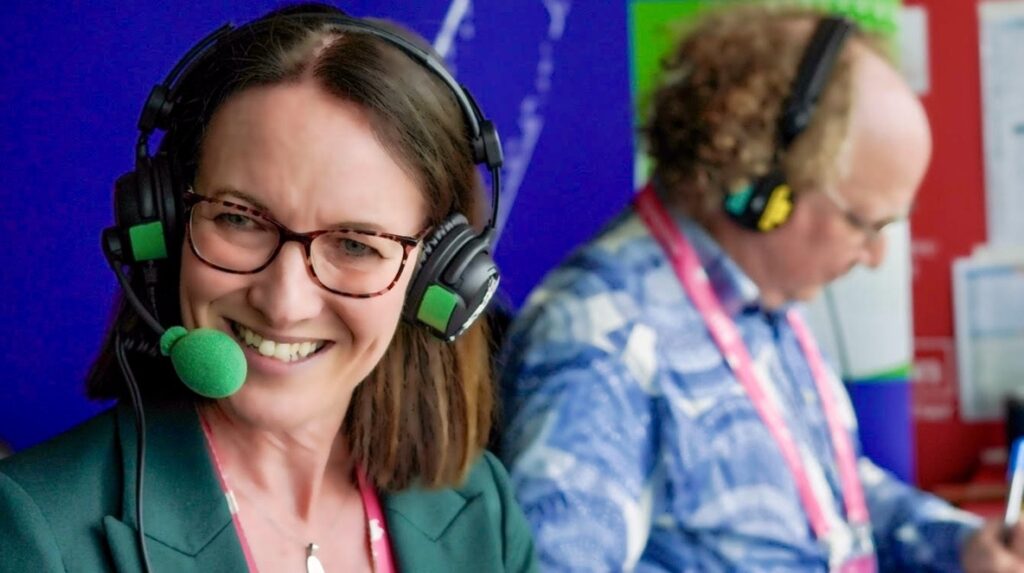
If you love cricket you know Alison Mitchell. But how exactly did she master the art of commentary and achieve National Treasure status?
Apart from becoming our very own, homegrown, leading female cricket commentator, Mitchell is also an award-winning broadcaster who has travelled across the world to cover England teams for various broadcasters, including BBC Radio 5 live and Test Match Special. And she’s done endless cricket shows and podcasts as well as writing for the Wisden Almanac.
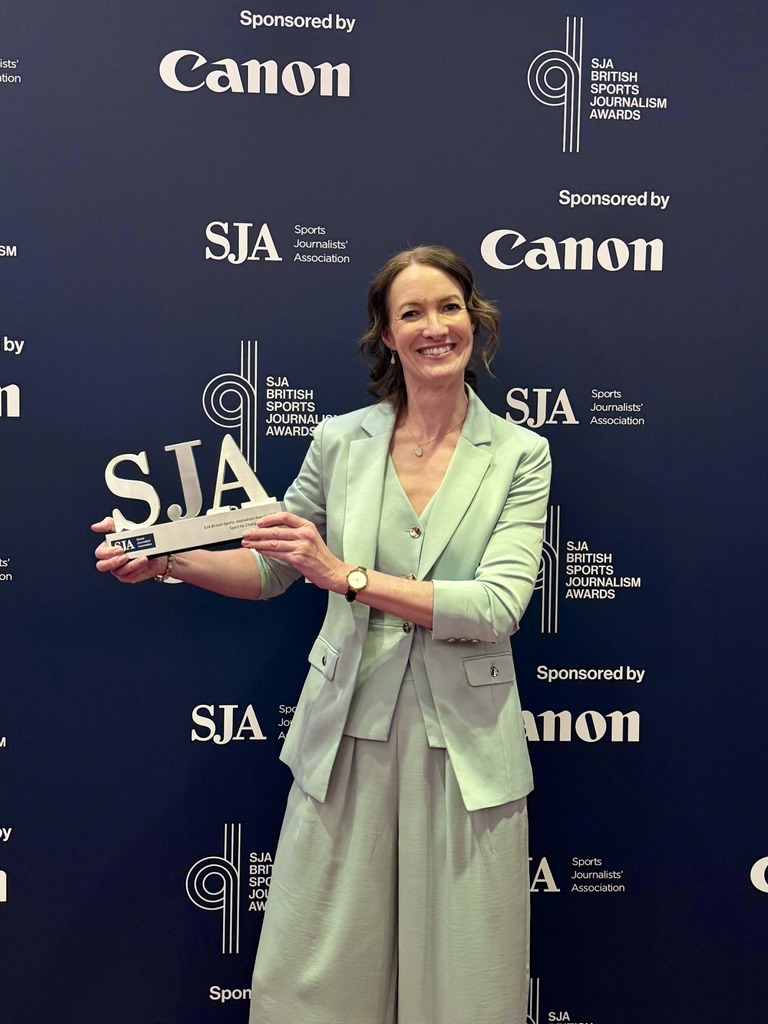
As we speak, Mitchell is preparing for that evening’s British Sports Journalism Awards, where she’s been a winner before. This time it’s the Sport For Change Award she’s shortlisted for, explaining that this stems from championing the story of the Afghanistan women’s cricket team for the last few years.
The Afghan women’s team finally got recognized by the ICC last year, says Mitchell, after the governing body basically turned its back on them for three years after they escaped Afghanistan. “They just refused to engage with them, and kept telling them they were a matter for the Afghanistan cricket board, the very board they were ostracised from”.
Reporting and campaigning with such passion and determination, you won’t be surprised to learn that Alison Mitchell did indeed win this year’s Sport For Change Award (photo at bottom of feature), adding it to her 2013 award for Sports Broadcaster of the Year trophy.
So let’s hear from the award-winning trailblazer, Alison Mitchell, in her own words…
For you as a commentator, what’s it like to work at a massive tournament like this T20 Women’s World Cup on home soil?
I presume it means you get to go home sometimes…
Well, there is that, yes!
It is very different to going away for a World Cup, where you are away for three, four weeks, however long it may be.
The men’s World Cup is usually even longer.
But yeah, you think of how rarely it happens.
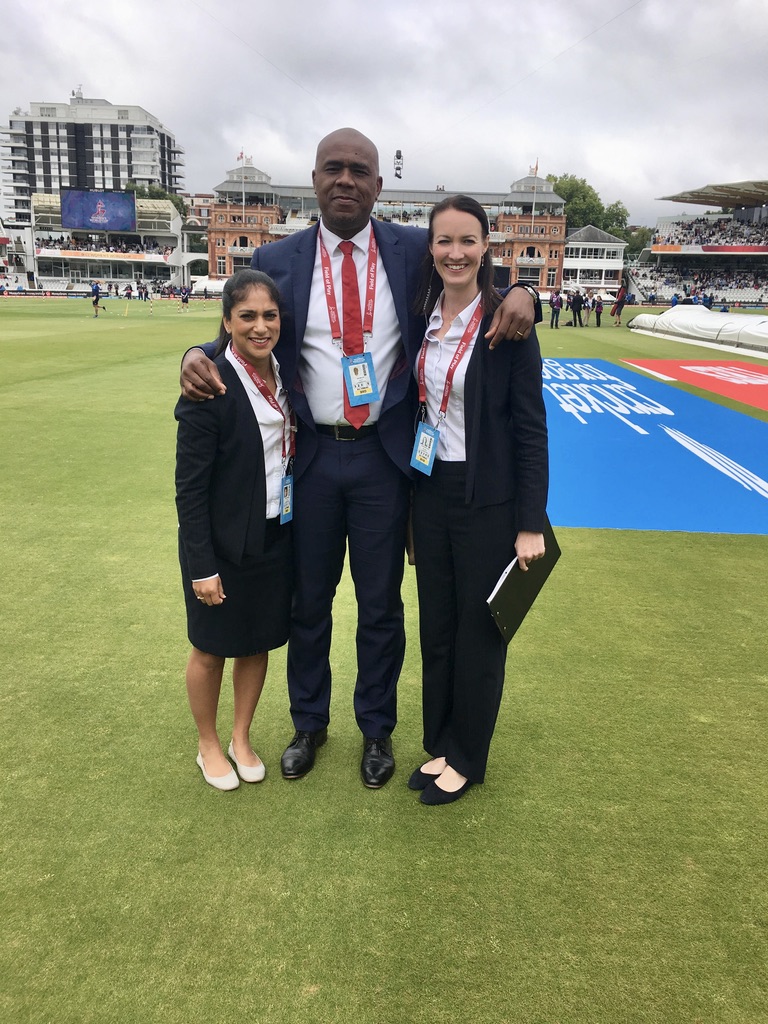
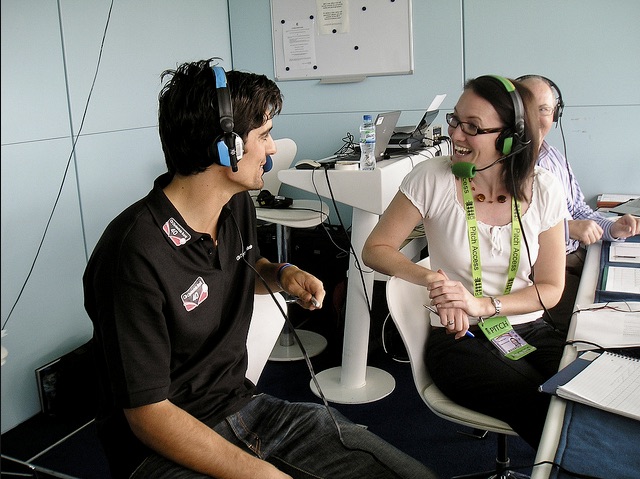
So 2019, the last time the men’s World Cup was in England, and 2017, the last time there was a women’s cricket World Cup on home soil here (below, with Lisa Sthalekar and Ian Bishop).
And I’ve been fortunate to have been involved in both of them and calling the winning moments of the 2017 Women’s World Cup at Lord’s is one of my favourite moments in my cricketing broadcasting career because It was such a transformational day.
The sound of Lord’s was different that day.
There were more females in the crowd, more children in the crowd.
The tone felt different.
It was more coffees being drunk than beers.
Everything about it just felt fresh, felt exciting, felt momentous.
Yeah, Lord’s being full, the stands that is. There were still questions about the pavilion, which was disappointingly empty.
I think that will be different this time round.
The game is in a different place off the back of that incredible success.
The sound of Lord’s was different that day.
There were more females in the crowd, more children in the crowd.
The tone felt different.
It was more coffees being drunk than beers.
Everything about it just felt fresh, felt exciting, felt momentous.
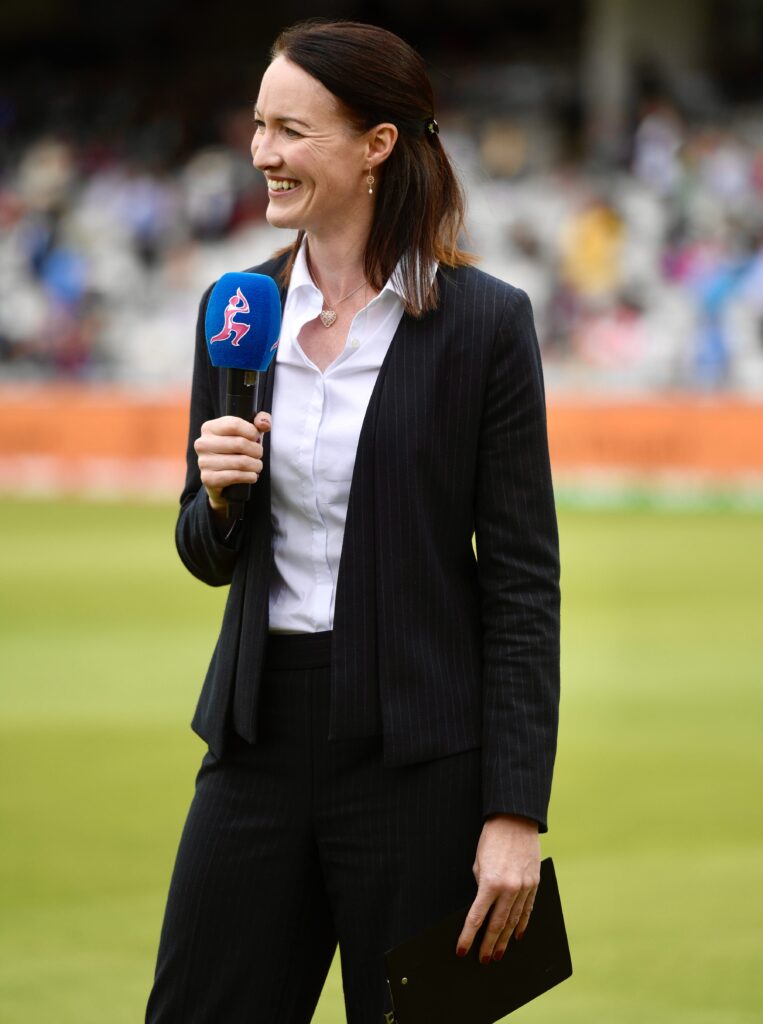
Are you able to stay dispassionate and neutral?
Because I’d find that the hardest thing if I was doing your job, say when England are playing, rather than saying ‘we’?
Oh yeah, the biggest lesson A1 in commentary is that it’s never ‘we’.
Even when you’re doing an Olympics commentary and you generally know that you get a little bit more patriotic, I think, when you’re calling an Olympics.
I’ve been really fortunate to do three Olympic games.
The biggest lesson A1 in commentary is that it’s never ‘we’.
Even when you’re doing an Olympics commentary and you generally know that you get a little bit more patriotic.
And I was involved in the gymnastics for the last two of those, through London and Rio, and also got to anchor 5 Live’s coverage at the women’s gold medal match in the hockey when Great Britain won.
Sara Orchard called that brilliantly on commentary.
I was there as the anchor presenter.
So that was really special for me as an ex-age group, county hockey player and club player. And hockey was my big sport that I played when I was young.
Yeah, a home world cup, no matter what you’re commentating on, you do still have to have enough dispassion so that you can get the words out you know.
Ultimately you still have to convey to the listener what is happening when you’re doing a radio commentary.
Different nuances of course for television, but on radio it’s no good if you break down or get choked by tears, because the listener will just be in their car or wherever, going: but what’s happening. So you’ve still got to convey the emotion and the excitement and maybe it’s more okay for your summarizer next to you to get emotional.
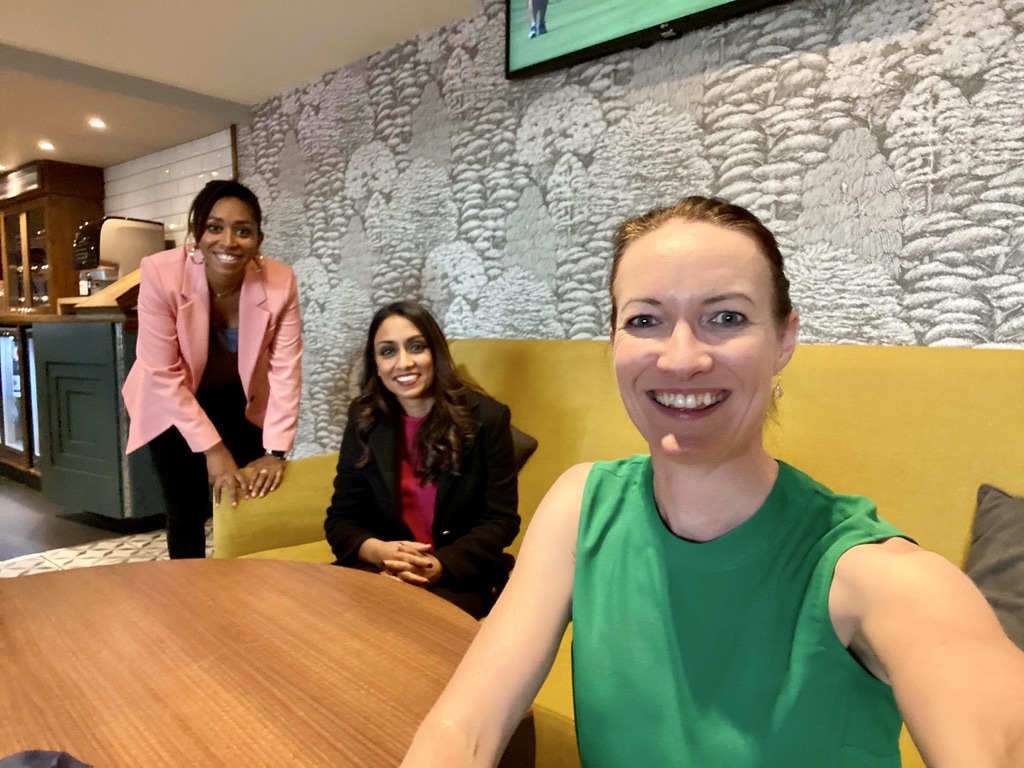
And I remember Ebony Rainford-Brent (above, with fellow pundit and ex-cricketer Isa Guha) was alongside me for that World Cup winning moment when Annie Shrubsole took the last wicket.
And I called it, and then I turned to Ebz and she had tears rolling down her cheeks.
And then when she spoke, her voice was cracking.
On radio it’s no good if you break down or get choked by tears, because the listener will just be in their car or wherever, going: but what’s happening. So you’ve still got to convey the emotion and the excitement
And that was okay because we’ve told the listener what’s happened.
We’ve celebrated the moment.
We’ve given a picture of what’s happening as a celebratory scene.
And then you can pick up the aftermath a little bit more.
In terms of getting prepared, you can be absolutely sweltering or chilled to the bone because you’re waiting for play to restart.
So what are the essential things you take to wear, but also the kit you have to take with you just in case it’s not set up how you need it?
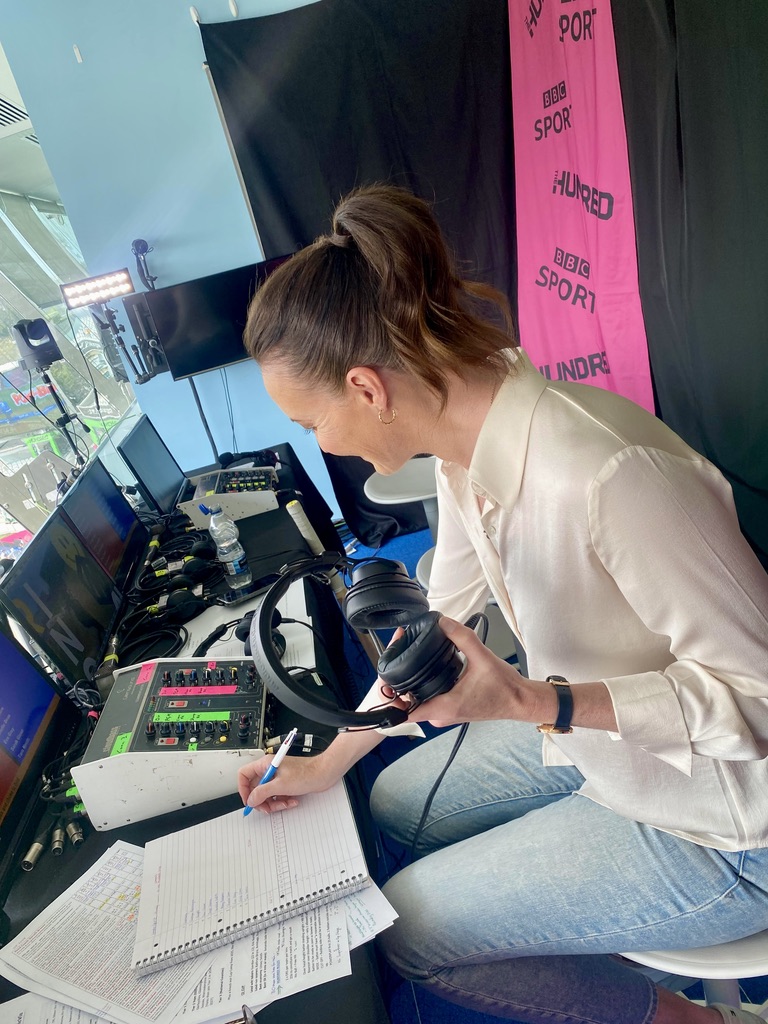
When I first began I was doing all domestic cricket, you are very much a one-person operation and you do have to carry with you your lip mic, your headphones etc.
Your commentary position could be a nice air-conditioned commentary box if you’re at a test match ground. Or you could be at ground level in a cold marquee with a biting wind swirling in front of you.
So yeah, now that I commentate pretty much exclusively international cricket, I’m quite spoiled in that we are, on the whole inside, in a commentary box.
For radio, it’s always really important we try and get an open window so that we can let the atmosphere come in.
But usually it’s engineered for us.
So all you have to do is arrive with your prep, your notebooks, whatever you need.
You put your headphones on and you’ve got the effects coming through a stump cam, for example.
You can hear the crowd effects in your headphones.
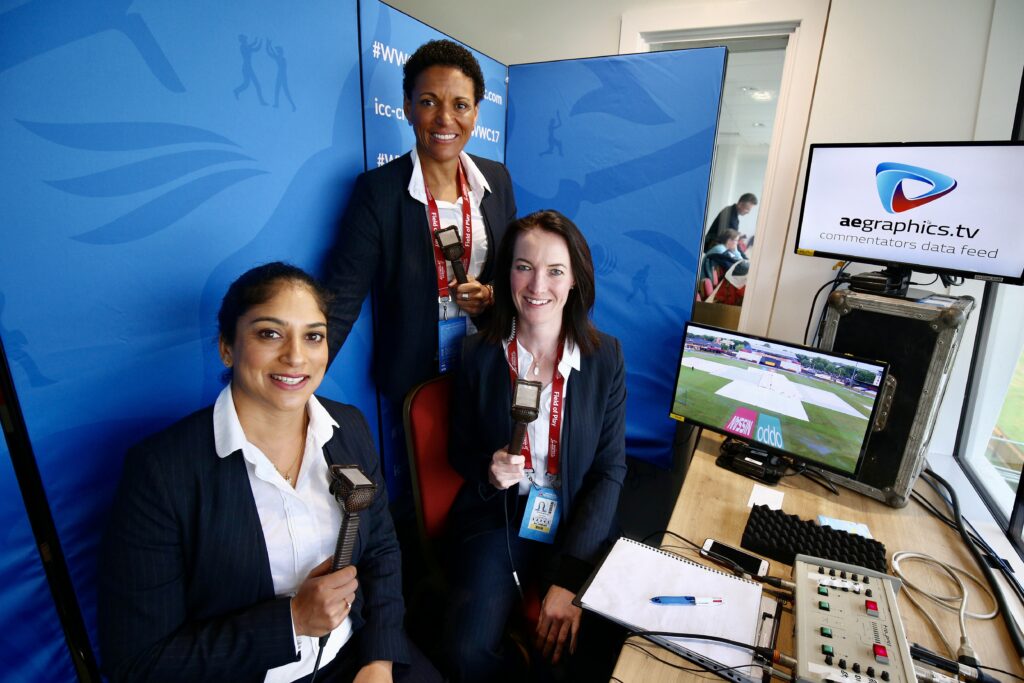
The Lord’s commentary box, the TMS – Test Match Special – box is the only one that does have an openable window.
Because when that spaceship style building was designed, it originally didn’t have any windows built into it at all that you could open.
Peter Baxter was the producer of Test Match Special at the time.
And he also used to look after facilities for the Cricket Media Club.
And he met with the architect, and insisted that the Test Match Special box needed a window that could open.
So they cut a window, especially for TMS in the Lord’s box.
So we’re very lucky in that when we have visitors to the box, they can stand and actually hear the Lord’s crowd and the atmosphere.
Whereas any other commentary box you go into, it’s like watching TV with the sound turned off (above, with friends and fellow commentators Lisa Sthalekar and Mel Jones at Derbyshire County Cricket Club during the 2017 Women’s World Cup).
It’s so well muffled inside the building that you can’t really hear the crowd, and you certainly can’t hear the sound of bat on ball.
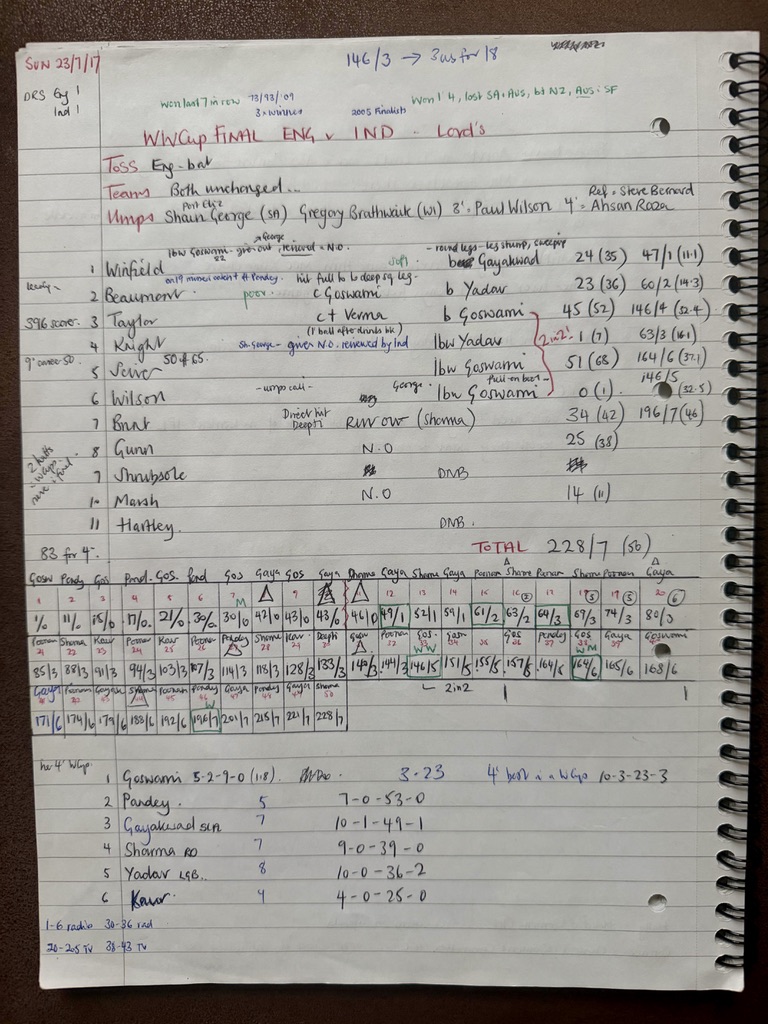
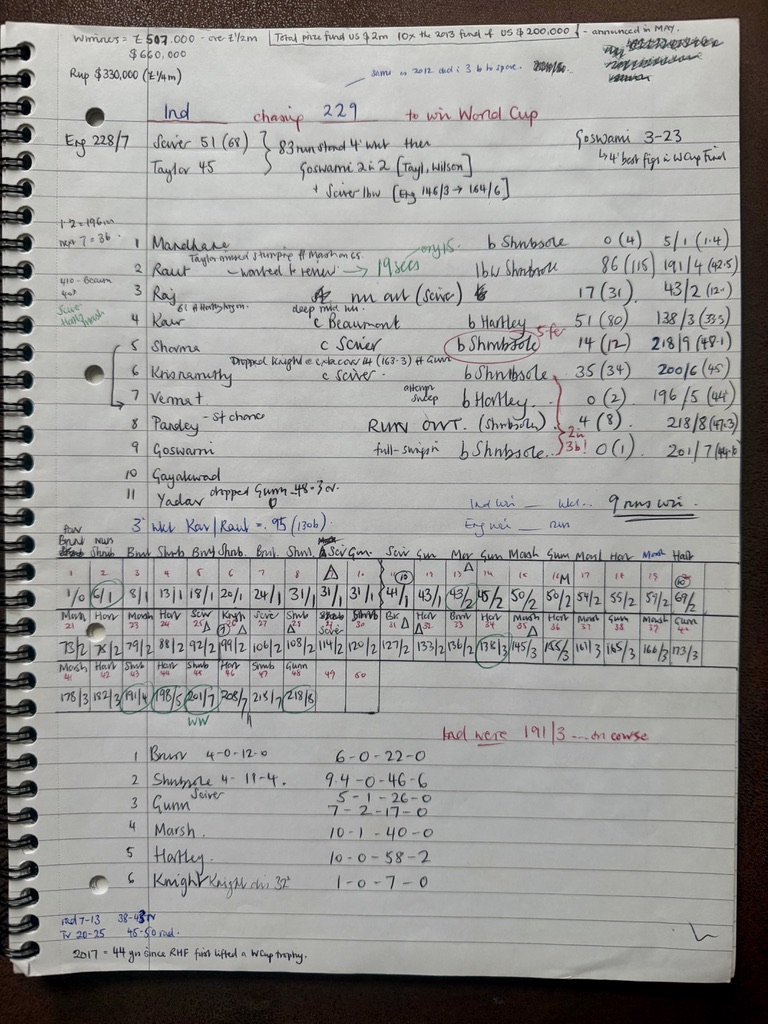
So in terms of preparation, when I do an international match for radio, it is pretty much just doing my notes beforehand, and then on the day, I keep my own scorecard as things unfold so I can recap for the listener what’s happened (below, scorecard for 2017 Women’s World Cup Final England v India).
The rugby commentator Sara Orchard does about a day’s prep, is that what you do?
I find it really hard to quantify because once you get into a series – if it is a series – I do the bulk of my work in advance, and then once you’re in it it’s just two teams and you’re keeping tabs as you go along.
What takes the most prep and logistics as well – because of all the travel in between – is doing a tournament like the Hundred. And to a degree, the Women’s World Cup, but again, I would prep every single team… I would do a sheet for each.
Again, it can be a day per team.
You can spend hours and hours, like the prep never ends!
You need to be disciplined ultimately about how long you spend on each team.
But I really like to find stories about players.
As a journalist, I’ve always felt that my USP is the research that I do on individual players to bring their story to life and help the audience connect with them to really care about that player, no matter which team they’re on.
I think that’s what I bring to a commentary box, particularly the television commentary box, because it’s very, very rare to have a journalist lead commentator.
We’ve got a few of us, particularly women, working on ICC events.
There’s me, Nat Germanos, Kass Naidoo – Harsha Bhogle on the men’s side, of course.
But, historically, you look at the television commentary box, and it was pretty always exclusively made up of usually former England captains, who would make up the bulk of a commentary box. And now many more ex-players.
As a journalist, I’ve always felt that my USP is the research that I do on individual players to bring their story to life and help the audience connect with them to really care about that player, no matter which team they’re on.
I really can go down rabbit holes sometimes, just learning about a player’s backstory, where they came from, what they did when they were younger, what their family background is, all that adds to the picture of the player…
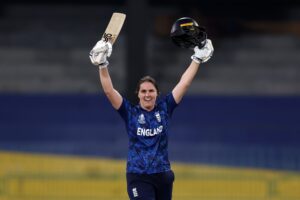
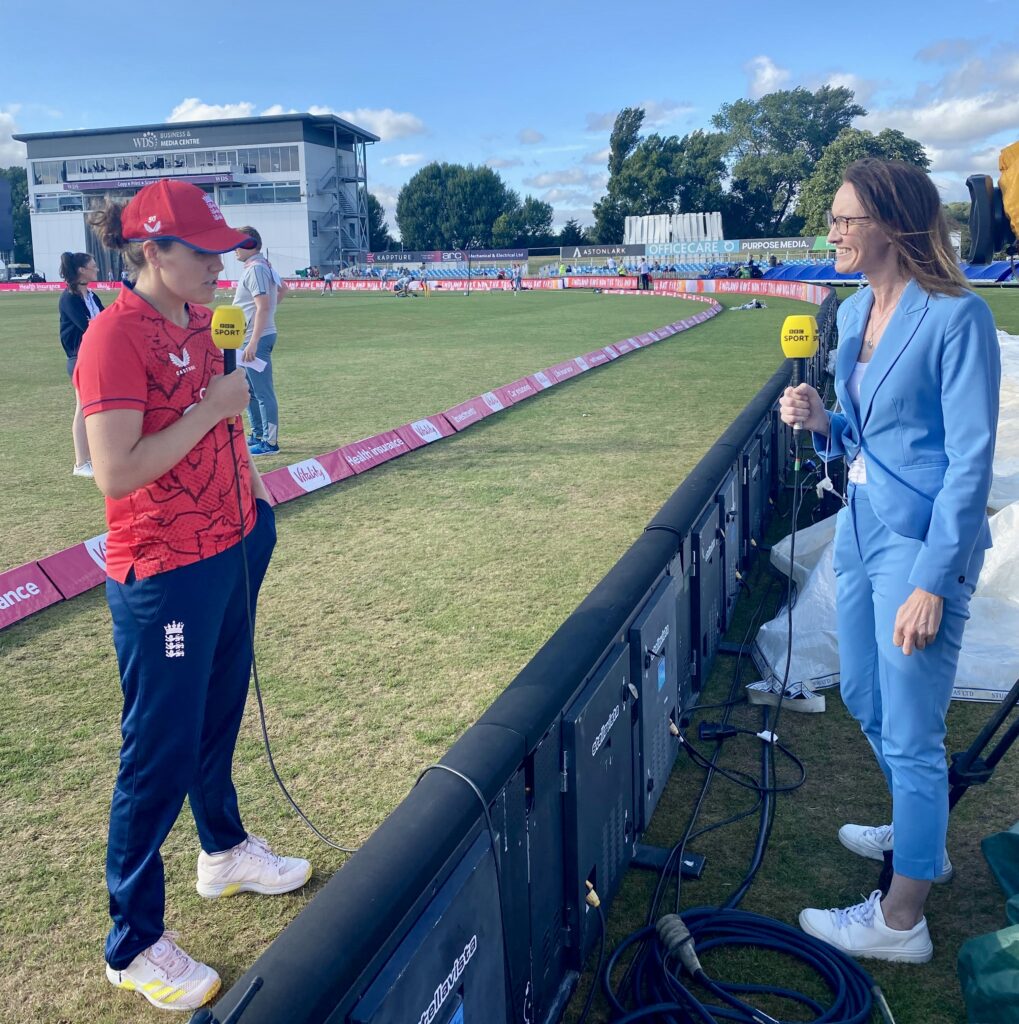
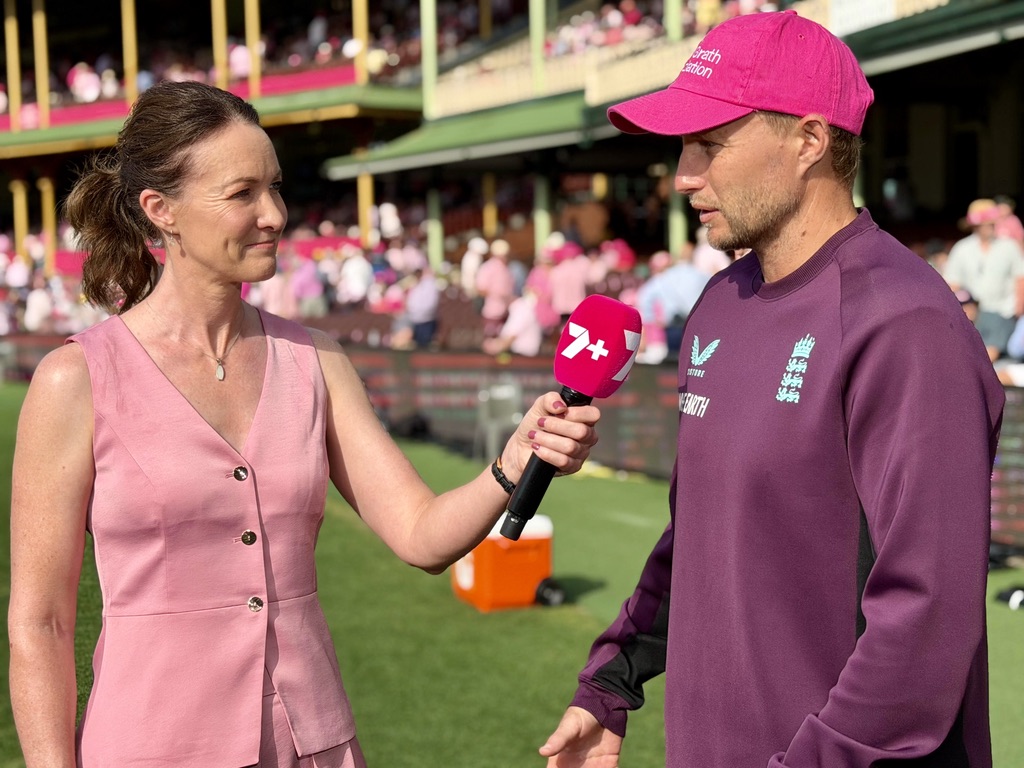
As well as the necessities, which are understanding their recent form, if they carrying any injuries, maybe what teams domestically they play for and have they had recent success… just understanding the cricket side of the stories (including interviewing the likes of England’s Nat Sciver-Brunt, below).
No, so how did your love affair with cricket start?
You played hockey, did you ever play cricket?
No, I didn’t play organised cricket because at school it just wasn’t offered for girls.
It was very much girls were hockey and netball, and boys had football and rugby and cricket.
I got to do some athletics as well and tennis in the summer and swimming, and I was just an all-sports all-rounder, absolutely loved sport, anything I could play.
So cricket was just what we did at home, and it didn’t even really cross my mind or I didn’t even think it was unfair that we weren’t allowed to play it at school or that it just wasn’t offered. You’re just very accepting of what’s in front of you, I think when you’re a young kid.
As a teenager I loved playing hockey so I was very well satisfied and I pursued that to a decent level, but cricket was the love at home. My dad was an avid club cricketer, my brother then played club cricket and bit of age group county cricket.
My mum is an Australian, so we just grew up in that Ashes type of household with all the banter that goes with having family on the other side of the world.
And I do have strong memories of when we would have trips to Australia every other year to go and visit mum’s family.
I had lots of cousins my age, and we would occasionally get taken to Adelaide Oval to watch cricket in Australia.
And I always felt when I went there that there were more girls at the cricket. It did feel in Australia a bit more of a mixed thing, whereas in England I was always the only girl among a group of dads and sons that would go to watch, say Northants play.
I just loved mucking in because I wanted to play cricket and I enjoyed surprising people, I think, from that age as well.
I learned that the expectation was always that a girl wouldn’t know even how to hold a bat.
So it would surprise people when I stood and I actually knew how to hold a bat properly and I had a stance and I would play with a high front elbow because my brother and dad had taught me so.
Occasionally, and I didn’t get taken to that many England games, but when we did, again, it was like a boys’ trip plus me. And all our family picnics where a game of cricket would always be the thing we did in the park. It was all the boys and me.
I didn’t think twice about it, though.
I just loved mucking in because I wanted to play cricket and I enjoyed surprising people, I think, from that age as well.
I learned that the expectation was always that a girl wouldn’t know even how to hold a bat.
So it would surprise people when I stood and I actually knew how to hold a bat properly and I had a stance and I would play with a high front elbow because my brother and dad had taught me so.
I played the odd game for my brother’s club team when he was like 15, I filled in.
But nothing organised at all.
I just learnt the game through talking about it, watching it, following it.
Then as I got older and it began to look like a profession for me, reading about it as well.
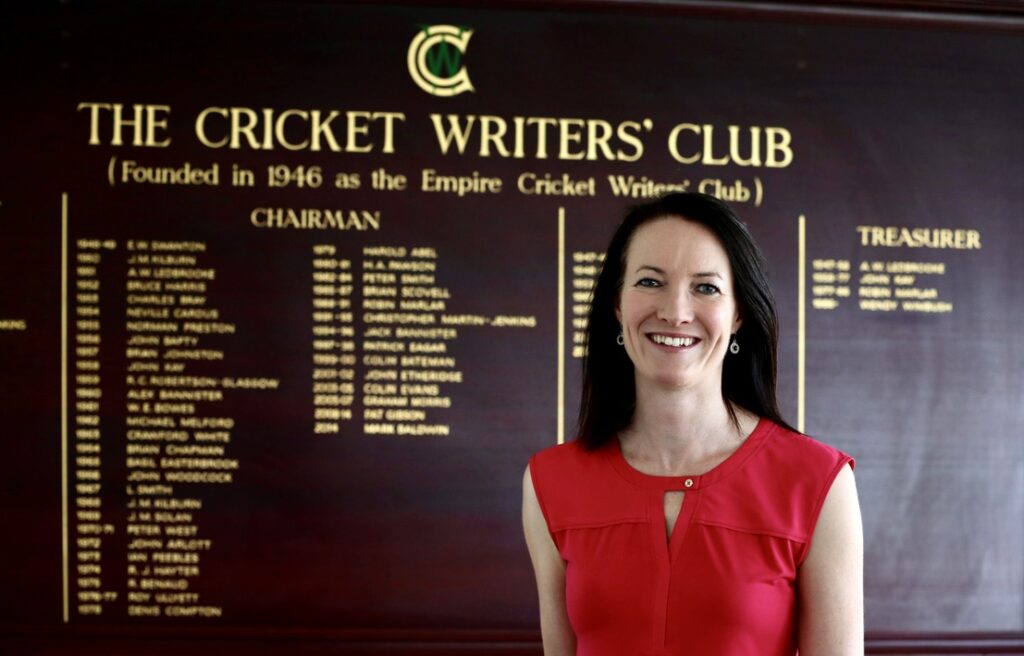
How did you get into cricket commentary then? Was it by doing sports journalism?
Well, I trained as a journalist.
I did an undergraduate geography degree in order to then get on a post-grad in journalism.
So I knew when I was 17, I was doing work experience at BBC Radio Northampton, and I just fell in love with radio.
I think I’d always had a bit of a thing about broadcasting or recording.
As a kid, I used to love making mock radio programmes, just playing with the tape machine at home and a microphone and recording me, recording my friend, I would make these little mock programmes.
So it was quite magical to then step foot into an actual radio station.
As a kid, I used to love making mock radio programmes, just playing with the tape machine at home and a microphone and recording me, recording my friend, I would make these little mock programmes.
So it was quite magical to then step foot into an actual radio station.
By then my love of sport was such that the sport show for me was the coolest show of the week.
And that was the only one I really wanted to work on.
Advice I took then was go away, get yourself a good degree in a subject you enjoy, then do a post-grad in broadcast journalism, and then you’re qualified to come out and look for jobs in local BBC radio or commercial radio newsrooms.
So that was my plan.
And then the cricket side of it, because I knew that I was going to want to do sport when I came out the other end.
When I was at university, I figured out that a geography degree, you could make apply to sport.
There’s this element of geography called cultural geography.
So I did my dissertation based on the relationship between cricket and television.
That was really significant for me as well, because it comes back to that idea of surprising people.
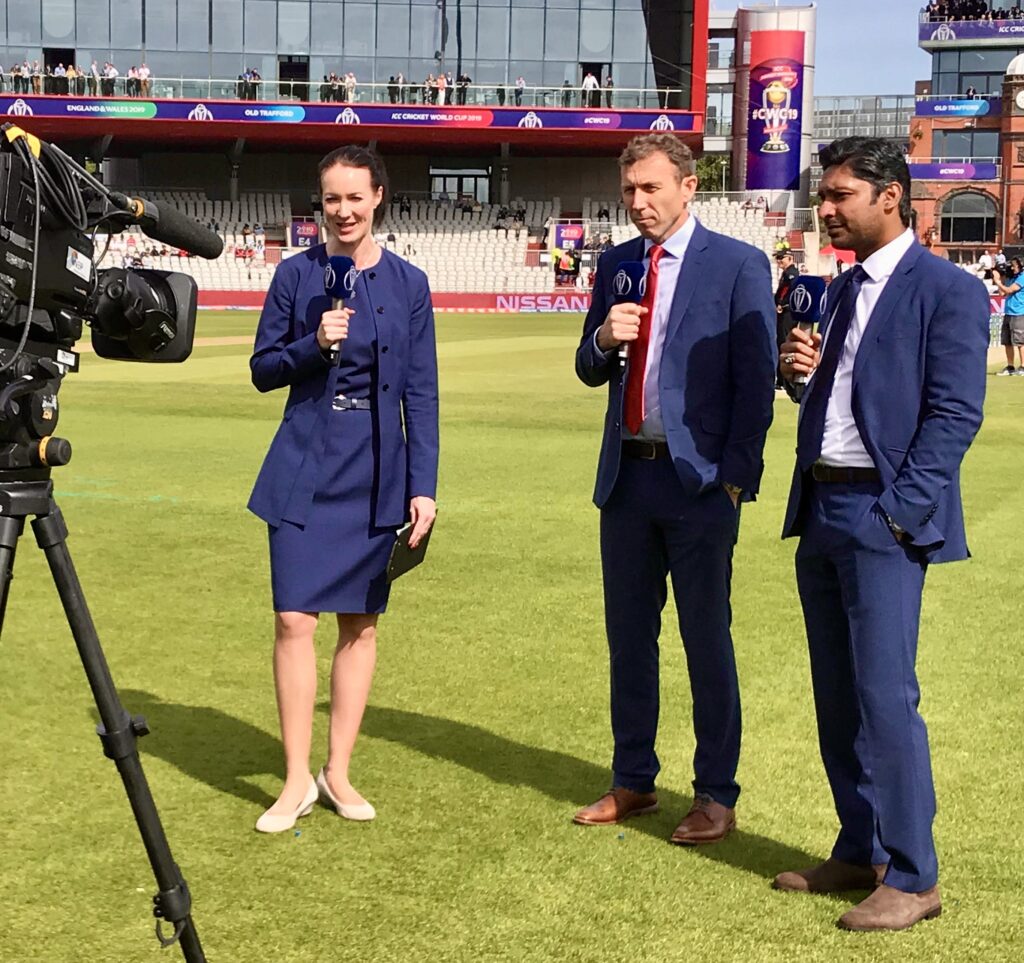
And I think I was innately aware that the biggest challenge I would have in wanting to get into the industry was being taken seriously as a female. (above, breaking another glass ceiling when presenting global coverage of ICC Men’s World Cup 2019 with Mike Atherton and Kumar Sangakkara at Old Trafford – the first time the ICC had women commentators on the men’s 50 over World Cup)
How to convince people that I actually really knew the sport.
Because yeah, a boy’s knowledge of cricket in particular was assumed.
And the projection onto me was always, well, how can a girl know that much about cricket?
So I then had a 12,000-word document that I could send back to the people that I’d interviewed for my dissertation, which included Gary Franses, who was the exec producer at Sunset and Vine, who did Channel 4 cricket at the time.
After I’d contacted them, he had me into shadow for a day and I interviewed Richie Benaud, David Gower, and Mark Nicholas.
I was innately aware that the biggest challenge I would have in wanting to get into the industry was being taken seriously as a female.
How to convince people that I actually really knew the sport.
Because yeah, a boy’s knowledge of cricket in particular was assumed.
And the projection onto me was always, well, how can a girl know that much about cricket?
I looked around the Sky trucks as well, interviewed their exec producer. Then Gary invited me back to be a runner on Channel 4 cricket the following season, 2001, which was The Ashes.
So I was between my geography degree and my post-grad, and I was running around test match grounds during Ashes matches, making Richie Benaud his tea and coffee.
Was that your big break, your turning point?
Hard to know. I wouldn’t necessarily say it was a big break, but it was absolutely part of my journey in understanding what exactly I wanted to do.
Because at that stage I was doing BBC radio, broadcast assistant stuff, in my holidays. I was answering phone lines, learning to edit, sorting out parcels for competition winners, doing every little menial task.
I did a two-week placement at the Wisden Cricket Monthly magazine, so I was getting a feel for print journalism, written journalism. Then I had a summer job at Nottinghamshire County Cricket Club in their marketing department that same year, 2001 in the summer.
That was giving me a feel for what cricket was behind the scenes.
So on two fronts that was helping, first to literally ask: is it cricket that I love or is it cricket journalism that I really love?
Do I want to be in the sport, or do I want to be a journalist outside the sport working in it?
Then the Channel 4 work helped me to decide that: no, my favourite thing in all of this, where I get the buzz, is the live action, watching the cricket, and living the action.
I realised that you could work in television and you might never see a live ball bowled because you could be sitting in a dark truck out in the car park.
So that very much cemented it for me.
I want to be behind the mic! I want to be the broadcaster.
I want to be those people on camera behind the mic, actually in the thick of the action.
That was firmly in my mind when I then went to do my post-grad in broadcast journalism… that when I came out the other end, I wanted to be a sports broadcaster.
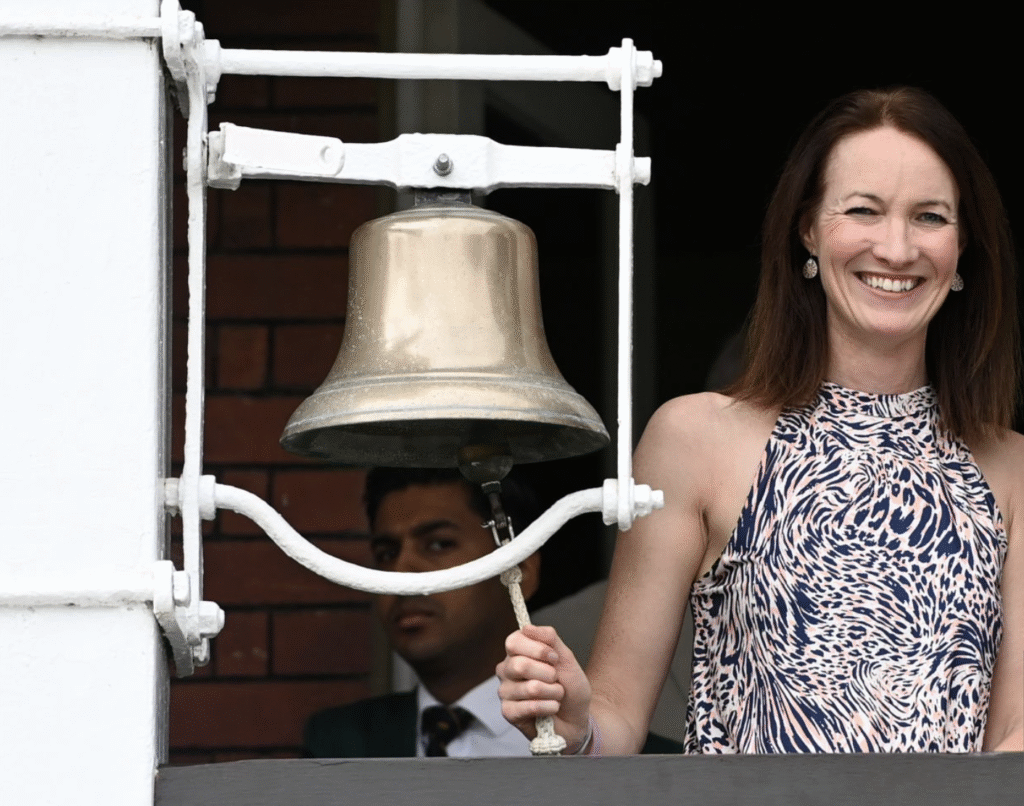
Was it lonely being the only woman doing this at the time, when you started commentating?
Well, the commentary didn’t come ‘til quite a bit later.
It wasn’t as if I set out to be a commentator.
And women weren’t really commentating at that stage.
So there was nobody to look to in a way.
I began by being a reporter.
It wasn’t as if I set out to be a commentator.
And women weren’t really commentating at that stage.
So there was nobody to look to in a way.
I was a sports news journalist, which was a great grounding for me.
I always say to journalists who contact me now – and they just want to be a commentator – I didn’t go in as a commentator.
I went in as a sport bulletin presenter, producer, reporter.
Starting in the newsroom and then gradually you’re allowed out, and you work in the field and you’re that reporter in the field.
Then the commentary for me was a natural evolution where I would be spending hours upon hours reporting on men’s county cricket, sitting in a commentary box, doing an update into a 5 Live bulletin, a round-up.
And that was lonely, not because I was the only female, but literally sitting in a commentary box on your own for eight hours, just speaking one minute every hour.
I was just saying: I have so much more I want to say about these matches.
Can I have a go at commentating?
And fortunately I had a producer in Adam Mountford who was very supportive of that.
I started just by commentating into a tape, recording myself and listening back and getting feedback.
Then the Beeb arranged for me to have a couple of days sitting with someone at a county game where I would do the updates.
Then in between that, when we’re off-air, we would do effectively practice commentating.
And I’d get that feedback.
Then I was eventually let loose on a county match 20 years ago in 2006.
And for my first ever actual ball-by-balls.
And then you graduate from domestic games up to international T20 ODIs and eventually test match commentary.
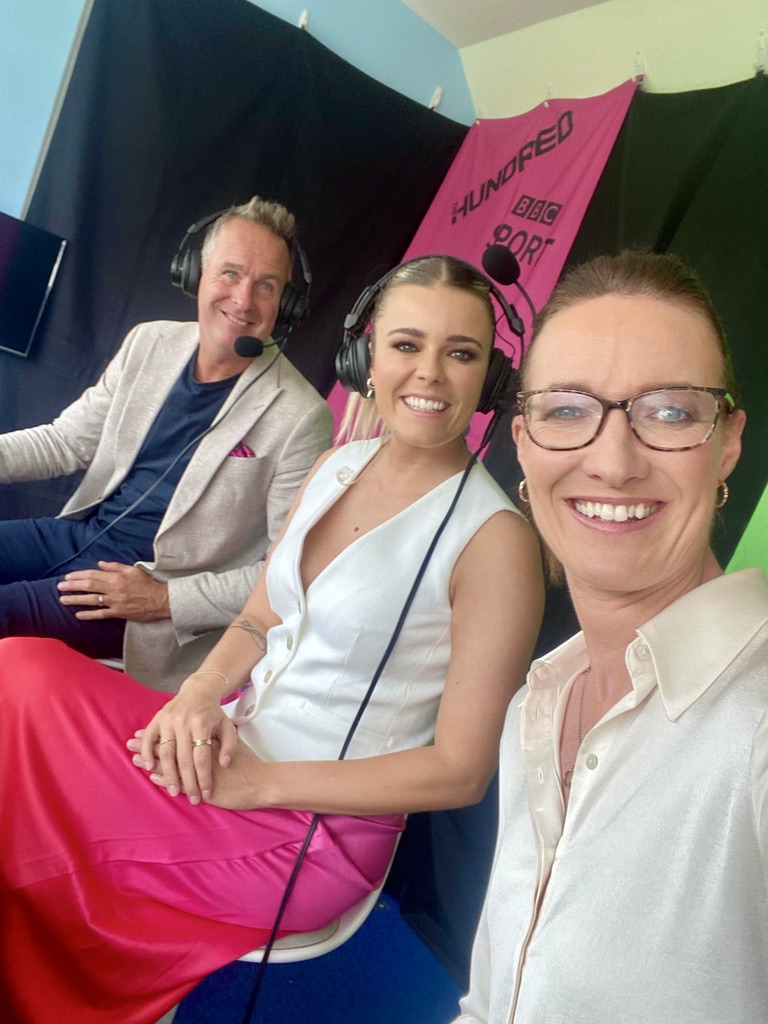
This is a question I ask everybody, but is there a difference for you when you’re commentating on a women’s game to a men’s game as you’re aware you might have slightly different listeners?
Do you feel there’s a need to maybe explain a little bit more?
No, I tell you where we have been encouraged to explain a little bit more.
And that’s been in the BBC’s coverage of the Hundred competition (above), particularly on television, because that again was very much built to bring in a new audience.
And because you’re also on BBC2, you’re aware that you might get a lot of casual listeners flicking channels, getting caught up in it, wondering what is this sport that I’ve never seen before.
So we were encouraged with that too, again, in a very subtle way, because you don’t want to talk down to those people who are watching who really do know their cricket.
Yet you don’t want to be too exclusive to those who are trying to learn and pick up the sport.
So it’s just naturally qualifying some of the terminology you might use.
I might have said: oh, that’s a brilliant dot ball, so no run’s been scored.
You explain what the terminology is without making it obvious, as you don’t want to be patronising to the people who do know what a dot ball means, but there’s ways of subtly slipping it in.
But no, with women’s cricket, when I first began covering the women’s game, which was in 2005, I went to the World Cup in South Africa, and I was the only journalist sent by any UK outlet to cover that World Cup.
You were maybe not as critical as you might have been for men’s games.
You still give an honest account of what’s happened in front of you.
But you’re always aware that you’re trying to encourage the game, encourage the selling of the game and even back to your own broadcaster.
You’ve got a role to help elevate what you’re seeing.
The natural shift which has come, and I think this is probably true for all women’s sports, is when the criticism of the game and of the players reaches the same level that it does for the men.
And the growth of professionalism for the women’s game has gone hand in hand with that.
I think probably the biggest shift was the 2015 women’s Ashes when England were struggling.
And the criticism really was quite fair, but fierce of them by that stage.
I remember Charlotte Edwards, the England captain, quietly behind the scenes, and those senior players being like, well, actually, this is not a bad thing.
This is good that people care enough and they’re passionate enough about our team because a decade earlier, there would have barely been any column inches on their match at all.
The natural shift which has come, and I think this is probably true for all women’s sports, is when the criticism of the game and of the players reaches the same level that it does for the men.
And the growth of professionalism for the women’s game has gone hand in hand with that.
But in terms of our commentary on it, you absolutely treat it, and I prep it exactly the same.
It’s just another game of cricket being played by different players.
Now, obviously there are some subtleties in changes in the regulations or whatnot.
But in terms of the actual mechanics, I think you have to do that in every sport.
Do you believe that there is an art to commentating? And if there is, what do you think it is?
Again, radio and television are a very different medium.
The art of radio commentary is to always have the listener know what’s going on.
That is your number one.
So in cricket, that is making sure that someone switches on, and they can hear the score.
That is the first thing people need to know, the state of the game.
What’s the score?
And then you’re bringing in your powers of description.
There is a beautiful rhythm to radio commentary.
You can pick out the colours, the textures.
You can paint all four corners of the canvas.
That’s the beautiful thing about it.
Then the rapport you have with your co-commentator, it’s just the two of you when you’re on air, or maybe three of you, but you have very little else going on in front of you.
It is for you, your co-commentator, and the scene in front of you to describe.
We can go anywhere.
There is a beautiful rhythm to radio commentary.
You can pick out the colours, the textures.
You can paint all four corners of the canvas.
That’s the beautiful thing about it.
We have very little editorial direction, we’re trusted on Test Match Special to take the conversation where we want to take it.
Our producer will help by bringing in perhaps emails, listen to interactions, when they feel it’s the right time maybe to bring something in.
Television is different again because you’re adding to the pictures.
There’s no point saying the bowler is running in or describing just what’s happened because the viewer can see that.
But you also have so many other voices in your head and you’re working as a cog in a huge team.
Which is satisfying in its own way because you’ve got your producer behind you, you’ve got your commentators next to you, statistician just there, you’ve got the director’s voice in your ear, maybe another producer in your ear, the Hawkeye analyst in your ear, you’ve got the monitors in front of you.
But also the window to half watch; you’ve got to be keeping an eye both on the monitor and be commentating on what the viewer can see, but also you’ve got the ability to see the whole picture.
And you might buzz down to the director and say: can you give me a shot of that person in the stand, I’ve just noticed something, or can you give me a shot of the fielder at mid-wicket? I want to talk about them for a moment.
You’re part of this lovely big, team of people.
So I love both in very different ways.
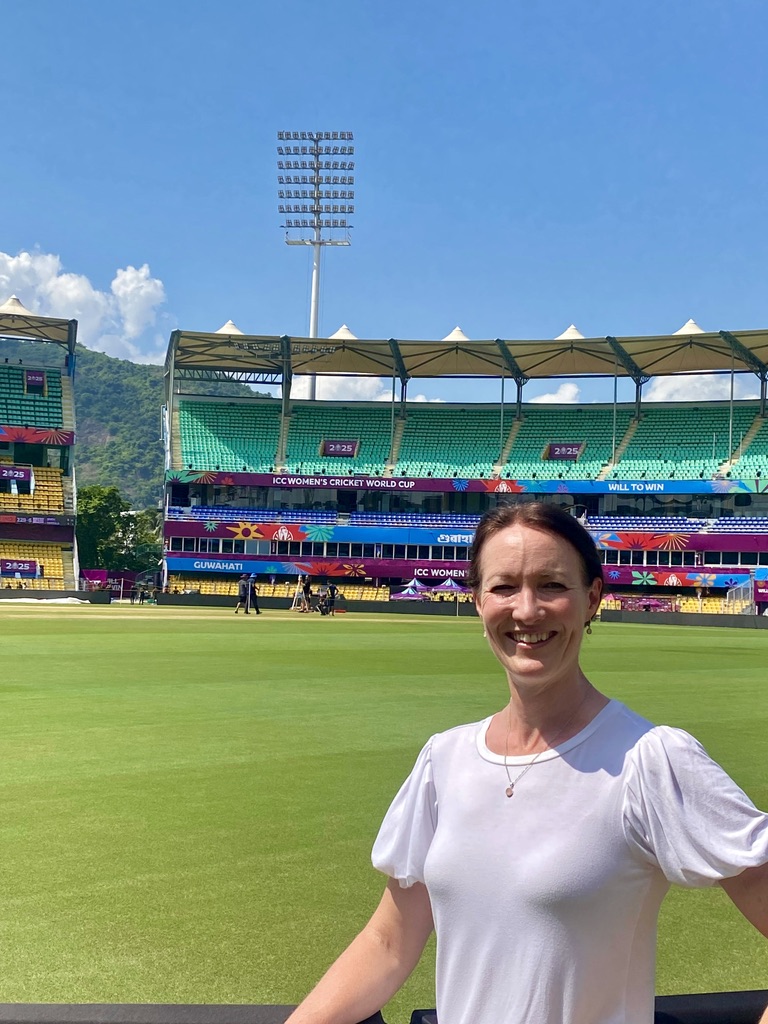
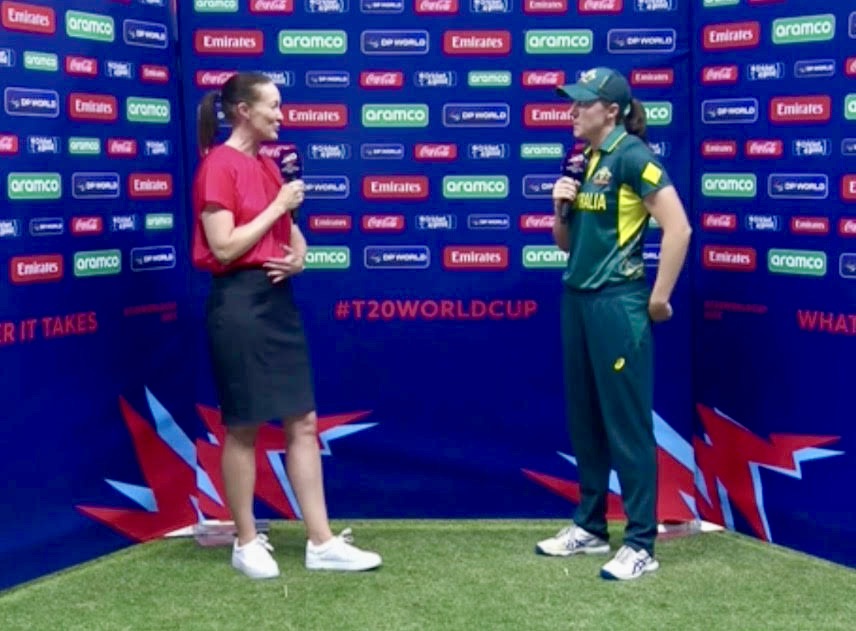
Last question – you’ve won awards and commentated at World Cups (above) – but what’s your advice to any young women or girls who want to get into this world?
I’m still an advocate for journalists – becoming a journalist and that leading into commentating, getting a grounding as a reporter, making your name as a journalist, and commentary can come and evolve.
But saying that, it’s such a different landscape from when I began.
There were very few opportunities even to commentate, whether you were male or female, whereas now every county match, men’s and women’s now as part of the structure, there will be a live stream, BBC Radio covering every ball of every match.
There is so much opportunity.
People then have social media as well to project themselves.
So social media presence can get you out there when you don’t even have a job at all.
So that’s a great canvas for you to work with to begin.
On commentating, build up your knowledge of the game, watch it, consume it, read about it, so you’ve got an appreciation of the history of the game, and listen to other commentators that you enjoy and take notes of perhaps the way they interact with their co-commentator, the words they use, the phrases they use.
Social media presence can get you out there when you don’t even have a job at all.
So that’s a great canvas for you to work with to begin.
But above all, it’s being yourself and enjoying it.
And your enjoyment and passion will always come out over the airwaves.
People love listening to someone I think who has a smile in their voice on radio in particular.
So be yourself.
Photos: Alison Mitchell, Getty