HER HEALTH – Man City’s goal with Her City is player health
Discussion around women’s health in football has been building over the past few years. Now, action has entered the chat too.
Clare McEwen looks at some of the health resources for players at every level, and speaks to Manchester City’s Director of Performance Services, Emma Deakin, about the club’s new Her City resource.
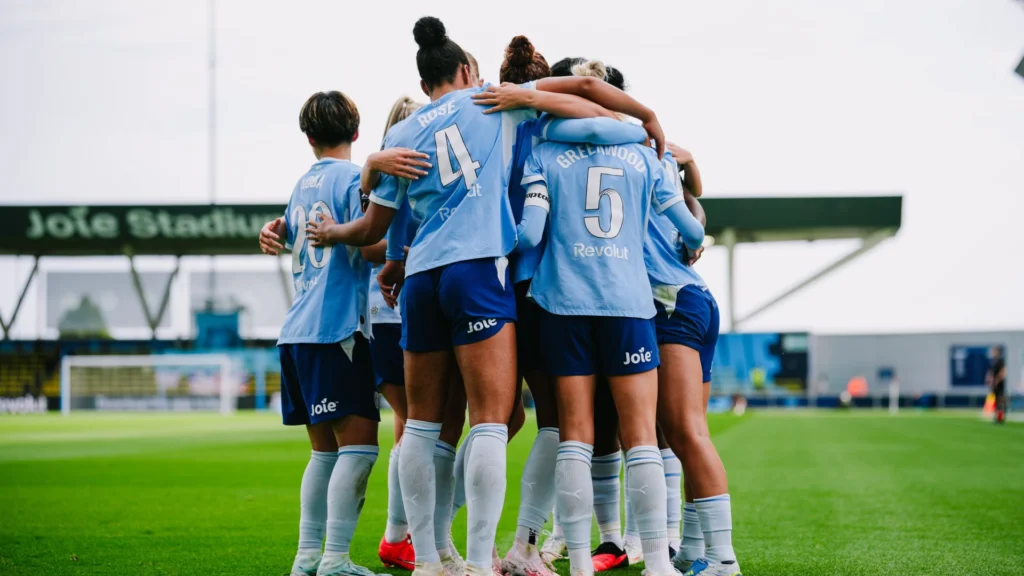
Things are changing rapidly when it comes to creating resources around women’s health for footballers.
During the past month, the Spanish football federation has agreed to pay for egg freezing for its international female players. And Chelsea have become the first WSL team to introduce bespoke fertility support and provide evidence-based information and myth-busting resources around fertility.
In the wider game, governing bodies are building educational resources.
The Football Association launched the Female Health Hub for grassroots players in April 2026. It covers menstrual health, breast health, and injury prevention. It provides information, and also includes videos with England players talking openly about the same issues every woman and girl faces.
UEFA have the OWN IT video series that provides female players with knowledge on key health topics, including ACL prevention, menstrual health, and pregnancy and motherhood. They also have tracking tools and research papers to support the content.
FIFA recently launched their Female Health and Performance Project that provides science-based information for players, coaches, medical staff, and parents.
Evidence
At a club level, Barcelona have the Barça Innovation Hub. They’ve built evidence from their players over several years and publish peer-reviewed science papers on many aspects of athlete health, including how the menstrual cycle affects athlete performance and injury risk.
And now Manchester City have launched their Her City initiative. Her City is the first WSL website dedicated to female athlete health and education. The website provides players (First Team and Academy), coaches, support staff, and parents with evidence-based and expert-validated information on a range of female health topics.
The information is delivered in a range of ways for the different audience types. It also helps open up conversations around critical analysis of other information sources, such as social media.
The project aims to bust myths, educate, and give players access to experts when they need it.
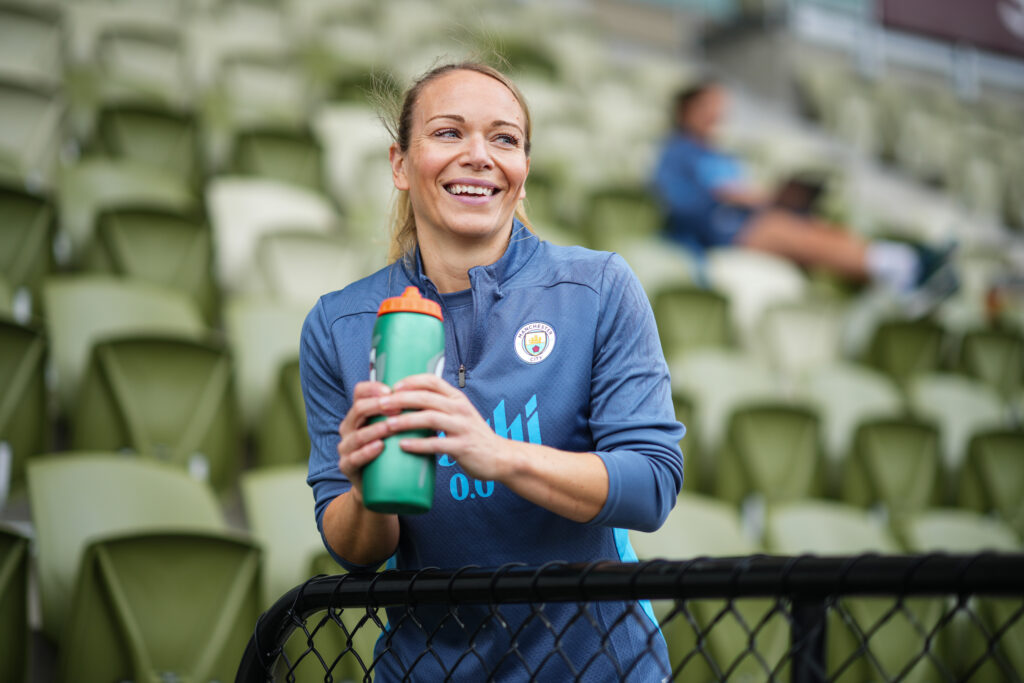
Manchester City’s Director of Performance Services, Emma Deakin (below), talks in-depth to us about the project.
Tell me more about the Her City website project?
Emma Deakin: It’s been a bit of an ambition of mine, Dr Rosie Anderson, and Sarah Malone, who’s our PhD student.
There are similar types of resources around in other sports – in netball and in Australia. The Australian Institute of Sport did an unbelievable female athlete health resource a couple of years ago. I suppose it started there.
When I came to City I was thinking, we’re talking about women and optimising women’s performance. The go-to when we talk about female athlete health is the menstrual cycle and periods – and it’s so much bigger than that, there’s so much more.
For us it started off as a bit of an education piece. When I came into City, Rosie was just finishing off her PhD on female athlete health literacy – what people felt comfortable about, what their education levels were in different parts of it.
Off the back of Rosie’s PhD, there was a really clear gap for us across the whole pathway from women’s first team, elite first team football, down to the Under-9s, Under-10s pathway.
And I think, within the staff group, within the coaching group, within the wider network.
We had a pelvic health talk by a pelvic health specialist that comes in to see our players. She was chatting through what’s normal, and what’s not normal, and it was clear this was a much bigger, broader education piece. We thought, we really need to do something and get something out there.
We were doing workshops for different age groups, including in the first team, but it’s that thing: you look at something once and you read it and then when it’s relevant to you a year later or five weeks later you’re like: oh god what did they say?
So we need something that is a real resource that not only players can go to but staff, parents, all the stakeholders can go to, and have some real scientifically-based, sensible, myth-busting resources.
That’s where it came from, off the back of Rose’s PhD. We were lucky enough that we could invest in another PhD with GSSI [Gatorade Sports Science Institute], and the University of Chester, which is Sarah Malone.
Sarah’s PhD is actually building the platform. She’s built the platform. She’s looked at educational frameworks and what works at different age groups. And what should we be looking at? Should we be gamifying bits of it? Should we be using infographics? Should we just be writing?
How can we make sure that not only is it information that we can get across, but it gets across age-stage specific.
Sarah’s done an initial study where she’s looked at everybody’s knowledge base and how they’d score themselves. Rolling out of the PhD, we’ll reassess the knowledge base afterwards – so we should have an actual ‘has it had an impact or not’ as well.
It was a massive project from me and Rosie at the start, where we were like: oh my god this would be so cool if we can get this off the ground and have something really tangible for players and parents and everybody involved.
One of the things we were conscious of is, can people make good, educated decisions based on actual information.
What do you hope Her City achieves?
I think we’re really conscious of how things are changing and how people, especially younger female players, get their information.
A lot of them – you hear it around the training ground or in the dressing room – will say: oh, did you see that on TikTok about what sports bra you should wear or have you seen that on Instagram, we should be doing this when we’re on our period, or we should be eating that.
Some of it will be relatively useful information and some of it will be absolute garbage and just a trend or somebody trying to sell something.
One of the things we were conscious of is, can people make good, educated decisions based on actual information. Whether they’re choosing what period products they want to use or if they need period underwear or what sports bra they want to wear.
We wanted to do that from a place of them having the knowledge and empowering them to make the right decisions for themselves and for the bodies.
That was important for us.
We’ll have players at Under-10s who will leave us at Under-15s, but hopefully they’ll leave us with that knowledge and that empowerment. They’ll take that if they carry on playing football or just as a woman in normal life.
When we launched the website, I had loads of conversations with my friends – who aren’t in sport – about it. There’s certain things I’ve said to them and loads of them know nothing about it. It’s crazy how little research and little knowledge and how little it’s talked about.
Over the last five to ten years, people are a lot more comfortable talking about the menstrual cycle. We’ve definitely got senior players who role model talking about it and will say: I get these symptoms, but you don’t have to put up with that, just go speak to the doc or go and do this – you can hear them having the conversations with the younger first team players.
So that’s super useful.
I think pelvic health and urinary incontinence is still probably the one that’s talked about less and more common than we think it is.
We did a survey when Emma Brockwell [specialist women’s health physiotherapist] came in. We put the survey out and asked how many players have issues with pelvic floor, pelvic health. I think two or three said, oh yeah, we might have a bit of an issue with it.
Emma then did the education session on what’s normal, what’s not normal, and what you shouldn’t be putting up with.
We re-did the survey and 18 players flagged something. That was a massive one for us – they just don’t know. Or they’ve asked their mums or it’s, well, I’ve had this since I was 13, 14, so it’s just part of what happens.
We think about it in terms of what colour shorts to wear or what kit we’re using, but from a performance perspective, we have players with a knee injury and we’re trying to develop quad strength. They don’t want to lift any heavier in the gym because they’re conscious that they might leak.
That’s a pelvic floor issue, but it has a performance impact that means we can’t rehab them as quickly or they’re not going to get as strong for pitch-based performance.
What we’re seeing more now is the link from female athlete health to pitch – rather than ‘female athlete health and that’s in a little bucket on one side and we’ll leave it there and treat it and ignore it’.
What we’re seeing more now is the link from female athlete health to pitch – rather than ‘female athlete health and that’s in a little bucket on one side and we’ll leave it there and treat it and ignore it’.
It has actual performance impacts and there are things we can do to maximise performance.
Bra fit is another example. We had players wearing two sports bras because one’s not enough support.
Again, we’ve brought in an external expert to do bra fitting and look at what works for certain players based on the shape, the size, how comfortable they are, what straps it has, what fit it is across the back, is it adaptable?
Just giving players more choices, that’s been a real big push around the website. Then using the website to reinforce that as well – getting that information out there that we all assume is normal.
Was it hard to find peer-reviewed evidence? Women’s health isn’t very well researched.
Sarah and Rosie have done loads of lit [literature] searches, lit reviews. They have found evidence, but I think that’s one of the reasons, like you say, why we wanted to continue investing in PhDs in this area.
We could have quite easily finished Rosie’s PhD and then looked for a different performance question, but it was really important to us that we keep building the evidence base across women’s sport. And that’s another reason why we invested in Sarah’s PhD.
There is evidence out there, but it’s not like you Google ‘ACL research’ and there’s thousands and thousands of documents that come up. It’s definitely still a limited area, but I think we’ve been lucky enough to work with the University of Chester and Sam Moss [Senior Lecturer in Sport and Exercise Nutrition, Liverpool John Moores University] and a couple of other external experts who have been really helpful, guiding us towards finding the research. We’ve also worked with people in Australia and all over.
The other thing we’ve done is made sure that when we’ve put information out there, it is our information. The pelvic health information has all been reviewed by Emma Brockwell and Jenny – who’s the breast health specialist – she’s reviewed the breast health information we put together.
What we didn’t want to do is put things out that other people might say: well that doesn’t really make sense, that’s not what the experts in the field say. We were really conscious of, this is the information we want to put out, can we get that reviewed.
We did a massive female athlete health review with Rich Burden who works for UKSI [UK Sports Institute]. He’s a physiologist and a specialist in female athlete health. He reviewed our entire strategy and the platform as part of that.
Continual review and continual iteration of the platform is going to be really important to make sure the knowledge base on there is up-to-date. If there’s new stuff coming out and what we know now isn’t right in three years time, it won’t stay on the platform.
We want to make sure that we can keep it up-to-date, keep it iterated, and almost gold standard from a science perspective. As much as we can.
Continual review and continual iteration of the platform is going to be really important to make sure the knowledge base on there is up-to-date. If there’s new stuff coming out and what we know now isn’t right in three years time, it won’t stay on the platform.
Another thing I spotted in the press release was that you want to help develop critical thinking skills and myth busting. As you said, TikTok is full of absolute rubbish.
TikTok, Instagram, everywhere.
They’re always on TikTok, Instagram, Snapchat, wherever they’re on, they’re going to see it, so we want to promote the conversation and, if they’re saying something, catch them on it and say, go on our website and have a look at that. Direct them to it.
We’re going to gamify certain parts of it so the younger players will score points, get little certificates, so there’s a bit of a reward for going through the pathway and learning.
It’ll hopefully give them that analysis that not everything you see online is true. Give them a comparable – what about this? But you can only do that if you have the conversation.
We’re not going to get away from them using their phones or going on TikTok or whatever else.
They’re going to see stuff and people are always going to try and sell things, so have they got the other side of the story? Our resource should be the other side of the story.
What we want to do is make sure that yes there’s a resource, but if there were questions off the back of it, there’s a clear pathway to us, to ask the questions and also for us to get back to people, in a confidential way.
Part of Sarah’s project was looking at coaching, performance staff understanding, and also parental understanding. In Under-14s, they’ll be with us for three hours a week and the rest of the time they’re at home.
One of the big things we want to do on the website – as well as the resources – there’s an ‘ask for help page’ so they can contact us. It goes straight through to our female athlete health team.
If a player doesn’t want to say anything in front of anybody – they don’t want to approach somebody at training – there’s a confidential page where they can reach out to the female athlete health team, which is Rosie, Sarah, and our doc. They will get back to them.
Or a parent can reach out with a question.
What we want to do is make sure that yes there’s a resource, but if there were questions off the back of it, there’s a clear pathway to us, to ask the questions and also for us to get back to people, in a confidential way.
Even though it is getting more talked about, there are certain things that a lot of players still don’t want to highlight, speak to coaches about or speak to male members of staff about.
We wanted to make sure there was a confidential pathway to that as well.
I think giving them the tools to analyse information, and critically examine it themselves, is really important in many aspects of life.
Yeah, for this part it’s related to female athlete health, but those critical thinking skills should be around everything. For us it’s another life skill that we can help give them – the resources and the tools to manage that, whatever they’re looking at. Whether it’s female athlete health or training models, nutrition.
If we’ve just given them a basis that the first thing to think is: I wonder what the opposite side of that is and I wonder if that’s true, rather than oh right, I’ll do that then.
When girls drop out at 14, 15, we’re saying it’s because they’re 14, 15 and they’re getting into other stuff. Well is it? Or is it because they’re really struggling with the bra fit and their breasts are really uncomfortable when they run and it’s too painful to play?
Would you like to see these sorts of resources and this sort of help filter down to grassroots?
Yeah, absolutely.
What I’m really conscious of is we’ve got no idea really, especially across grassroots football, of the drop-off rate as females move through puberty and move through those changes.
When girls drop out at 14, 15, we’re saying it’s because they’re 14, 15 and they’re getting into other stuff. Well is it? Or is it because they’re really struggling with the bra fit and their breasts are really uncomfortable when they run and it’s too painful to play?
We don’t know, so I think the information filtering down to grassroots and into schools, teaching female athlete health in schools, it’s a part of what we should be teaching females, let alone female athletes or female players.
There’s a lot of things that as you get older, you learn about and know it can be addressed – they won’t be dealing with it for 10 or 20 years or whatever.
So yeah, it’s massive. The more we can get it out there, get it spoken about and get younger girls comfortable talking about it, the better.
Photos: Manchester City FC, Helen M Jerome