
WORK HARD. PLAY HARD. FIGHT HARD. World Sevens London was a vibe.
This was only the third time the World Sevens tournament has taken place, the first was in Portugal, the second in the US, and this time the three-day event set up camp in West London across three of the hottest days at the very end of May.
We were there for every single minute of every match in Brentford, and caught up with the coaches and players in the mixed zone – and even in the shimmering heat on the pitch.
Spoiler alert: we loved it.
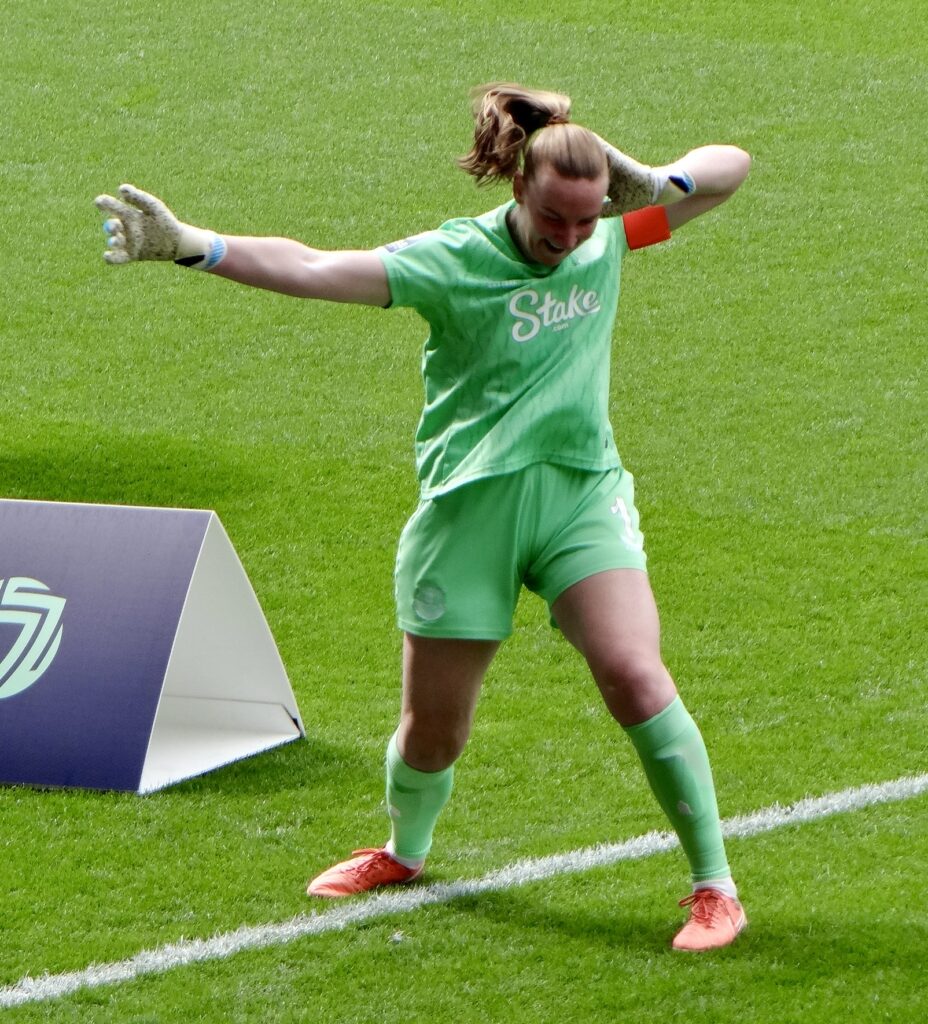
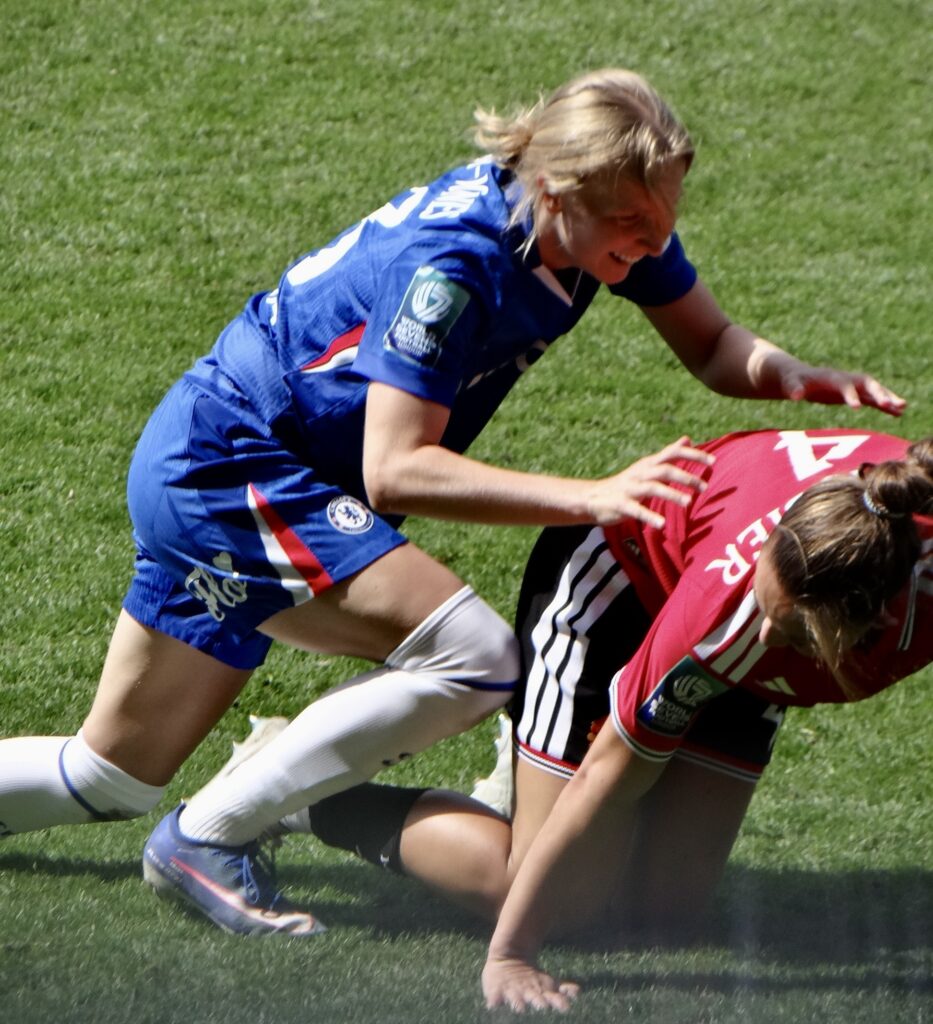
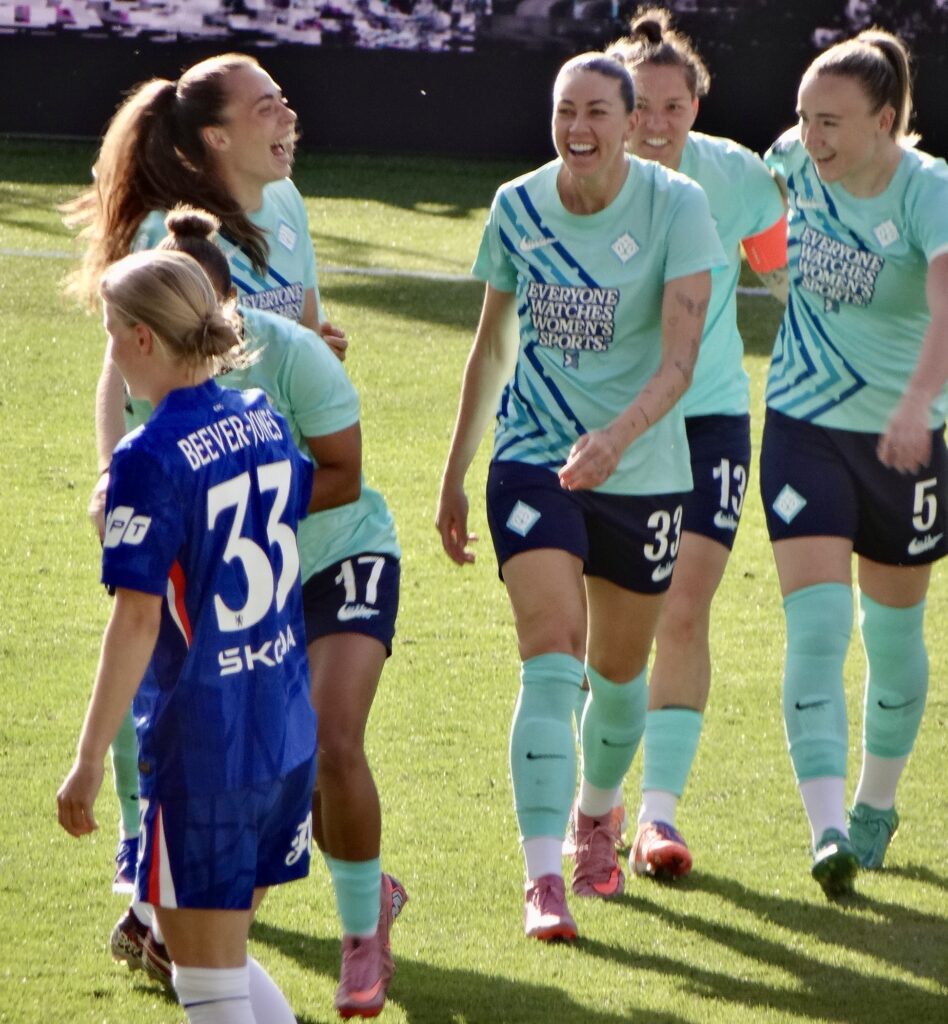
The World Sevens started with a couple of days of group stage ‘round robin’ matches – six ties on each day. First out the blocks was an absolute banger, as Chelsea v Everton went into extra time (‘overtime’), which meant both teams immediately went down to six-a-side (no, really) and into golden goal (first goal wins) territory.
Some teams, like Chelsea and Man United, basically fielded their biggest, starriest players across every 30-minute match, just as they would in the WSL. Others mixed and matched to give more of the rest of their squads their moment in the limelight. Each quick, roll-on roll-off substitution – and they generally came in batches – was marked by their luminous bib being caught by the departing player.
Complete outliers were Spurs. Not only did tactical and media duties fall to their assistant coach Lawrence Shamieh rather than Martin Ho, but they also deliberately chose to give their academy youngsters equal time with the first team aces (below, right). This was achieved by pairing each star with one teen (more of which below) so, for example, you had central striker Cathinka Tandberg paired up with the brilliant Rania Oukriss – and I spoke to both forwards and Shamieh about their innovative approach.
The climax came on the Saturday, when fans packed out the Gtech Community Stadium for the semis and final – seeing their favourite teams and stars in action, and up close. As well as lots and lots of goals, and record-breaking scores and memorable goal celebrations.
Dancing Queens
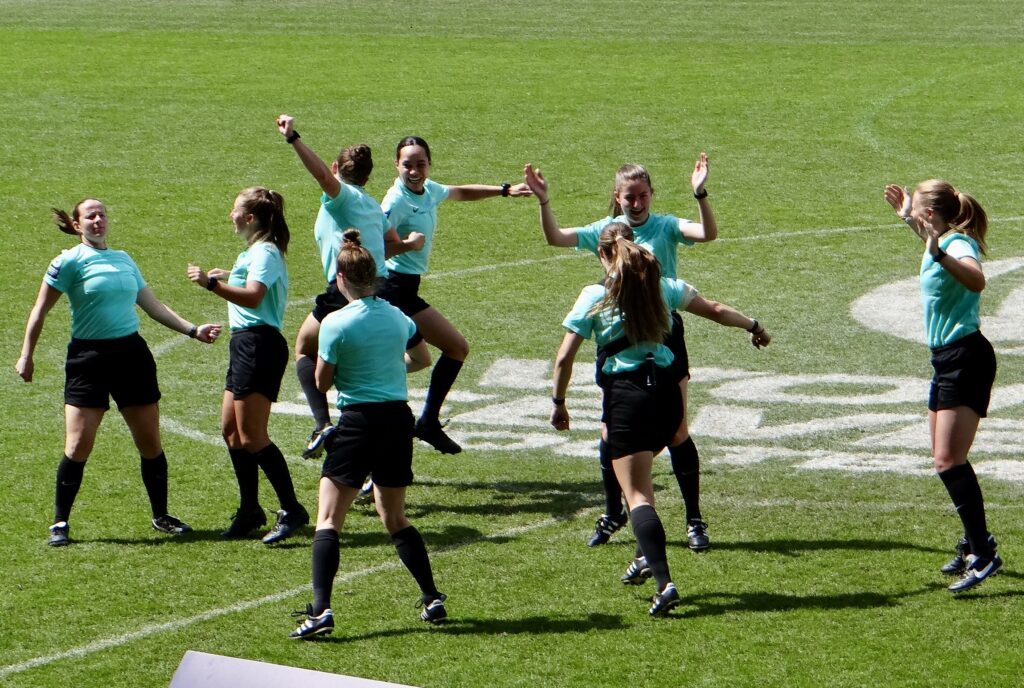
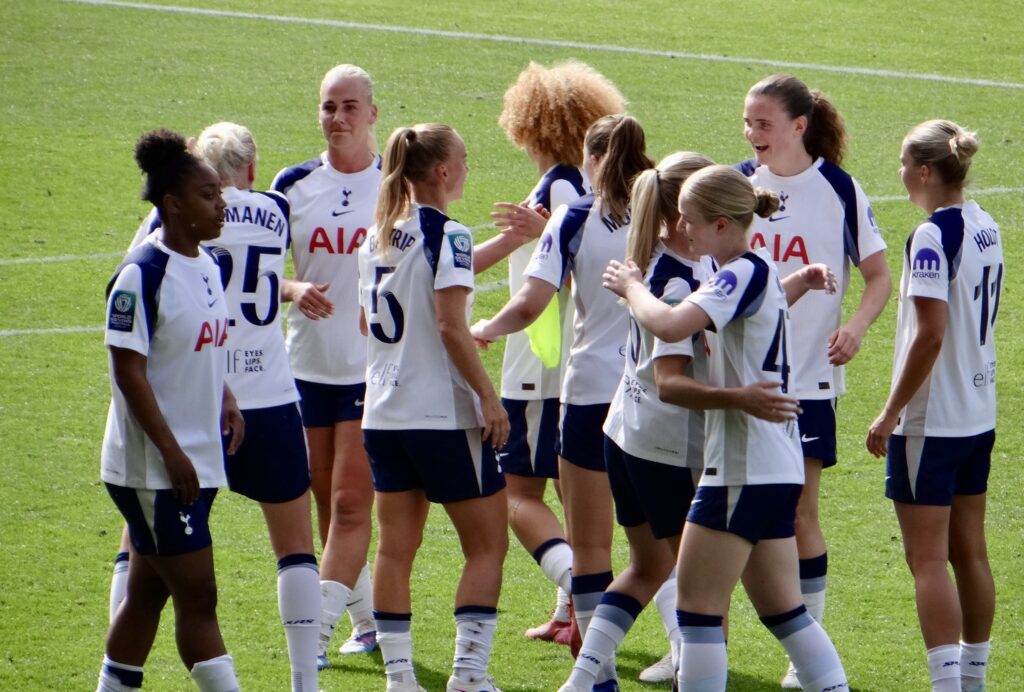
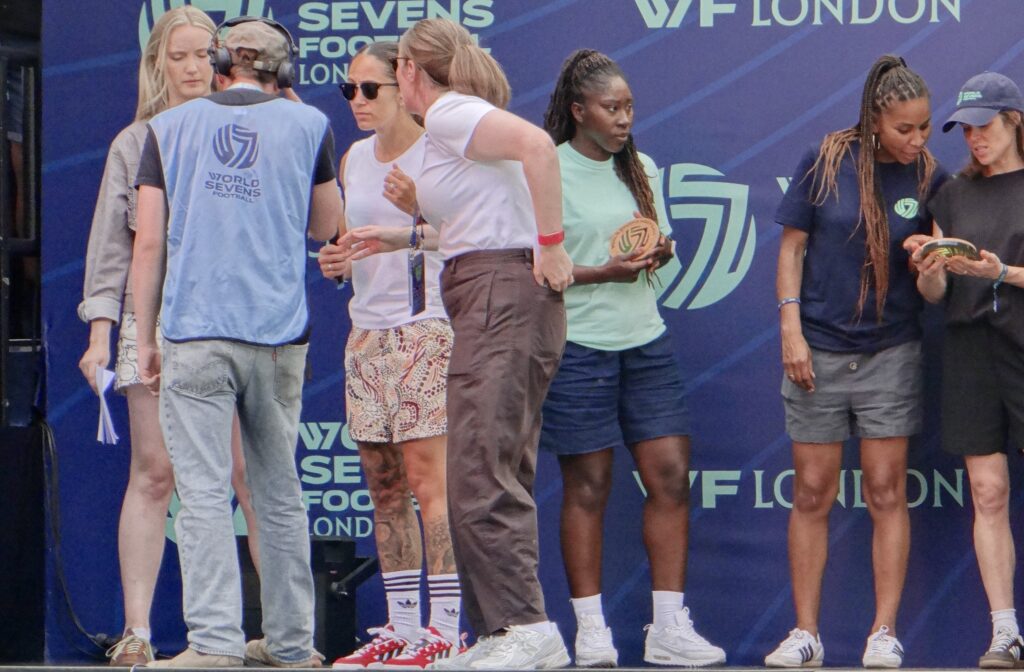
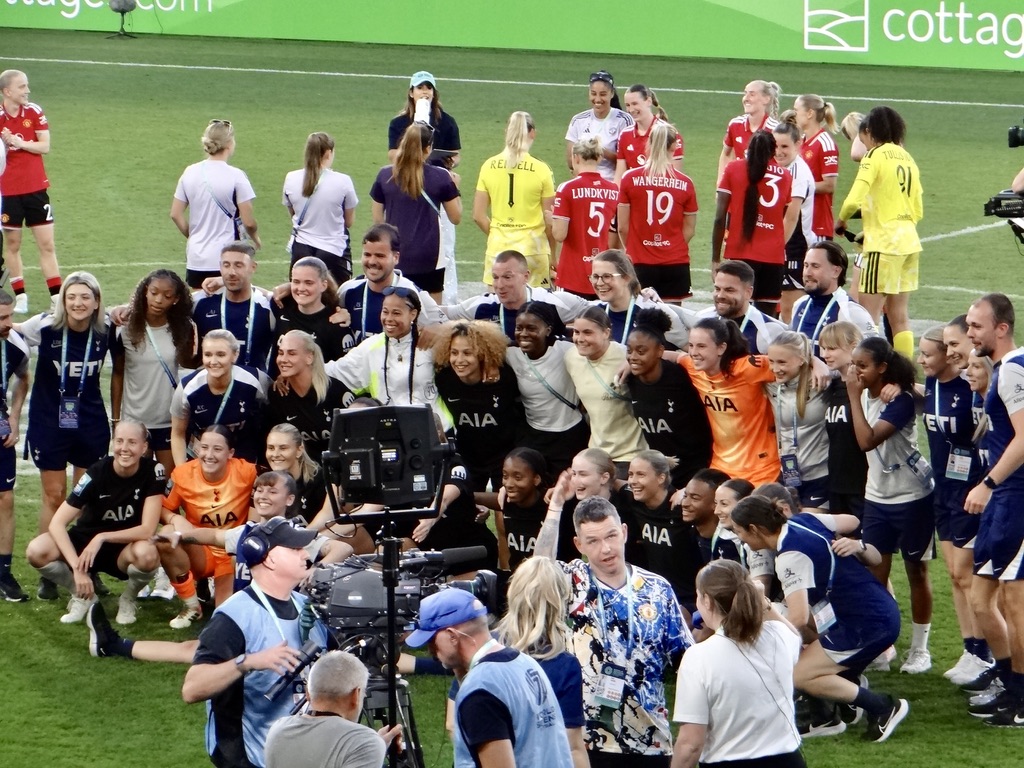
Oh, and we cannot forget each team’s choreographed walkouts, which all started modestly as little dances, flips, skips and forward rolls, and evolved into full-blown productions. Also fair play to the refs and the rest of the officials who threw themselves into their very own joyous walkout dances (above, left). And even though both eventual finalists delivered memorable scenes, the walkouts award would surely go to Everton for their imaginative and superbly staged mini-dramas, most notably and jaw-droppingly representing birth then death on successive days!
In hindsight, we were also witnessing the last appearances of many of these players for these Sevens teams. Not to mention one high-profile head coach. Many have since upped sticks and moved elsewhere in the WSL – or further afield. Chelsea have even recruited a couple of Players of the Match from their Sevens opponents. Which makes the whole event seem even more emotional and perhaps a joyous send-off for stars and teams alike.
Maybe we could have predicted the eventual finalists before the tournament even started. Perhaps we knew that the likes of Aggie Beever-Jones, Jess Park and Melvine Malard would excel in this format. But I guarantee that no-one would have anticipated the other two semi-finalists, and that Rachel Maltby and Ruby Mace would be the other players get us off our seats…
Group 1 was intense from the off, with Everton, Leicester City, London City Lionesses, and their local rivals Chelsea. Group 2 featured Aston Villa, plus the only team with previous World Sevens experience, Manchester United, and London rivals Tottenham Hotspur and West Ham.
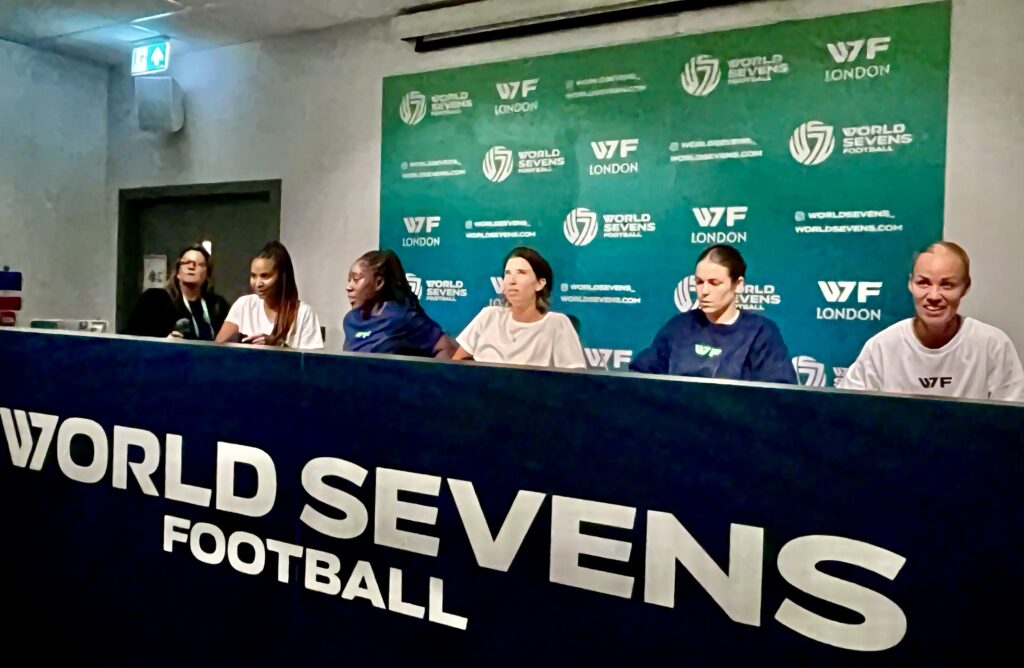
First off though, we heard from the Famous Five ex-players – Laura Georges, Anita Asante, Tobin Heath, Kelley O’Hara and Caroline Seger – who got behind the project and have helped push World Sevens into the spotlight.
So let’s first listen to those legends of the global game, and then look at each of the eight competing clubs and how they fared, the fun they shared, as well as hearing exactly what the World Sevens meant to them when they spoke to The New Women’s Sport Magazine.
Culture Club
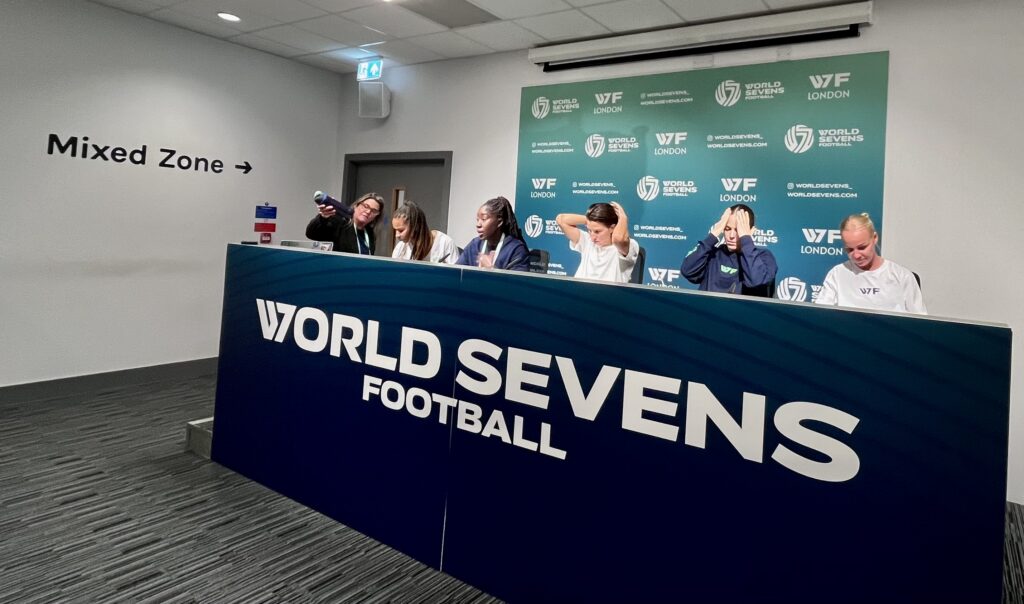
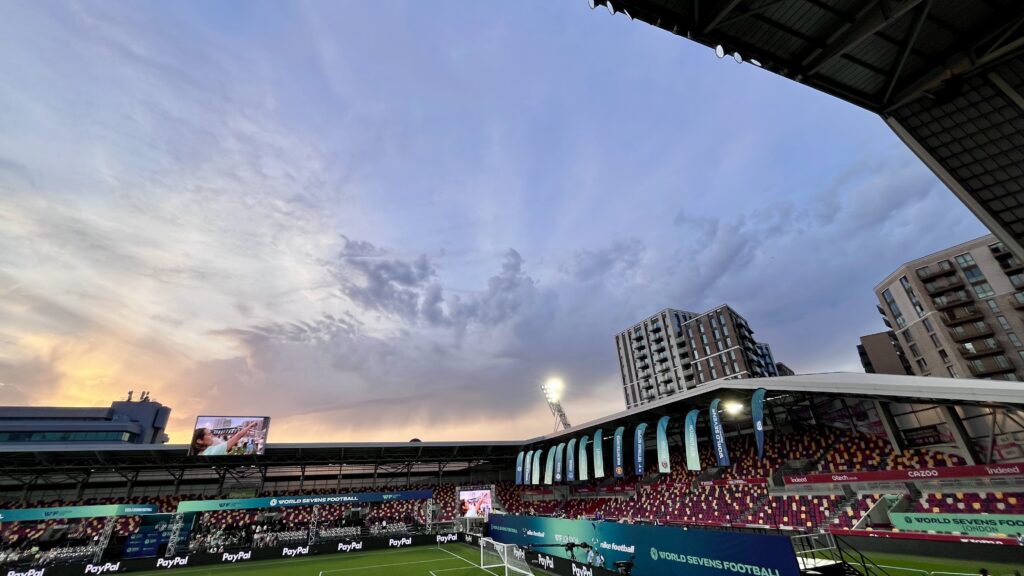
First of all, I wanted to know why exactly they’d picked the Gtech (above, right) for this third edition of the World Sevens. Former Lionesses star Anita Asante jumped in straight away, saying: “We chose Brentford because number one, the facilities, the infrastructure, it’s a Premier League stadium.”
For them it reflects the kind of platform they want players to experience, bearing in mind that not all the clubs in the WSL get to experience Premier League quality stadiums. Plus it’s a recognisable club in London that many people know about, know how to get to, and it’s accessible too.
They were also keen to emphasise the importance of the culture around football and giving the inner city of London the opportunity to experience this new format.
Crucially, Brentford were also eager to be involved, she added: “It was a natural synergy because of the enthusiasm and energy behind this club and how much they wanted to support this asset – which was fantastic.”
Asante already knew Brentford from her other work, and she clearly admires what they do in the community, as well as lauding their aim to expand participation in women’s and girls’ football. So the verdict was that there was a natural fit – an alignment – between World Sevens and Brentford.
Falling in Love
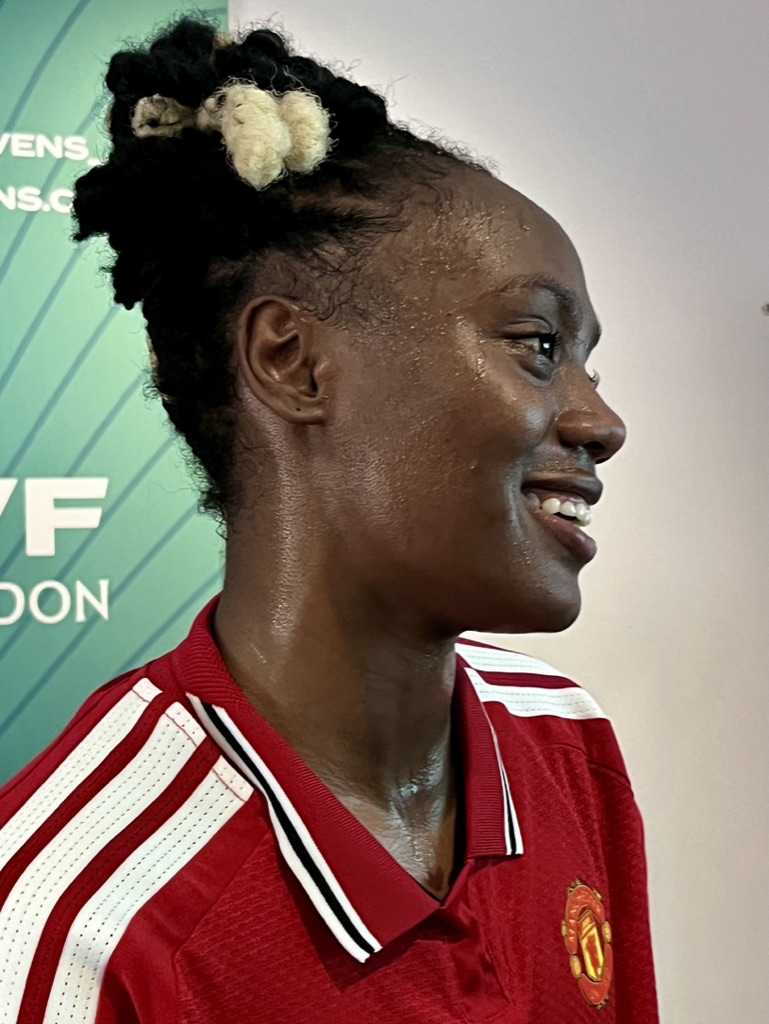
Every single one of the Famous Five beamed with appreciation when I told them that the (then) Manchester United and France star Melvine Malard (below) had told us that her motto for the World Sevens was: don’t think, just enjoy. And I asked if they wanted to add their own words. They did…
USWNT legend – and herself a one-time United player – Tobin Heath believes that football has become so professional, so data-driven, so serious, with younger players becoming professionals, that “you quickly lose the soul and essence of football.
“As a player, elite-level World Cups and Champions League finals are moments you dream of. But we’ve gotten so professional, so fast that we lose the soul so quickly.”
Heath warmed to her theme, talking personally: “I can say from the time that I started to the time I finished my career, I almost didn’t even like who I was as a player at the end, because I had lost this feeling, this sense of my soul of football.”
She honestly believes that something like the World Sevens gives this back to players. “Even players towards the end of their career, it gives them a sense of that feeling that honestly it’s like the first high of football, right? It’s the first feeling of falling in love.
“I think that that’s something I would have craved,” added Heath, “especially towards the end of my career, because I had lost that. I had become so focused and professional and winning and elite, and you forget about the love.”
Blessing
Fellow US legend, Kelley O’Hara agrees with Heath, acknowledging that of course, the professionalism of football, specifically women’s football, is a good thing. Then she stepped out of the general into the personal to explain why she chose to join World Sevens.
“One of the reasons I’m part of this,” said O’Hara, “is because I would have loved to play in this tournament.
“I didn’t get to, so the fact that I get to… help create it and provide this platform and opportunity for players who are still in the game is a blessing.”
In short, she is thankful to do this because she would have loved playing in it. Malard’s joyous reaction was no surprise either, as O’Hara herself had bumped into the France star in the elevator the previous day, and she had the same reaction. “So it’s exciting that a player who’s played in it and is coming again has that response.”
Shackles Off
Chipping in, Asante added: “That’s what we want, the freedom. It’s like the shackles are off.”
She reckons that in this format you see certain types of player – like defenders – show other qualities you don’t always get to see on bigger pitches in tight spaces. “So you create new identities with these players, who get to show another side of what they can do and who they are in terms of how they express the way they play.”
With 188 international caps to her name, ex-France stalwart Laura Georges says she knows Melvine Malard well from her appearances with the national side, long before the World Sevens.
She reckons that Malard not only had a hard time playing with the national team, but also being ‘that’ player for Man United, and “coming to Sevens it was just for her to express herself.
“From this tournament I could see the change going back to the national team, being more confident because during the tournament she was able to score some goals.”
Which meant that Malard’s first World Sevens was a key moment for her. “She’s such a happy person and this tournament was her opportunity to say: it’s time for me to shine and express what I want to express with my team.”
So the Sevens in Portugal wasn’t just a key moment for Malard, but for the likes of her countrywoman Georges, who says she knew right then that it was something special.
CLUB BY CLUB. HOW THEY FARED. OUR VERDICT AND THEIRS.
ASTON VILLA

REPORT CARD: overachieved!
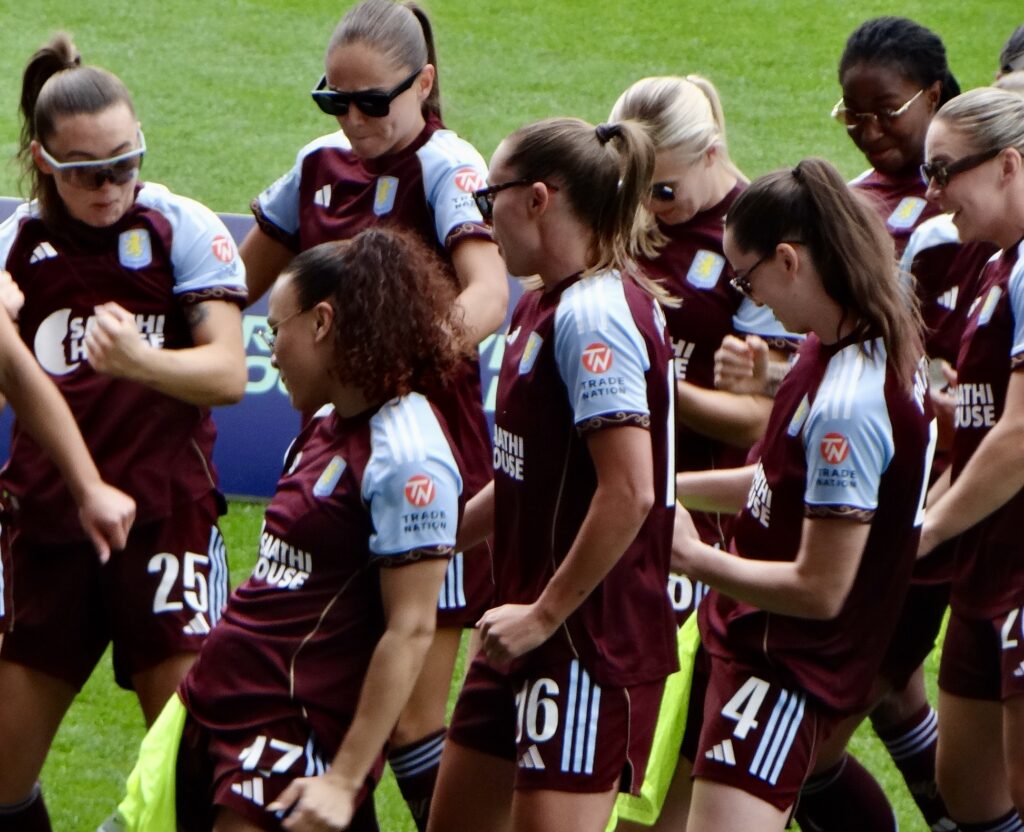
WALKOUTS: Blues Brothers-style sunglasses and coolness all-round on Day Two, plus Japanese star Maya Hijikata exploding out of the squad huddle ahead of their semi-final.
MATCHES: beat Spurs 6-3 (with Rachel Maltby getting two goals and one assist to almost avenge their 7-3 loss to Spurs in the WSL); lost 4-0 to Man Utd; beat West Ham 3-2 (with skipper Rachel Daly opening the scoring). Semi-final: lost 8-2 to imperious Chelsea.
IN THEIR OWN WORDS:
RACHEL MALTBY
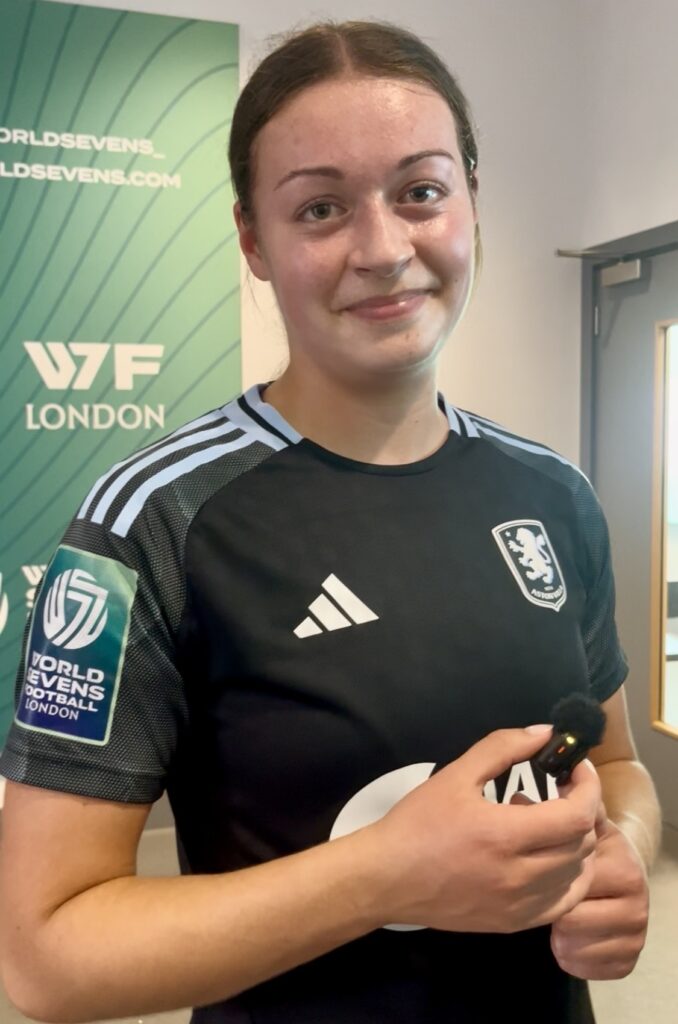
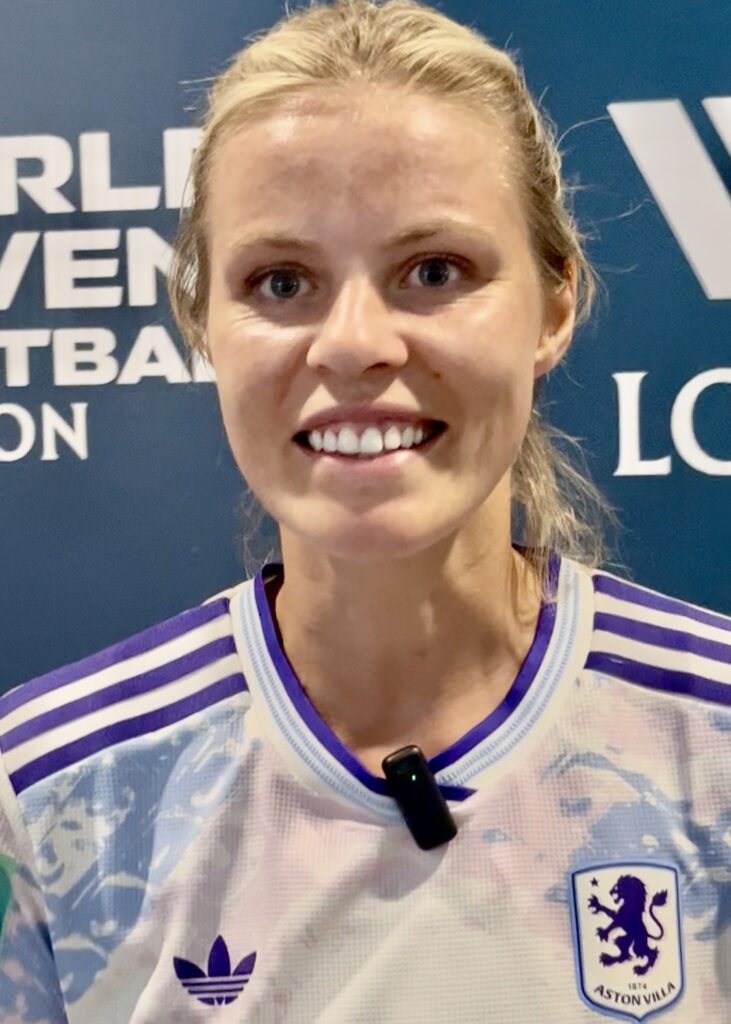
Player of the Match Rachel Maltby (below, left) – who celebrated her goals with brilliant backflips – said there might’ve been a tiny bit of revenge over Spurs involved in Villa’s fine 6-3 victory at Brentford. As for the Sevens itself, she was all positivity:
“It’s a different type of intensity to a normal game and we definitely felt that. The roll-on, roll-off subs are really useful. I think the way that the tournament is, with the subs and the time of the halves… it’s fun!”
HEAD COACH NATALIA ARROYO
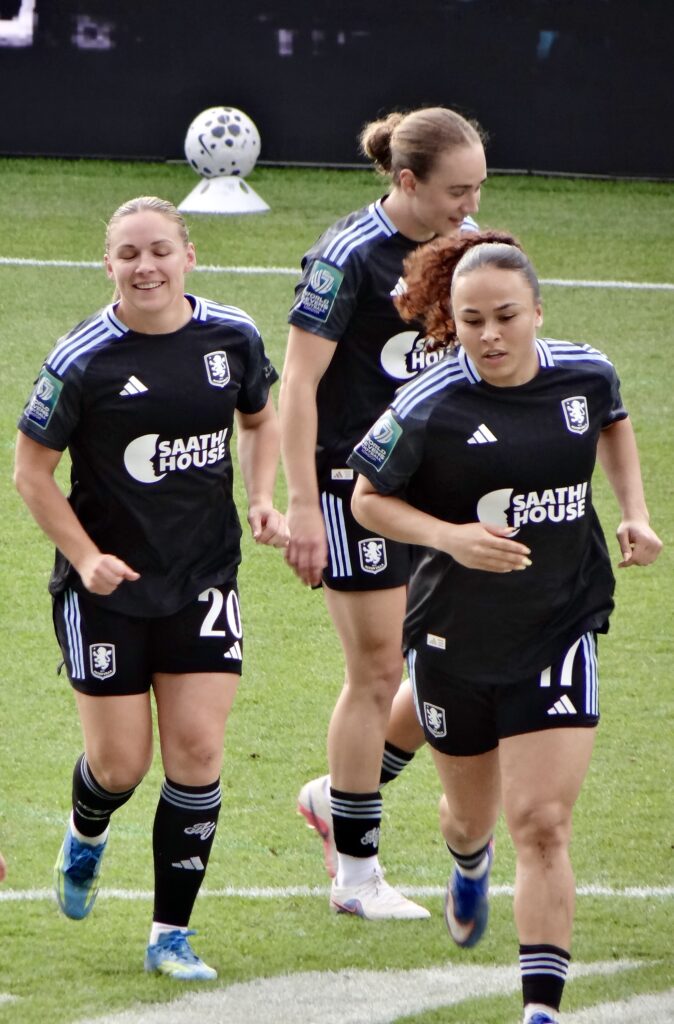
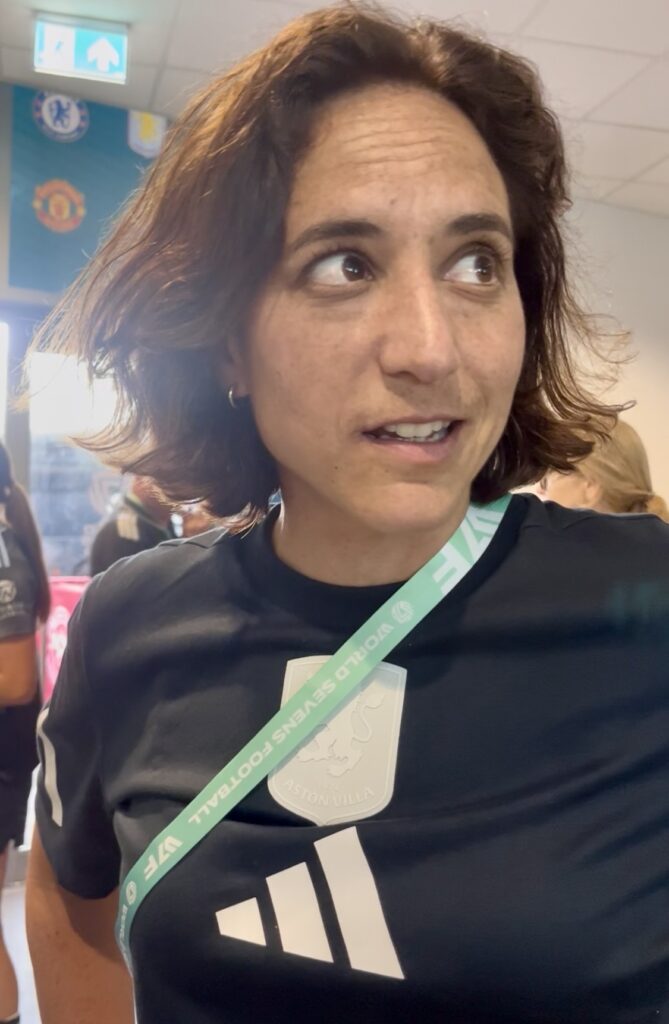
Villa’s head coach, Natalia Arroyo (above, right), like Maltby, enjoyed their ‘revenge’ victory over Spurs, but didn’t think it made up for their defeat. “It was a tough result in the league and I think somehow this was a mirror of that.
“This doesn’t count as three points in the WSL, but it counts for our mood, our confidence, and we were happy to do that.”
Things that stood out for Arroyo included the Sevens atmosphere and vibes, which she described as “not like normal” – alongside not having a changing room, or any “bored moments.”
“They want to win and you try to win every second, every action of the next games, but it’s not like that in a normal competition.
“I think that balance was good, so it’s how much of the pressure, and tension and tactics we take, and how much is an inconvenience for the players, and how much we can make this flow.”
Philosophical as ever, Arroyo smiled as she concluded that as a coach, she’d like to be more involved, but “hopefully this is a learning that maybe if I just watch and let them play that’s much better!”
RACHEL DALY
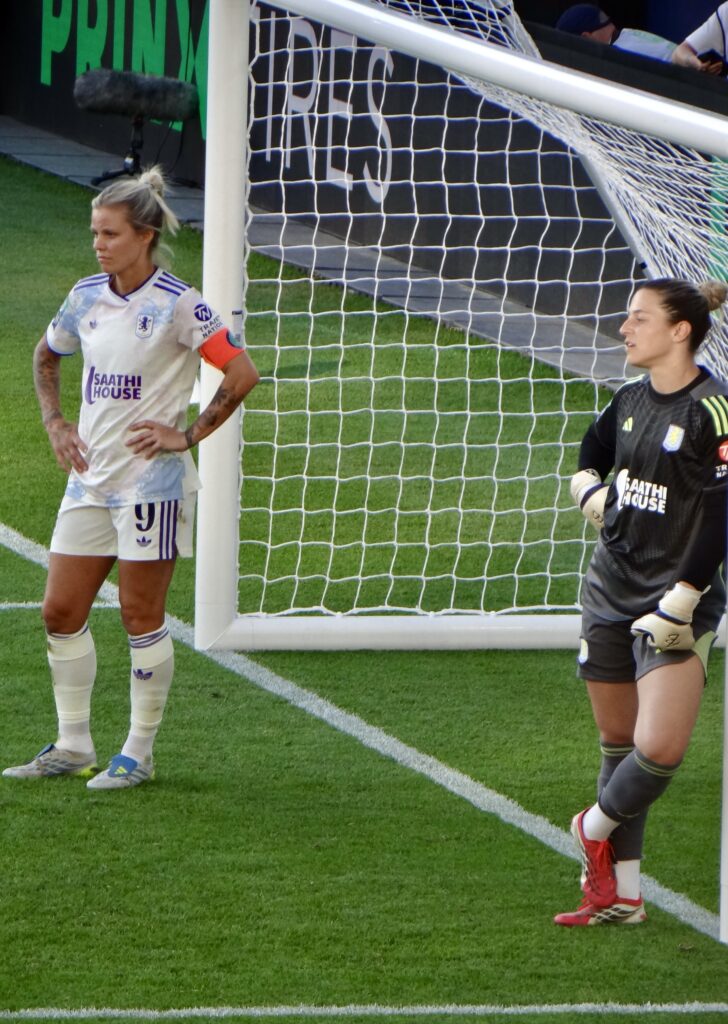
Villa captain Rachel Daly (below, left) was all smiles after beating West Ham. “We love it!” she said, “It’s exciting, it’s a different vibe completely. We’re so used to 11-a-side and the seriousness… obviously we take it seriously, but it’s nice that everyone can let their hair down and have a bit of fun and work together. It’s just enjoyable.”
Having embraced the Sevens vibe, I wondered if Daly thought there were things we could take into 11-a-side games? “Yeah, play music during the game. I absolutely love it!” she said, before qualifying this and adding “I think tactics almost go out the window when it comes to 7-a-side. It’s just work hard, play hard, fight hard.”
Daly also loved how much the crowd gets involved. “It’s brilliant. In the league, the WSL, you don’t get much time, much interaction with the fans, so it’s good for them.
“And everyone comes together. Even for us, mingling with all the other girls in the changing room area, different teams, it’s nice.”
SABRINA D’ANGELO, RACHEL MALTBY (again)
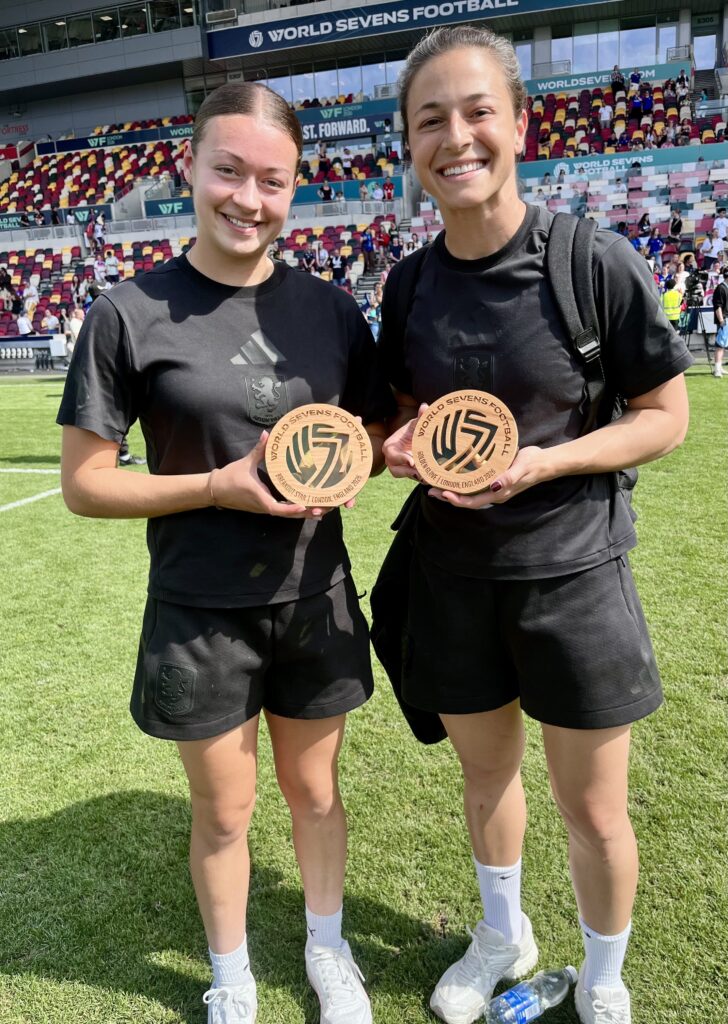
Villa managed to pick up two awards in the Sevens, with (the departing) Sabrina D’Angelo picking up the Golden Glove award for Best Goalkeeper, and Rachel Maltby as Breakthrough Player (above, right). They spoke to me straight after picking up their trophies, still basking in the glow of these well-deserved accolades.
Sabrina D’Angelo – aka Sabs – said that even though the semi-finals didn’t go as planned, “it’s just an honour to be recognised and to get this award. Obviously it’s a team award, and I couldn’t do it without the people in front of me.”
When asked about Maltby’s performances, Sabs didn’t hold back: “Maltby this entire season has been incredible. Just being young and coming in and embracing the WSL, and then to come into this tournament and just be herself… and then to see those backflips. She has so much potential and I can’t wait for what’s ahead for her.”
Similarly, Maltby was full of praise for her keeper. “Yeah, I could say the same for Sabs.
“Ever since I’ve come into the senior environment, she’s always been one of the first ones to support me. She’s been a rock at the back, but also off the pitch, she’s always been there for me. She’s been one of the people who’s allowed me to express myself on the pitch as well.”
With a lower, narrower goal, Sabs agreed it was a keeper’s dream, enabling her to load up her showreel with highlights. “It’s a nice goal to play in. It’s just so quick-paced, with reaction saves, 1v1s, block saves. We love small-sided in training, so to be in a 7v7 is a goalkeeper’s dream.”
On the other hand, Maltby admitted the smaller goal made it harder for outfield players. “It’s a challenge. We’re so used to being in the big goals, so our accuracy has to be better.”
Still beaming, both Villa stars clearly loved the Sevens. For Sabs it was all about the energy, “a lot of teams embraced the event and brought good vibes.” As for Maltby, she loved the atmosphere and social energy. “It really means a lot,” she said, “For all the players after a long and tiring season, to have a bit of fun at the end and all come together, it’s really good.”
Sabs is now at Northern Super League club AFC Toronto, back in her native Canada.
Kirsty Hanson is now at Spurs.
CHELSEA
REPORT CARD: undefeated!
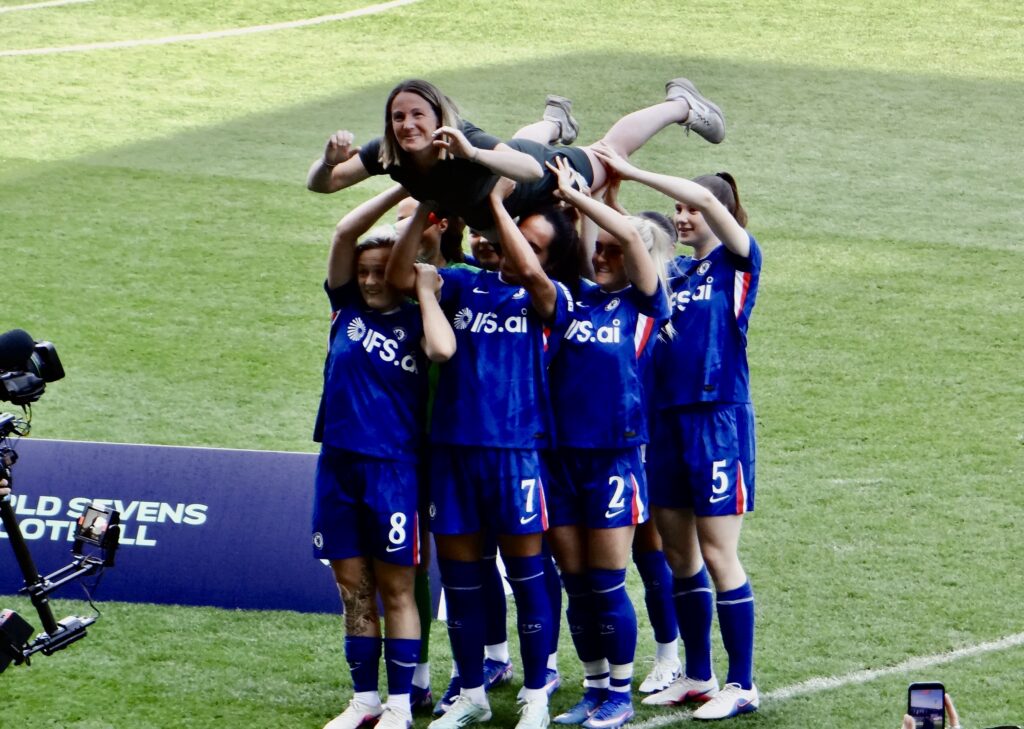
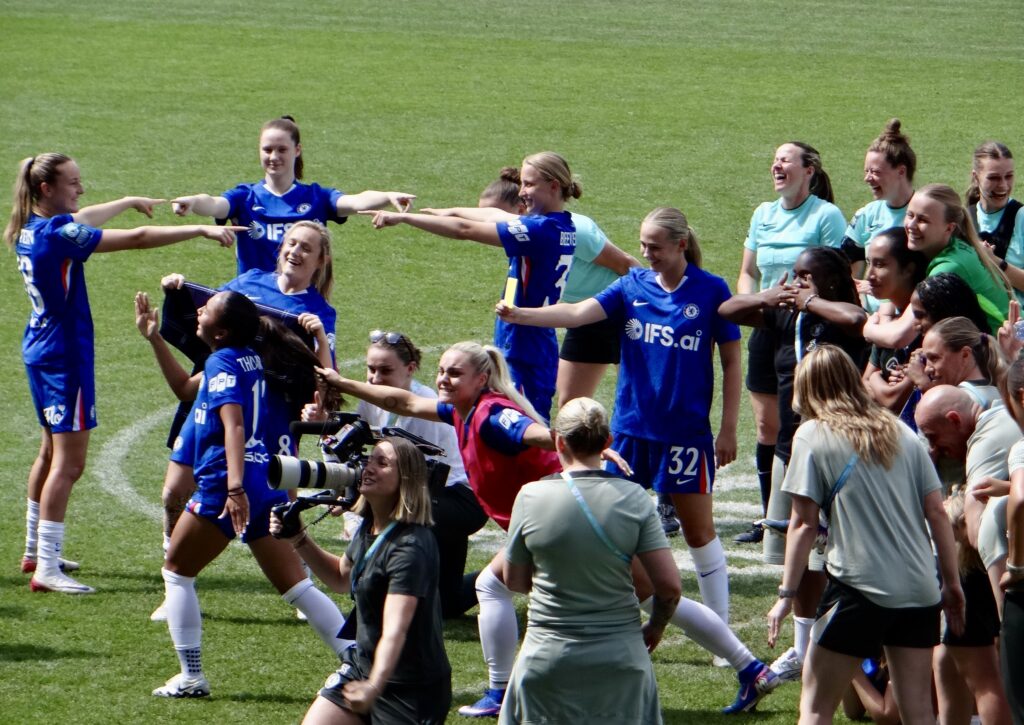
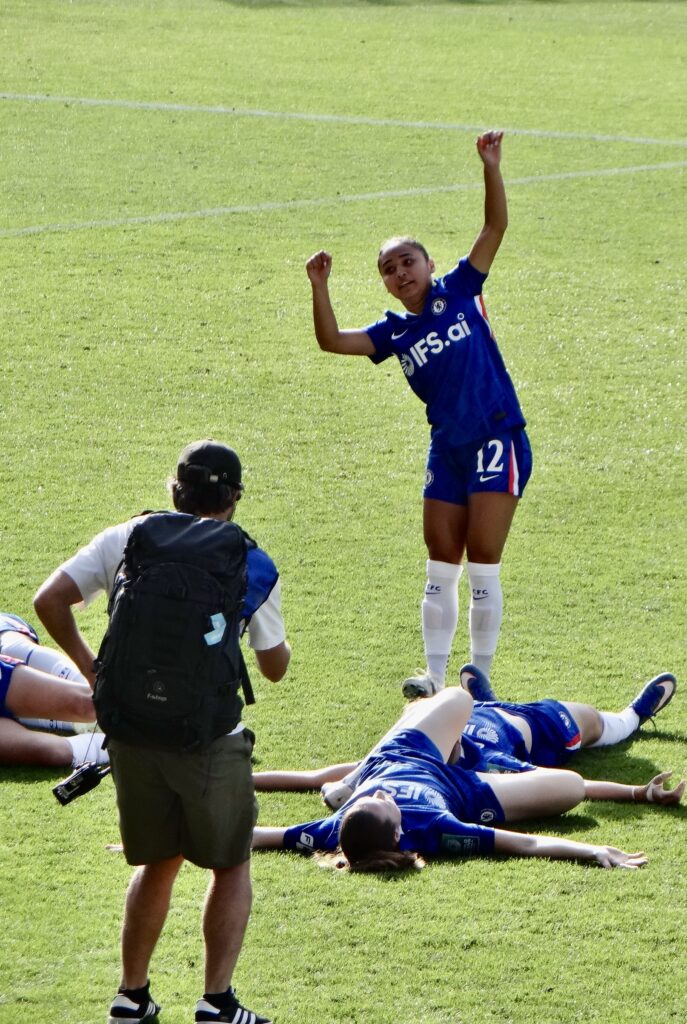
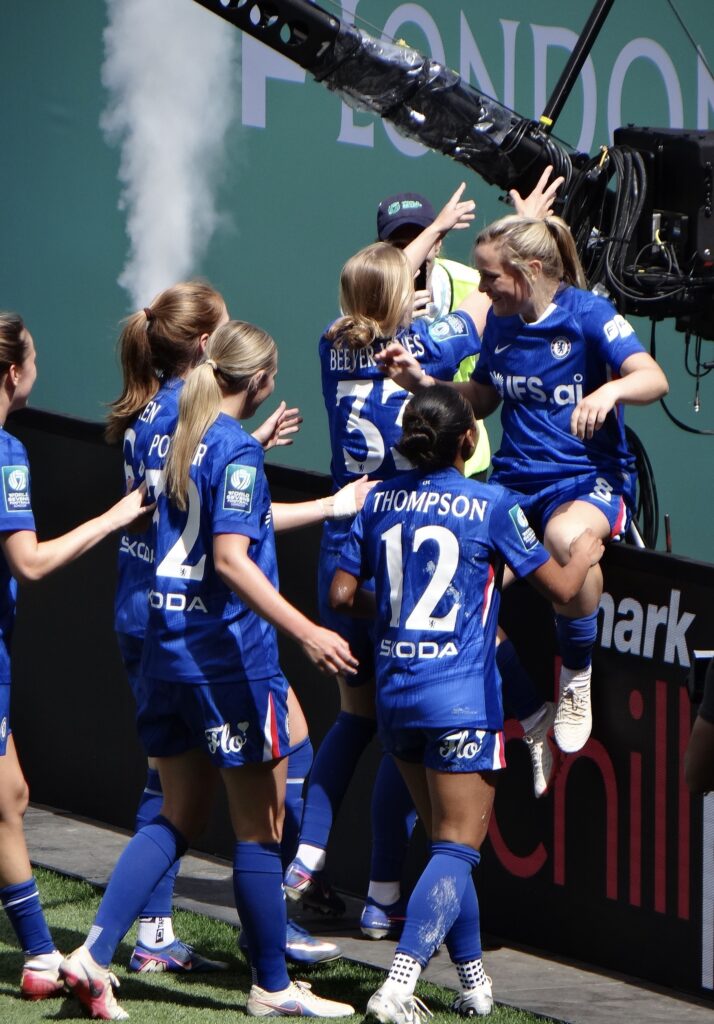
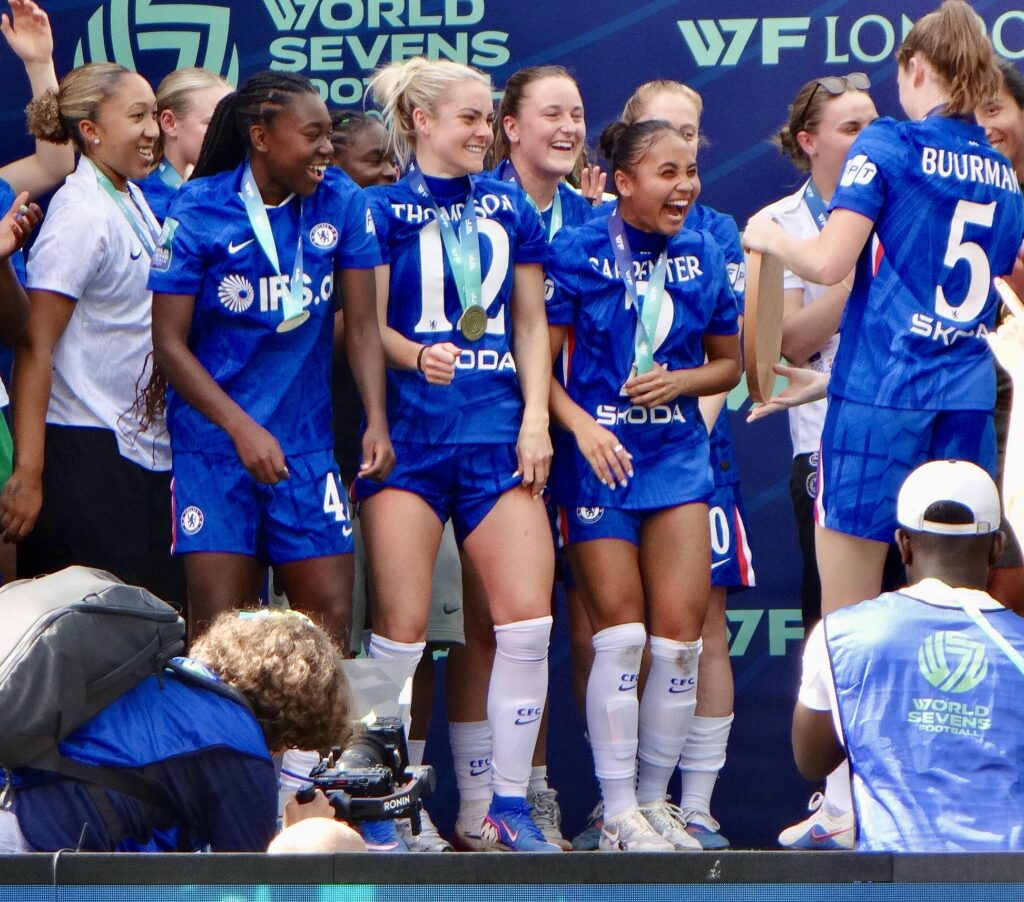
WALKOUTS: acrobatic tumbles, Alyssa Thompson in nine-pin bowling (below), Sonia Bompastor joining in (see below) blowing kisses to the fans while lifted above the team. Then the final frozen tableau depicting Thompson having her hair pulled – this time by Ellie Carpenter – with Lexi Potter showing her the red card and Bompastor ‘filming’ it all. Plus Erin Cuthbert lifting her kilt! Priceless.
MATCHES: beat Everton 4-3 (with Aggie Beever-Jones getting two goals); beat Leicester 3-1; beat LCL 5-2 (including a goal for teenager Lola Brown). Semi-final: beat Villa 8-2 (braces from Beever-Jones, Mayra Ramirez, Veerle Buurman). Final: beat Man Utd 6-5 (hat-trick for Beever-Jones).
IN THEIR OWN WORDS:
AGGIE BEEVER-JONES
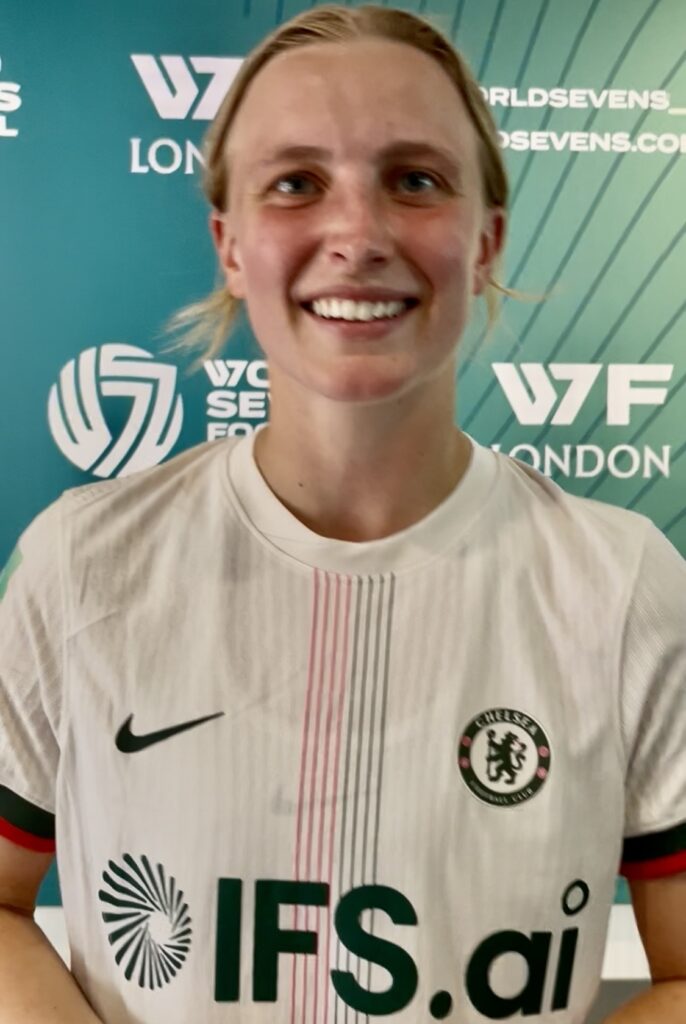
My post-match chat with Aggie Beever-Jones (below, left) – who was simply extraordinary throughout the Sevens and eventually awarded Player of the Tournament as well as Golden Boot – suddenly took a turn when she realised that Sonia Bompastor was sitting directly behind her.
What they said to me in that moment had quite an impact on what happened in the rest of Chelsea’s tournament, notably in their walkouts.
“If anything,” said Beever-Jones, “I’d love to see Sonia come in and play. I know she’d love it. I was kidding that she needs to do a walkout, so hopefully I will get her to do one.”
She then turned to her head coach and asked: “Yeah, you’re on that?” And Bompastor, quick as a flash, replied: “Yes, you have got that now. It’s recorded!”
And my word, did Bompastor jump at the chance, with a key role in the walkouts not once, but twice, in the semi and the final itself (evidence in photos above).
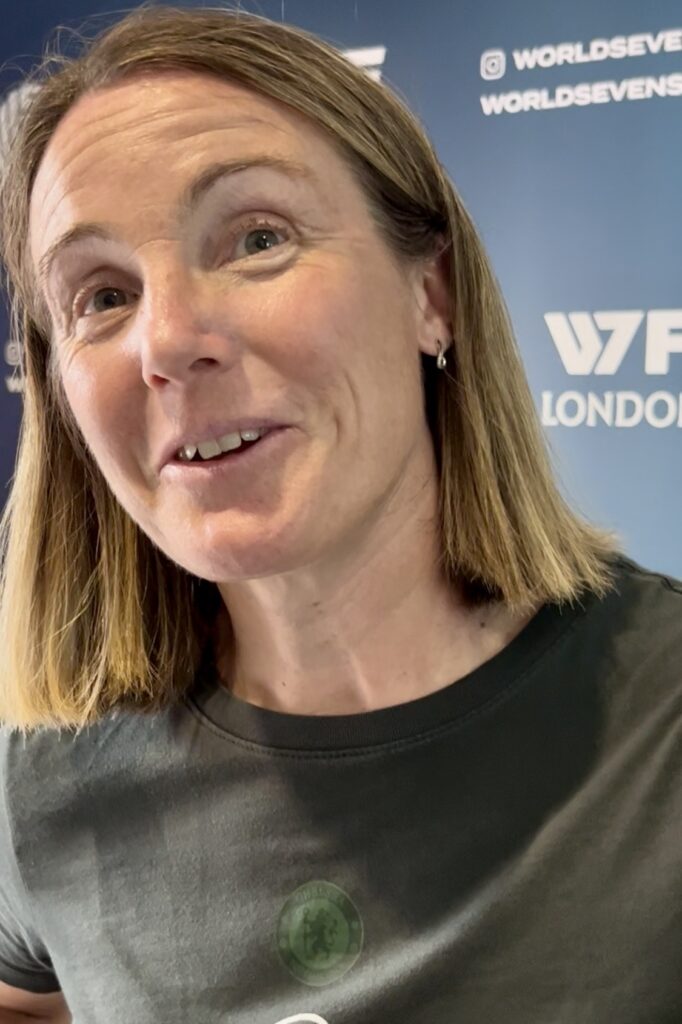
HEAD COACH SONIA BOMPASTOR
I asked Bompastor how she prepped Chelsea for extra time and going down in numbers to six, and maybe five.
“We knew the rules,” she said, “and for us it was good to prepare for that, but we didn’t prepare going down to five players on the pitch because we train with seven, and the intensity was already high.
“But we knew when you go down to five you have to run even more and you have to stay on your player – and a lot of spaces on the pitch, even more than when you are seven, for sure.
“But also that’s a lot of opportunities for the players to take initiative on 1v1s. So it’s good when you have the players who can beat on 1v1 the defenders and create some great goals.”
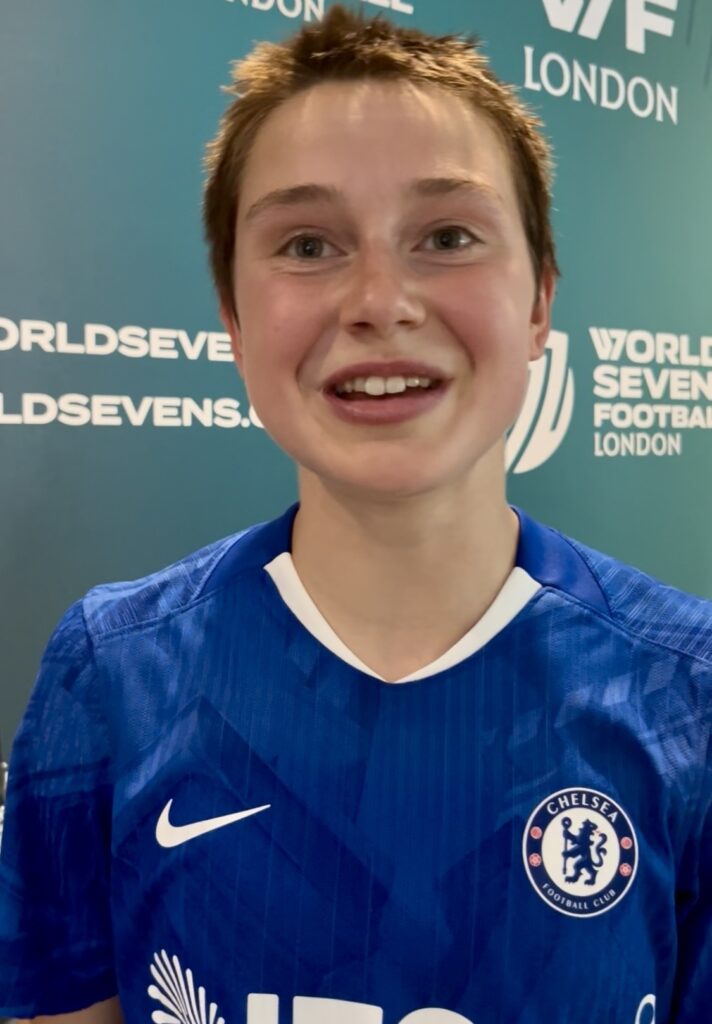
LOLA BROWN
Teenager Lola Brown (below, left) was beaming after scoring against Leicester in the Sevens, and said she enjoyed this different sort of game. Talking about her goal, she beamed again, crediting teammate Keira Walsh for the great assist.
The match itself, she said, “had a fast tempo, but I think that’s what makes it really enjoyable and really good to watch.” And she summed up the whole experience as great fun, “the walkouts, the games, everything. It’s just a joy!”
VEERLE BUURMAN
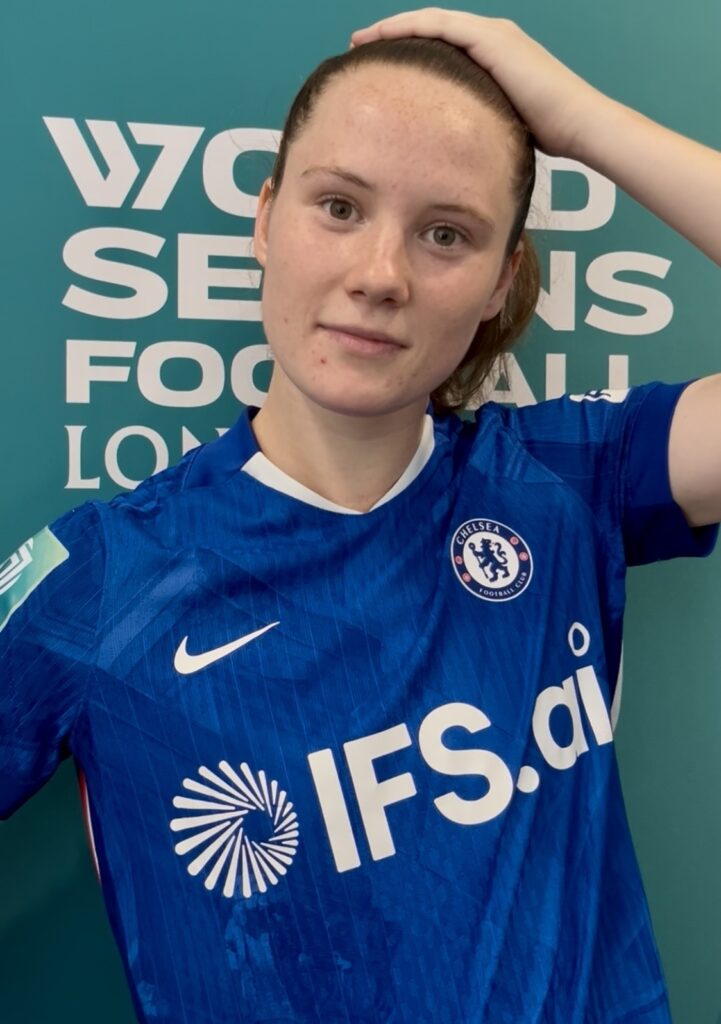
Chelsea’s goal-scoring defender, Dutch youngster Veerle Buurman (above, right) laughed when I asked if they’d perhaps run out of celebrations after scoring so many goals.
“Sometimes it’s difficult,” admitted Buurman, “with the walkout as well! You have to really think what you’re going to do, because everyone is doing such a good job in the walkout, doing different things… also I didn’t expect that I would score a goal, and I got two!”
Buurman reckoned that the World Sevens is a really nice way to just switch off and have fun on the field. “Of course, you want to win,” she added. “That’s also important, but you can see on the field when you’re scoring goals, everyone is enjoying it and laughing and also you’re playing against teams and players you know, so it’s really nice.”
The final plus for her was having so many supporters there. “All the teams have fans, seeing them dancing and screaming, it’s really nice to have them here.”
SONIA BOMPASTOR
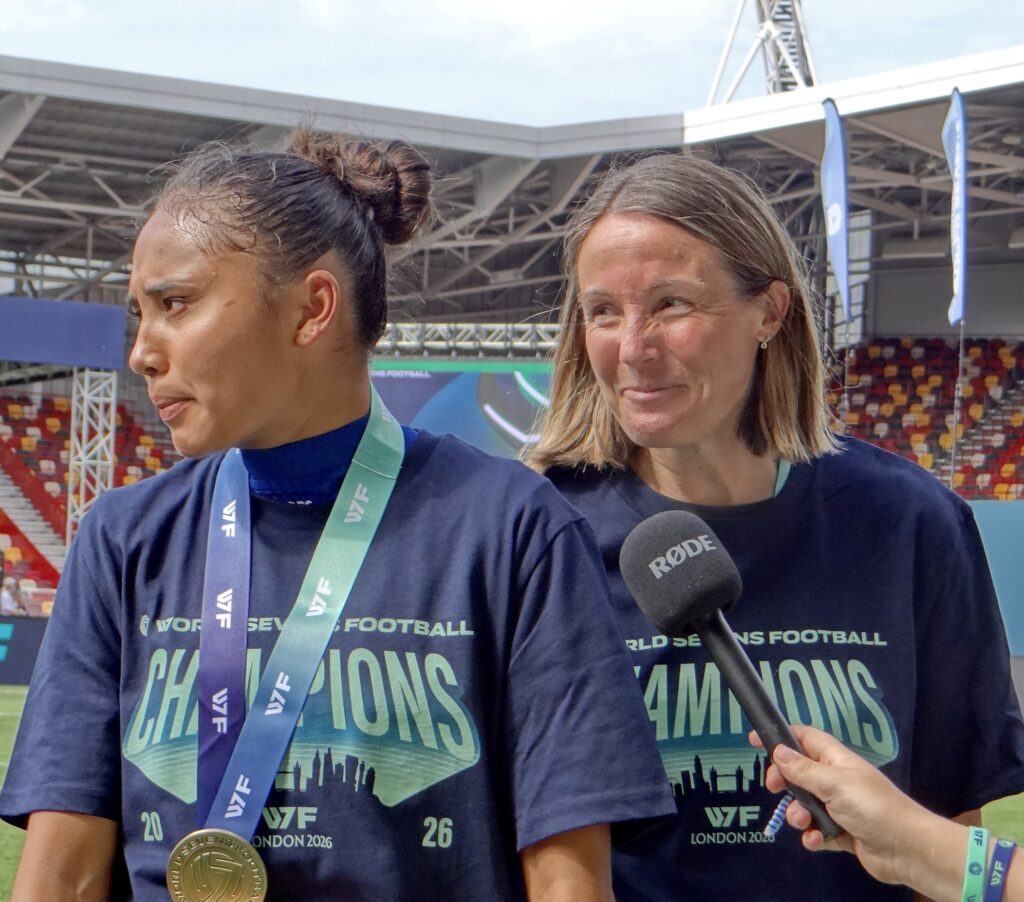
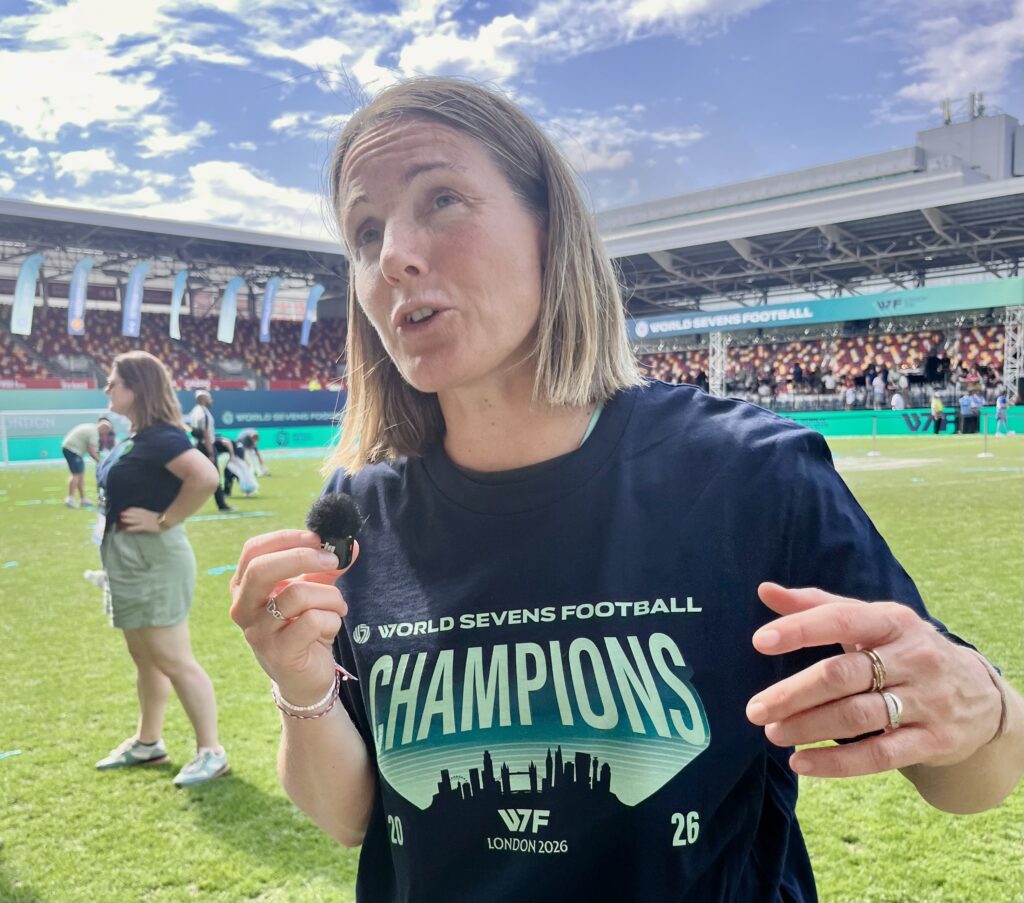
Talking to Bompastor on the burning hot pitch, straight after Chelsea had won the tournament, I wondered if she’d discovered anything new about her players across the three days.
She was adamant that she didn’t learn a thing because she believes that one of the main qualities for a manager is to “learn your players and know them as much as possible”. For her, that is essential. “I know them really well as players, but also as persons.”
One of the few things she did learn is that we might have more of the ‘fun element’ in the league. “The players need to understand when they are playing football, as much like as there is pressure when you are a Chelsea player, you need to come on the pitch with this desire to have fun… and if you do that, you can express your best version of yourself.”
I also quizzed her on any Sevens rule changes she might like to see in 11 v 11 games. Typically thoughtful, she said it would be hard to take just some rules because you have to think about the whole format and all the rules.
“Obviously sometimes playing with no offside is great, but the size of this pitch allows that.”
A very noticeable difference in Sevens rules is something akin to rugby, as the clock stops whenever play stops, so there’s no arguing over added time. Bompastor mulled this over too.
“Stopping the time when there is like free kicks, corner kicks… but two times 45 minutes is already a long time so maybe we should also reflect on maybe not as much, but stopping the time when you have this,” adding, “It’s difficult because this format is different. Maybe some things can be complementary.”
Warming to the Sevens theme of fun, she summed up the whole, three-day experience: “The only thing for me that we need to think about is did the fans enjoy coming and watching? I think yes. So what can we take from this to go into the future with the same mindset?”
Johanna Rytting Kaneryd has moved to OL Lyonnes
Niamh Charles has moved to Man City
EVERTON
REPORT CARD: close, but no cigar!
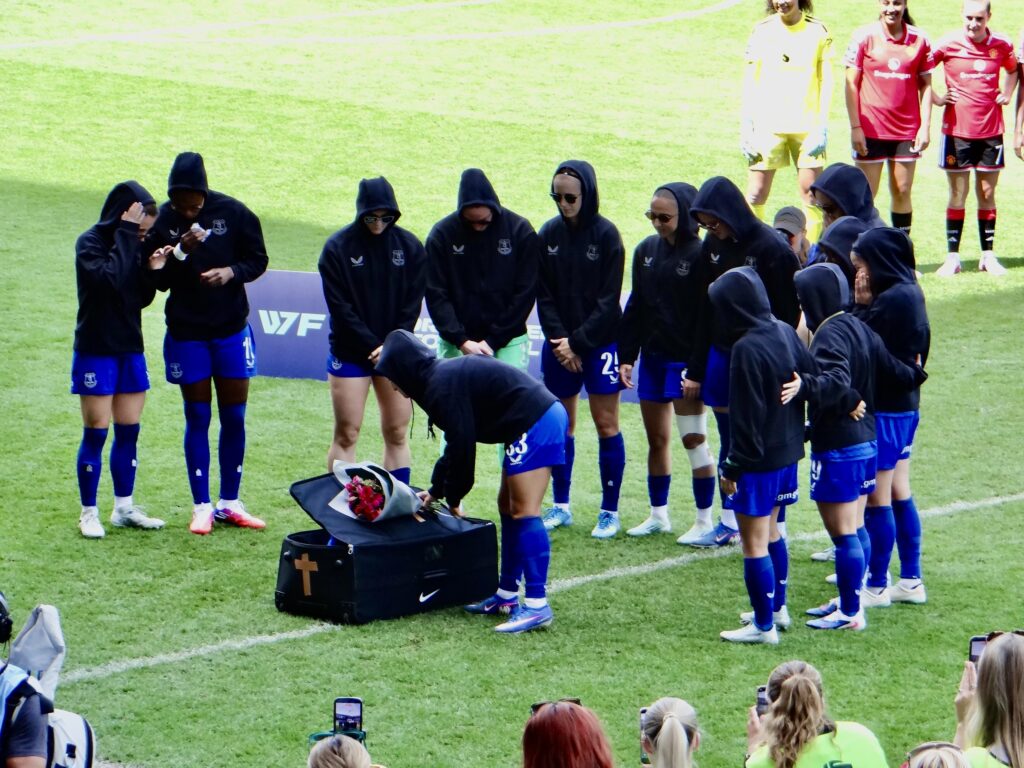
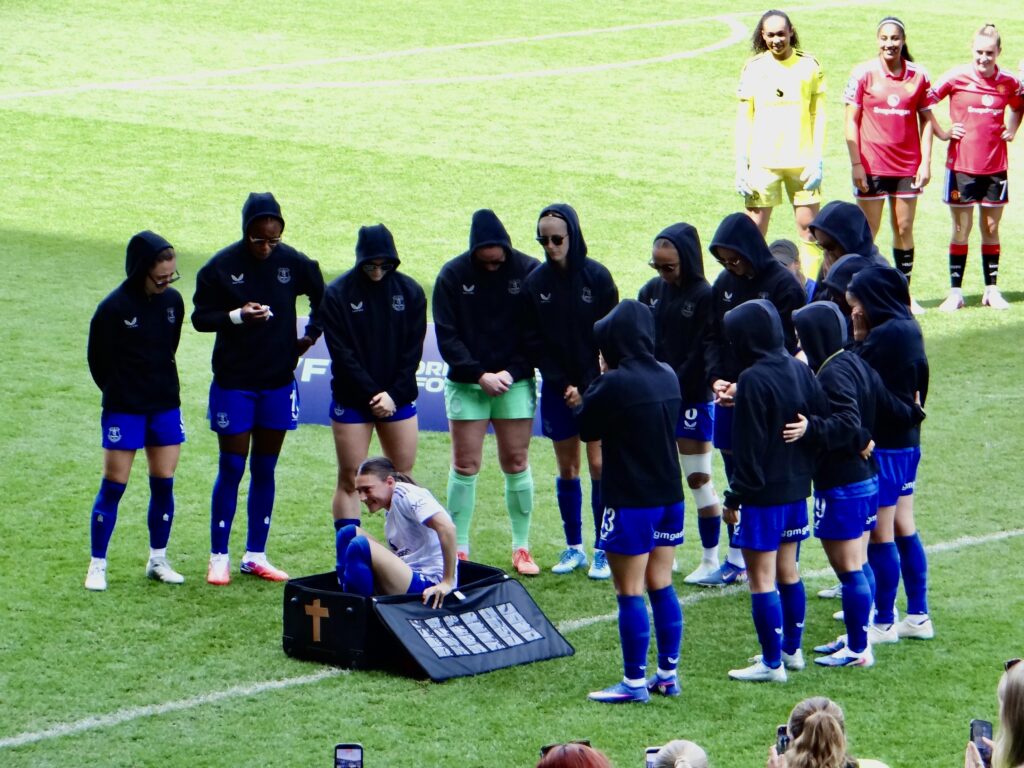
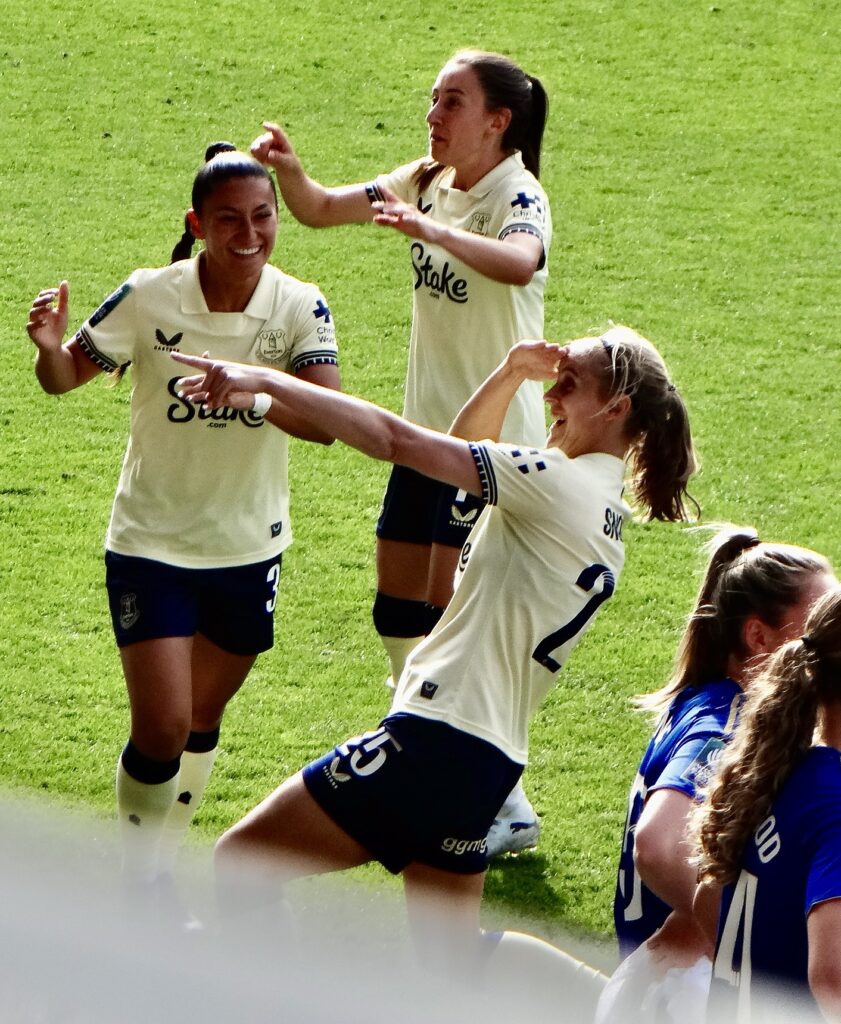
WALKOUTS: dancing, striking a pose, then elevated to an art form with Friday’s dramatic ‘birth’ by Katja Snoeijs followed by Saturday’s ‘death’ of Hannah Blundell in a sombre service, with mourners and flowers… before she burst out of her tiny coffin (no, I’m not making this up, see photos above), ripped off a Man Utd shirt and revealed her Everton kit underneath. Genius.
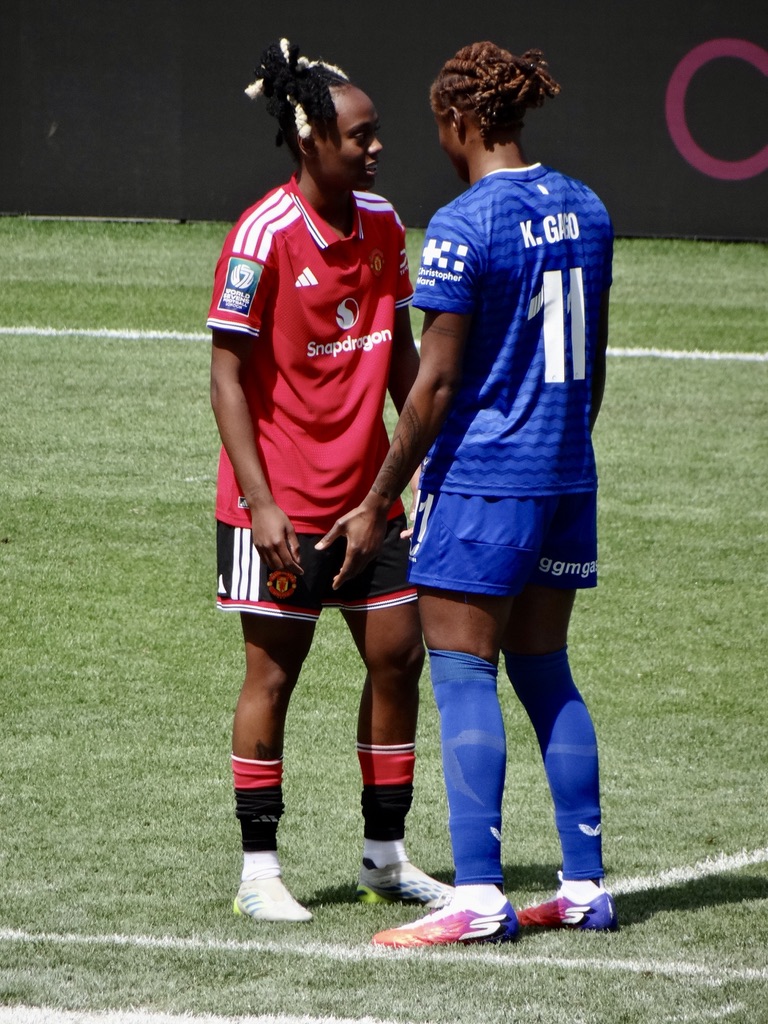
MATCHES: lost 4-3 to Chelsea; beat LCL 2-1 (with Ruby Mace opening the scoring); beat Leicester 8-2 (with Katja Snoeijs grabbing a brace, and Mace getting one goal and two assists). Semi-final: lost 5-2 to Man Utd (with France international Kelly Gago and her United counterpart Melvine Malard both scoring).
IN THEIR OWN WORDS:
RUBY MACE
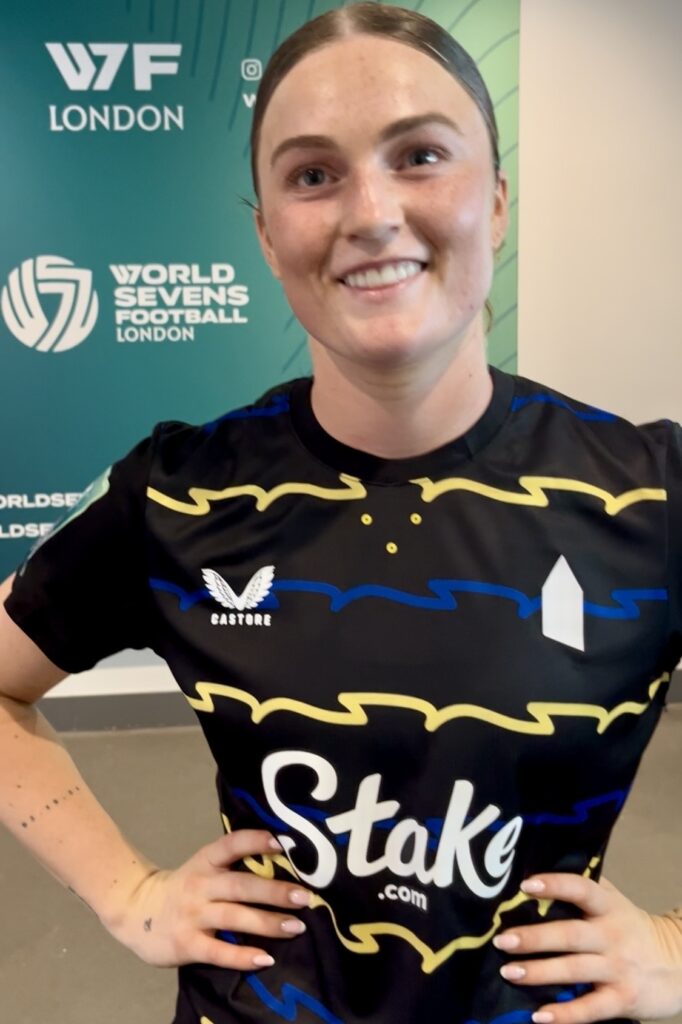
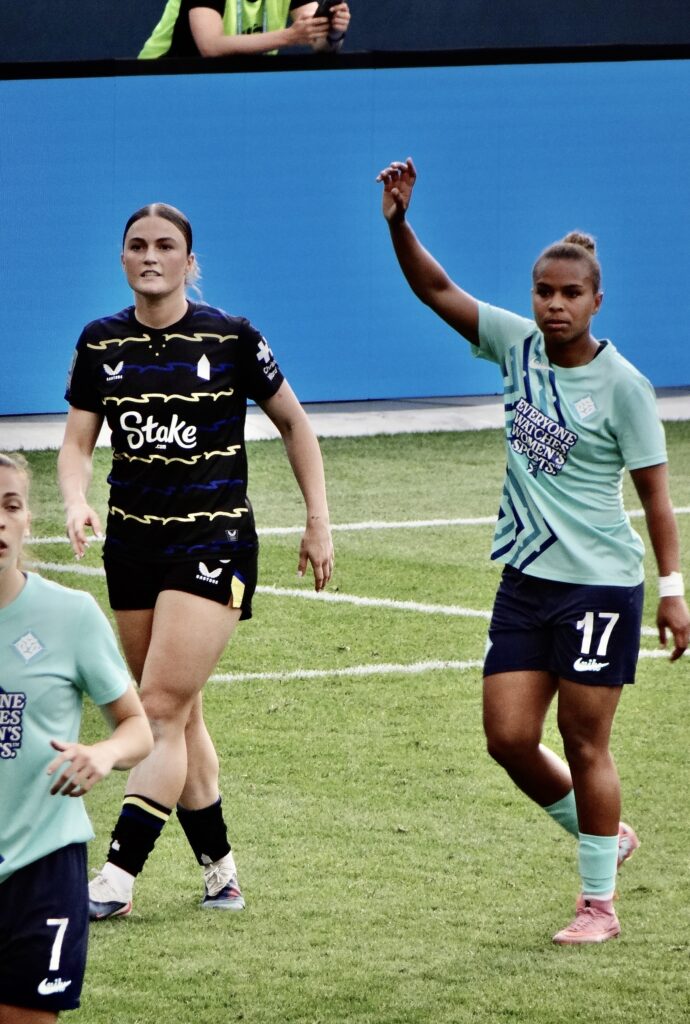
One of my favourite WSL players, Ruby Mace (below, left), seems tailor-made for World Sevens, and she threw herself into all the Everton matches.
“I’m absolutely sweating right now,” she said. “But it’s so much fun. It’s different to what we normally do and it’s a great way to end the season.”
I also noticed that she always seemed to be on the far side of the pitch when any substitutions looked imminent and wondered if this was deliberate or pure coincidence.
Mace laughed: “Maybe that was tactical! Sometimes you’re so in the moment that you just want to play football and you’re not used to coming off every two minutes. But sometimes you just have to take one for the team to make the team more fresh.”
HEAD COACH, SCOTT PHELAN
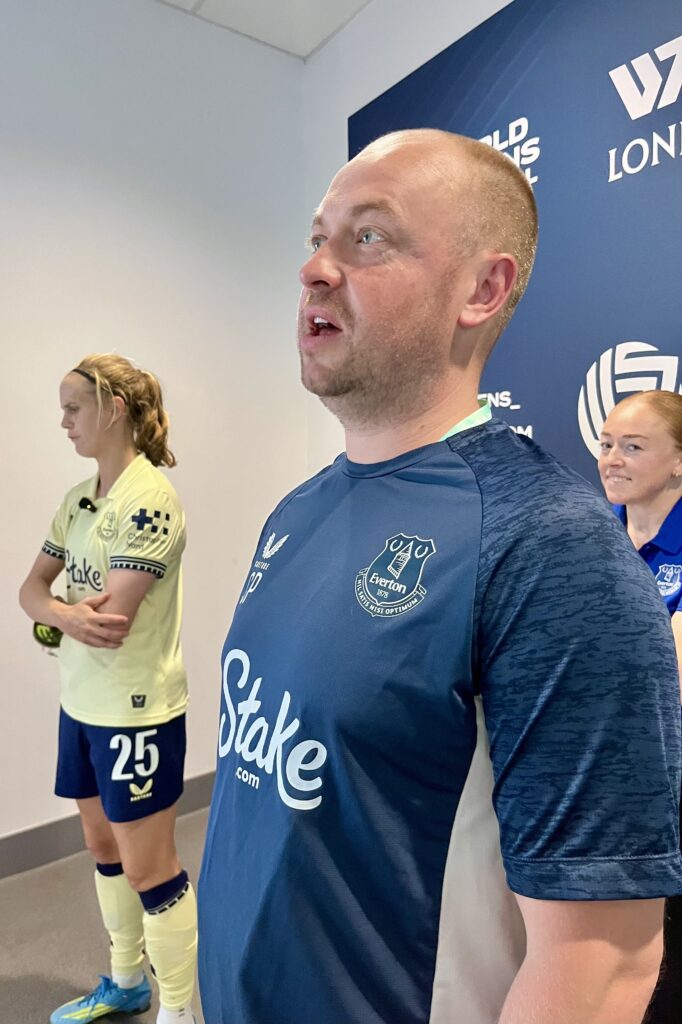
For Everton head coach Scott Phelan (above, right) everything was positive throughout. “Even the first game, even though we lost in terms of the score, the energy inside the stadium and the concept is amazing in terms of an idea.”
Tactically, Phelan admitted it was a challenge. “It’s hard with the amount of rotation in and out of the pitch to keep the tactics clean.
“Actually we just want to be sensible with our decision making. We have players in the right areas that they’re comfortable and we try and make decisions from there. And the girls have been able to execute that really well so far.”
Phelan was aware of Mace making it harder to sub her off and quipped: “I think I would as well if I was a player. I’d be playing in the furthest corner away from the substitutes area.
“The girls just want to play and that is the point of this competition. It brings back a purity that maybe the league takes away at times. The players are allowed to express themselves more than normal and it’s been really nice to see that.”
For Phelan, this tournament was a reminder of why they all do it. “We all started football for the reason, probably because we love the sport, and that can get taken away when you add extra pressure and consequence of a bad performance.
“And this has definitely not got that feeling about it. It’s been really good to see our girls express themselves. I think everybody’s enjoying it. We’re really happy we made the decision to come here.”

KATJA SNOEIJS
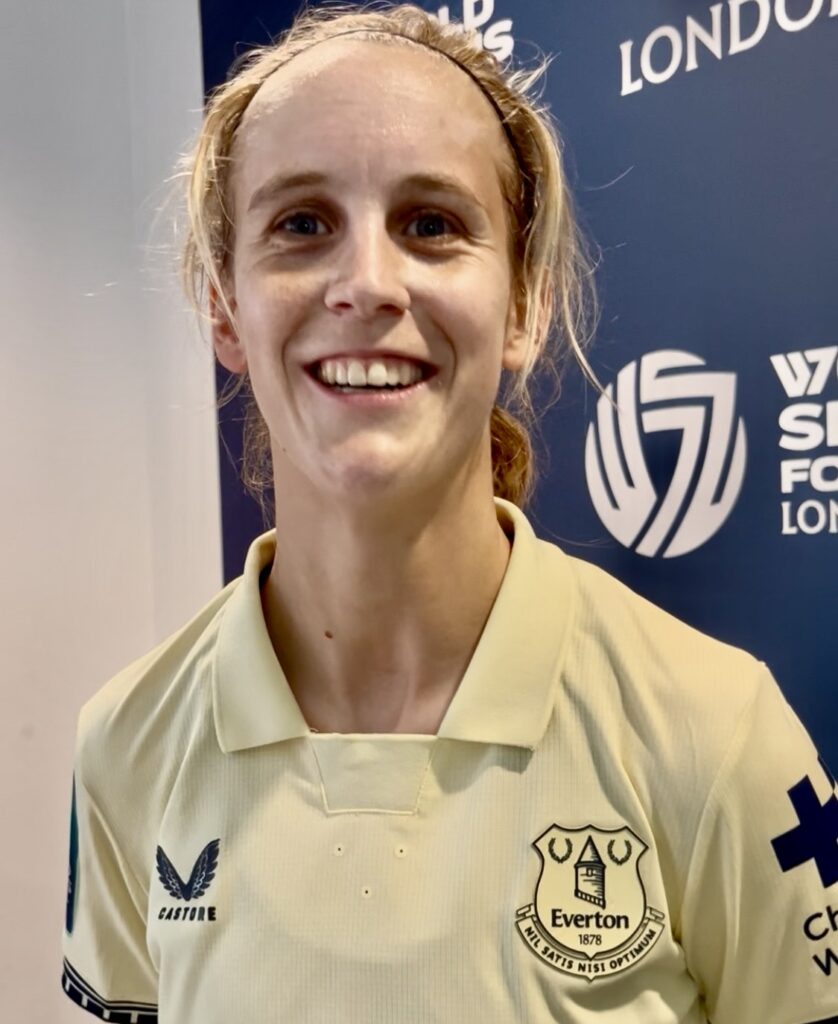
Sporting a wide, Cheshire cat grin, Katja Snoeijs gave her verdict as ‘ten out of ten’ for Everton’s 8-2 win over Leicester. But for her, the highlight of the tournament was actually something the rest of us didn’t get to see, the bus ride to the stadium and back.
“That’s when we really hype up,” she said, adding, “Also the games, but we have a really enjoyable team, we have a lot of energy. In those little moments, it’s so fun to be part of this team.”
Like her head coach, Snoeijs says Everton “showed in the first game that we could compete against a team like Chelsea. This also gives us a lot of confidence in the way we play. It’s also a weird game and hard to predict. Anything can happen in 30 minutes!”
Loan star Hannah Blundell has risen from the dead aka joined permanently from Man Utd.
Katja Snoeijs is now at Ajax.
Kelly Gago has moved to West Ham.
LEICESTER CITY
REPORT CARD: good start, then faded!
WALKOUTS: nothing noteworthy.
MATCHES: beat LCL 2-1 (with Nelly Las the player of the match); lost 3-1 to Chelsea: lost 8-2 to Everton.
IN THEIR OWN WORDS:
NELLY LAS
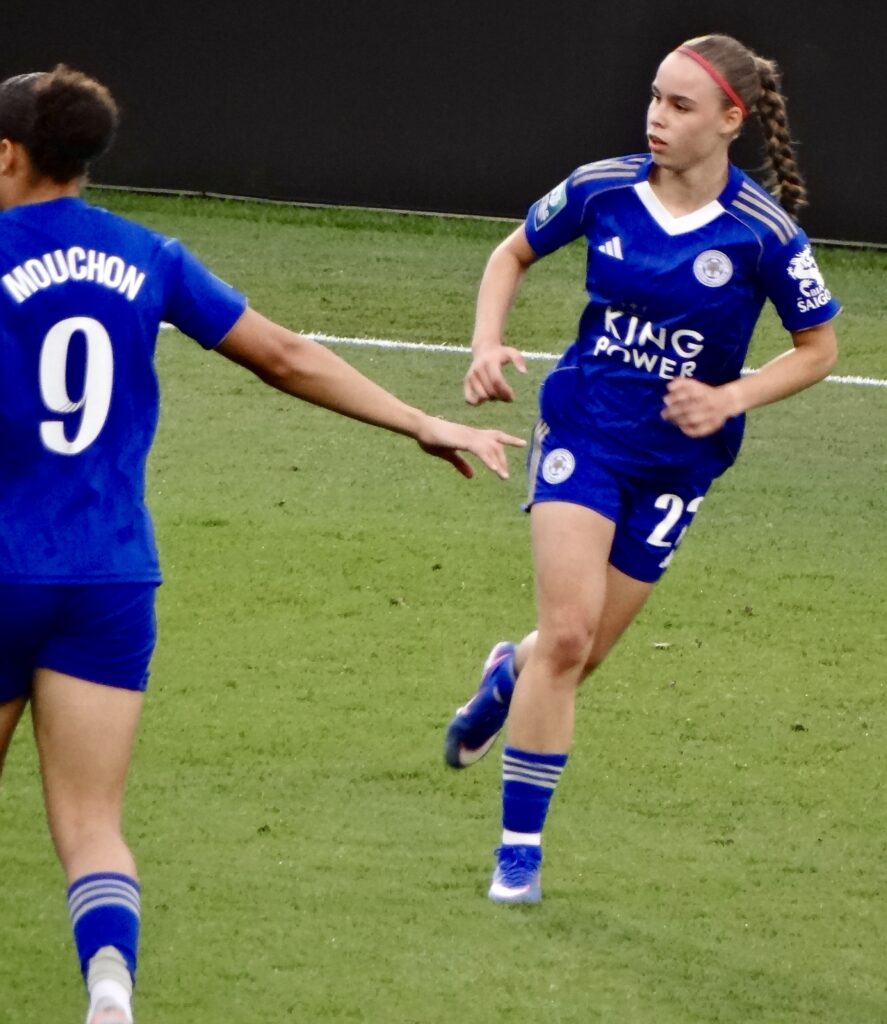
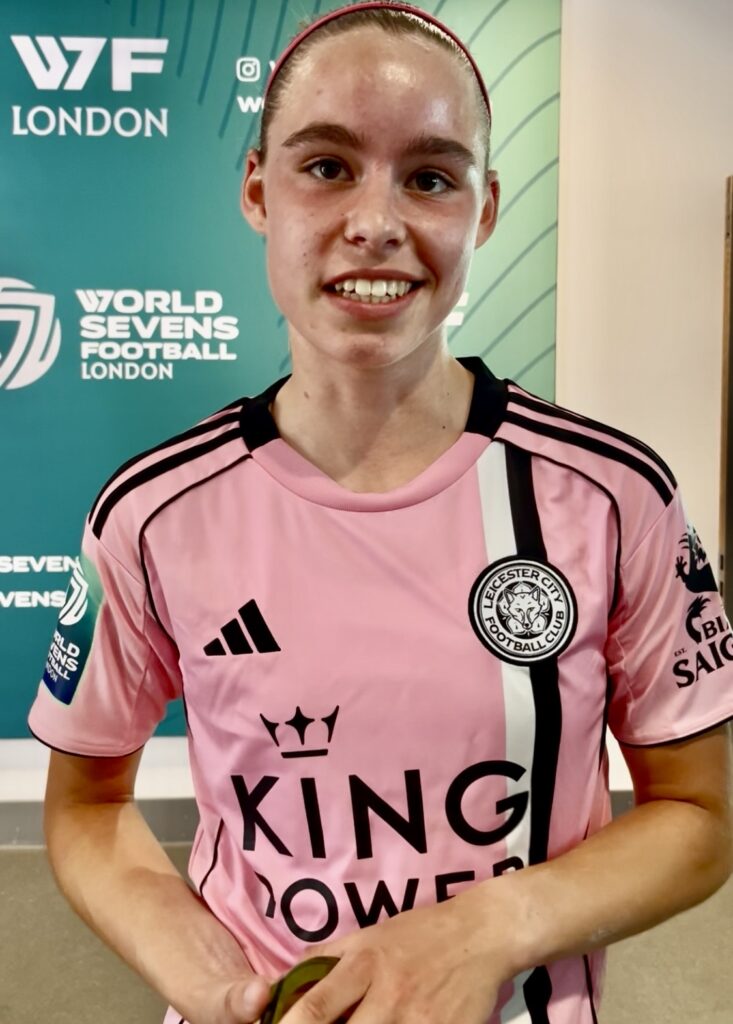
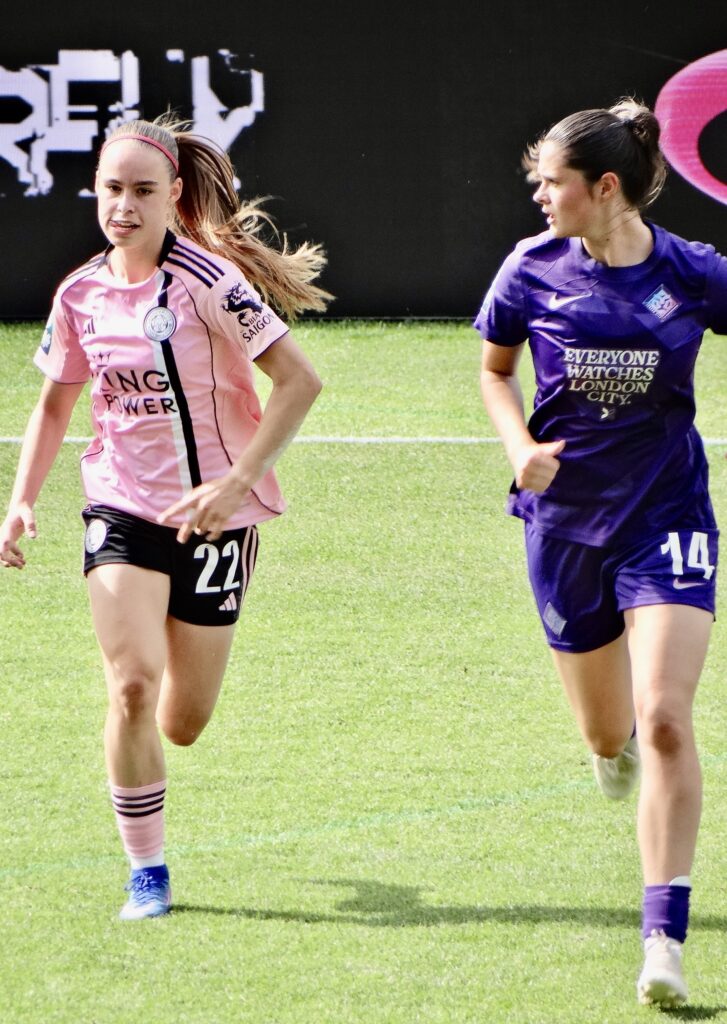
Just 18 years old, Nelly Las (below, left) impressed across the tournament, in a Leicester City team intent on just going out to express themselves. “We didn’t really have a main tactic,” she said. “It was just to go out, have fun and play our football, show ourselves. And it was really fun. A great experience.”
HEAD COACH RICK PASSMOOR
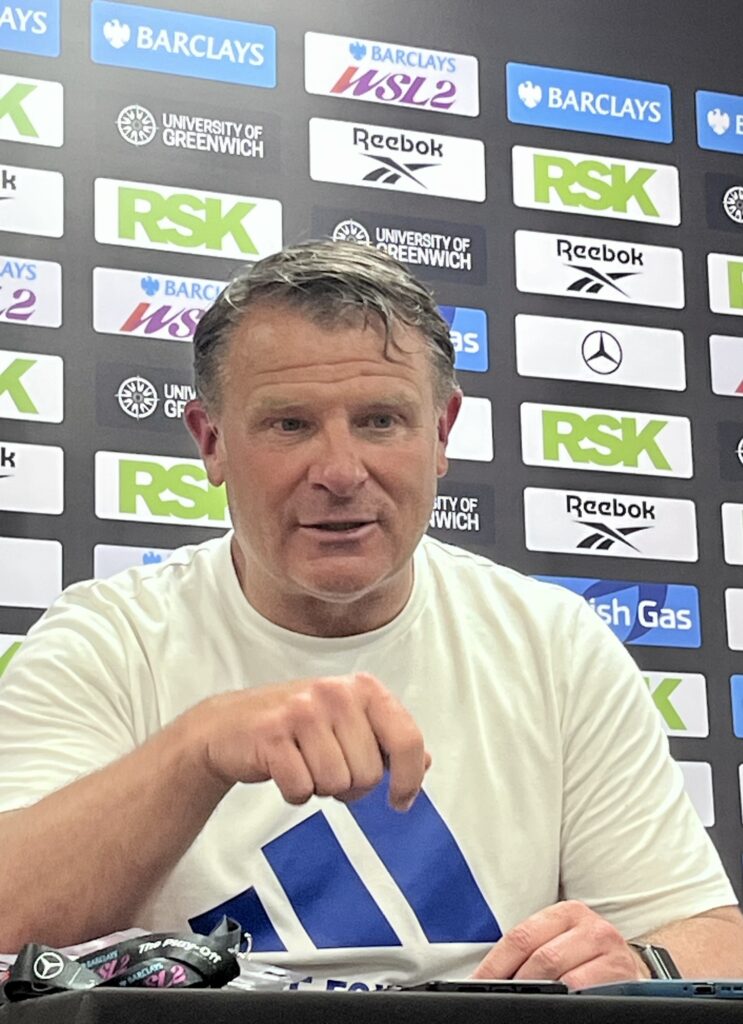
Having just suffered defeat and relegation in the Foxes’ playoff match the previous weekend, head coach Rick Passmoor (above, right) couldn’t really see this as a bounce back from that, because they were still processing their understandable frustration and disappointment.
“It’s one little last go,’ he said of this competition. “To put a smile on your face. Put a smile on the fans’ faces. We’ve got incredible fans and they’ll be coming down again today and tomorrow. So it’s a great opportunity for them to go back to their roots of the team.”
For Passmoor, this was exactly what they needed and what Leicester were there for. “Playing football, enjoying the occasion and the atmosphere, the DJ, even the old guys having a little bit of a swing round. Great, great product, really enjoying it.”
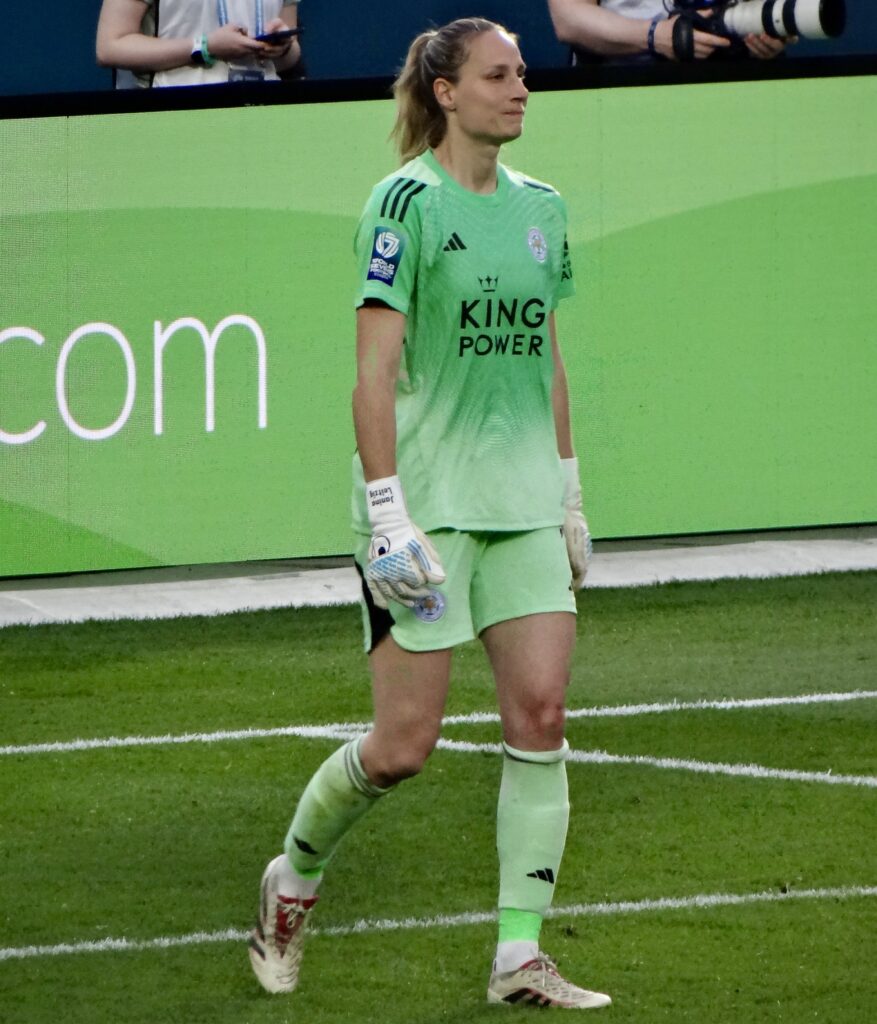
Leicester have lost iconic keeper Janina Leitzig to Man Utd.
Teen star Nelly Las has moved to Chelsea.
Several others have moved to Everton. And Charlton.
LONDON CITY LIONESSES
REPORT CARD: no wins, much entertainment!
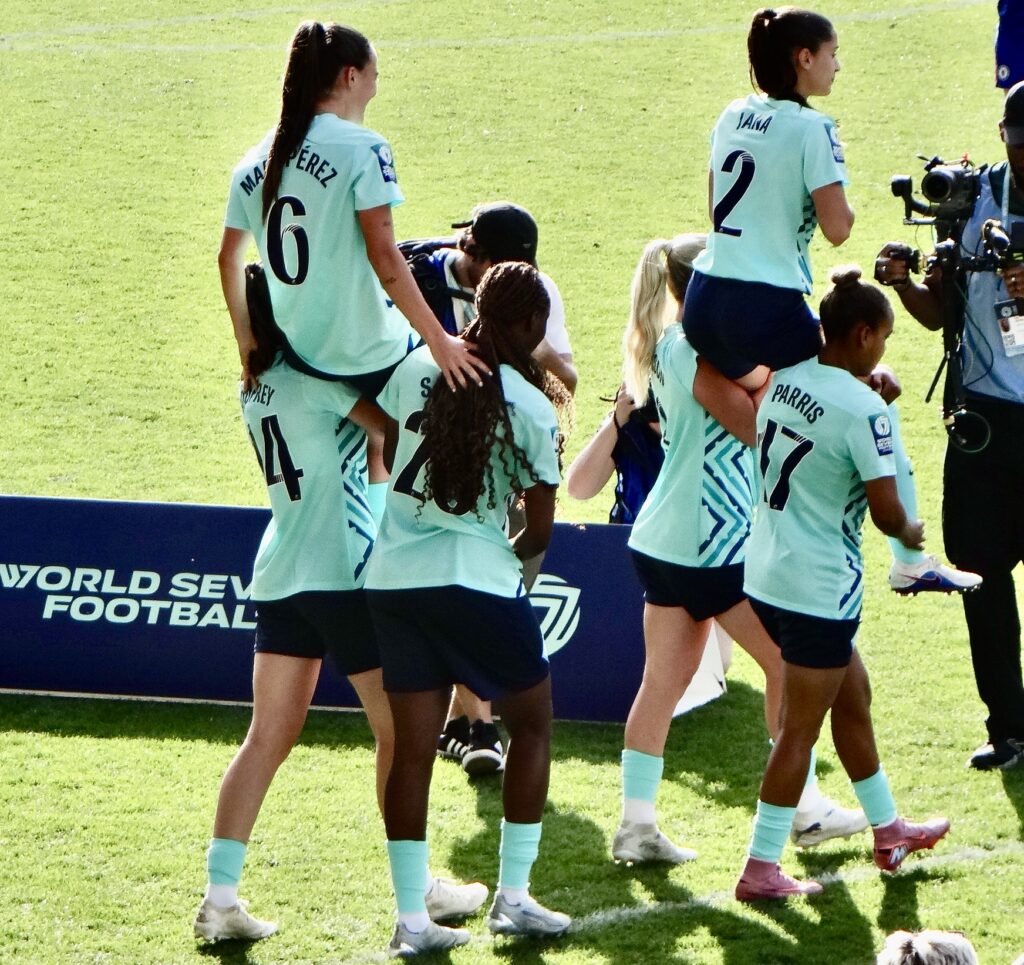
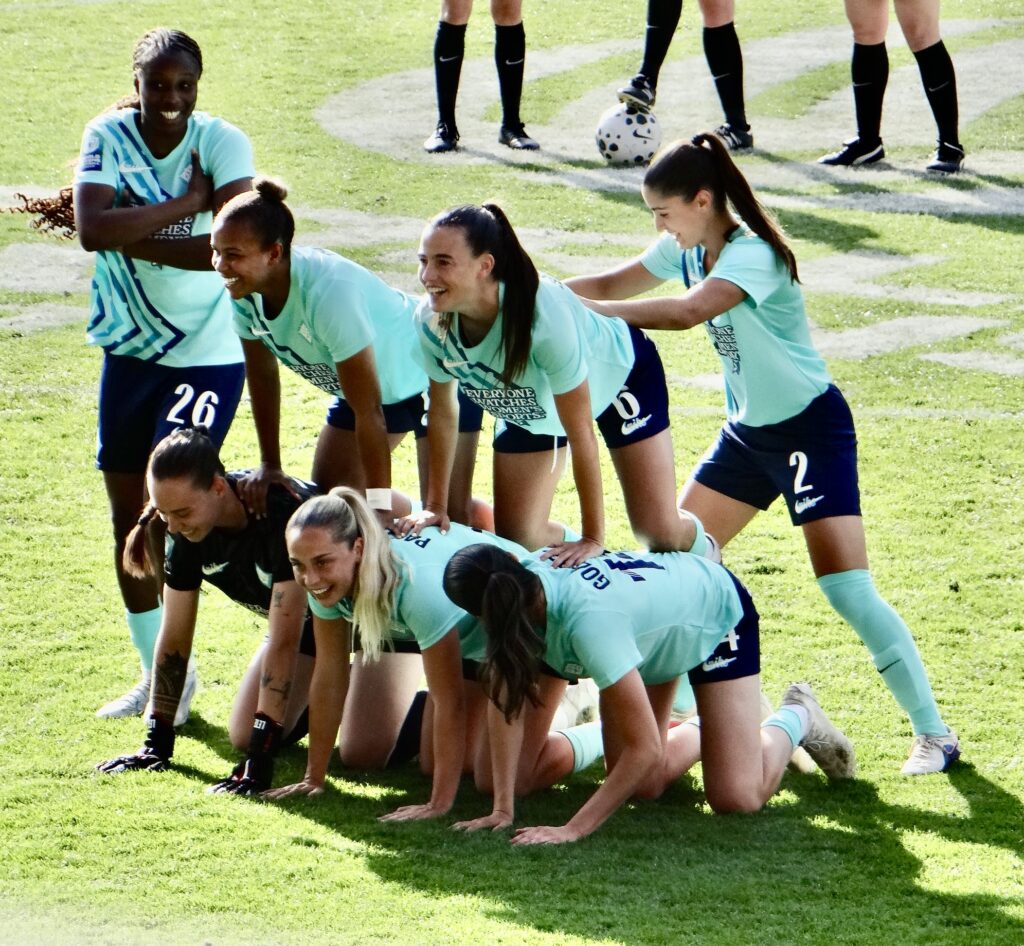
WALKOUTS: highlight was a three-layered pyramid that almost succeeded, with Jana Fernandez just chickening out of clambering atop her teammates at the very last moment. They also had a dancing flashmob positioned above one goalmouth.
MATCHES: Lost to Leicester 2-1; lost to Everton 2-1; lost to Chelsea 5-2, (with all their goals shared around the team).
IN THEIR OWN WORDS:
DELPHINE CASCARINO
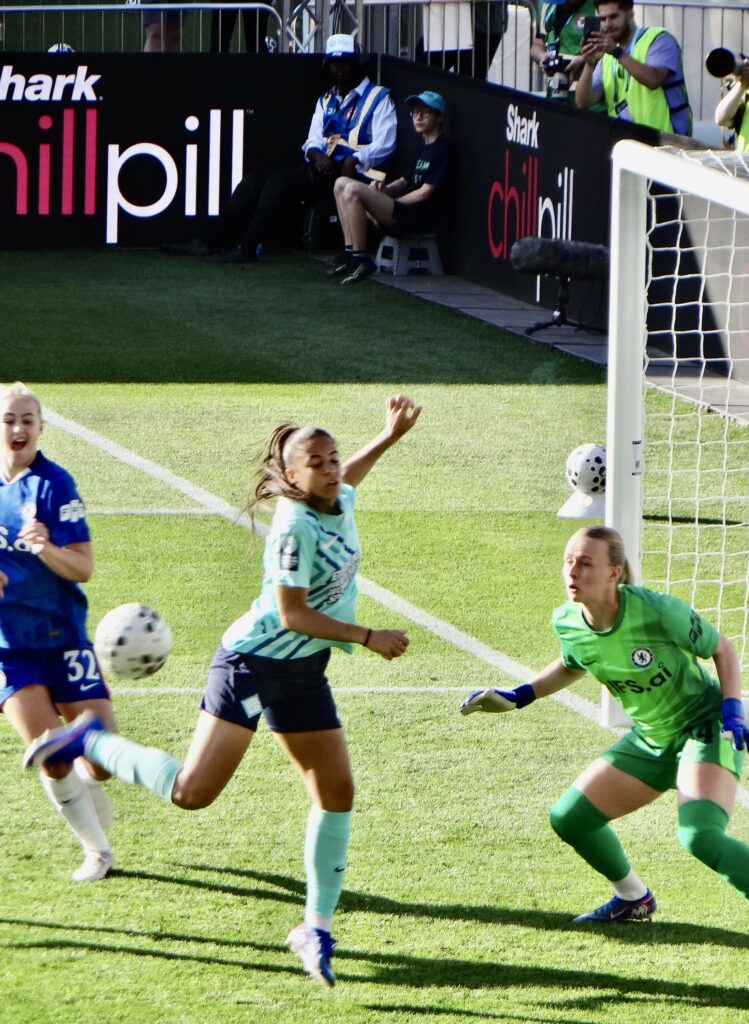
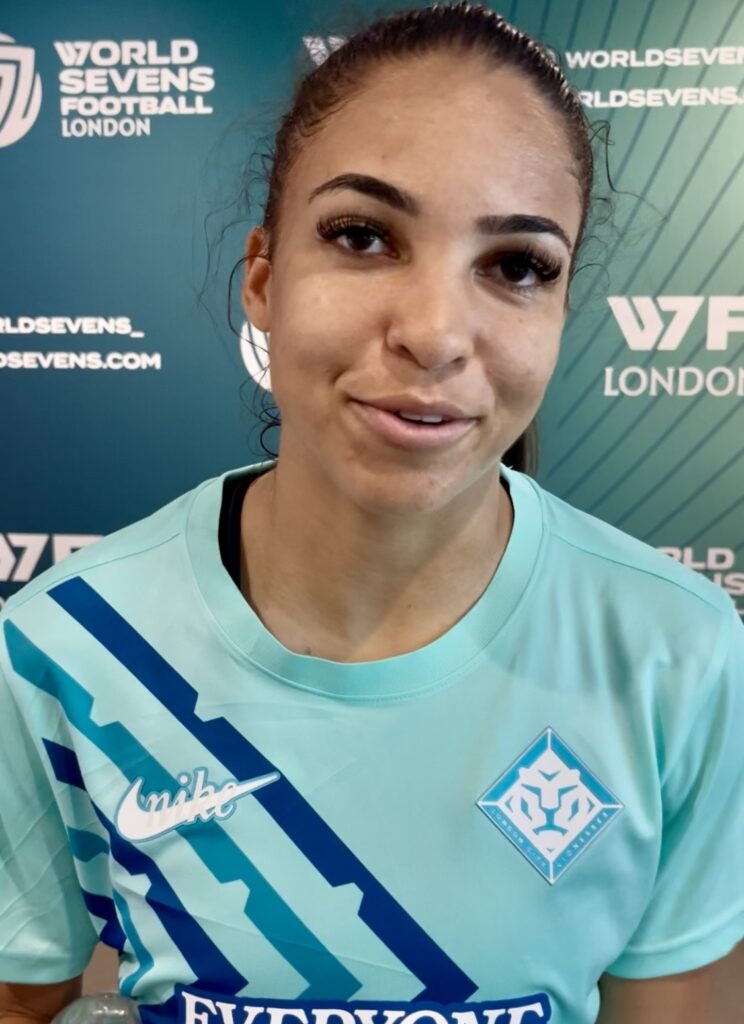
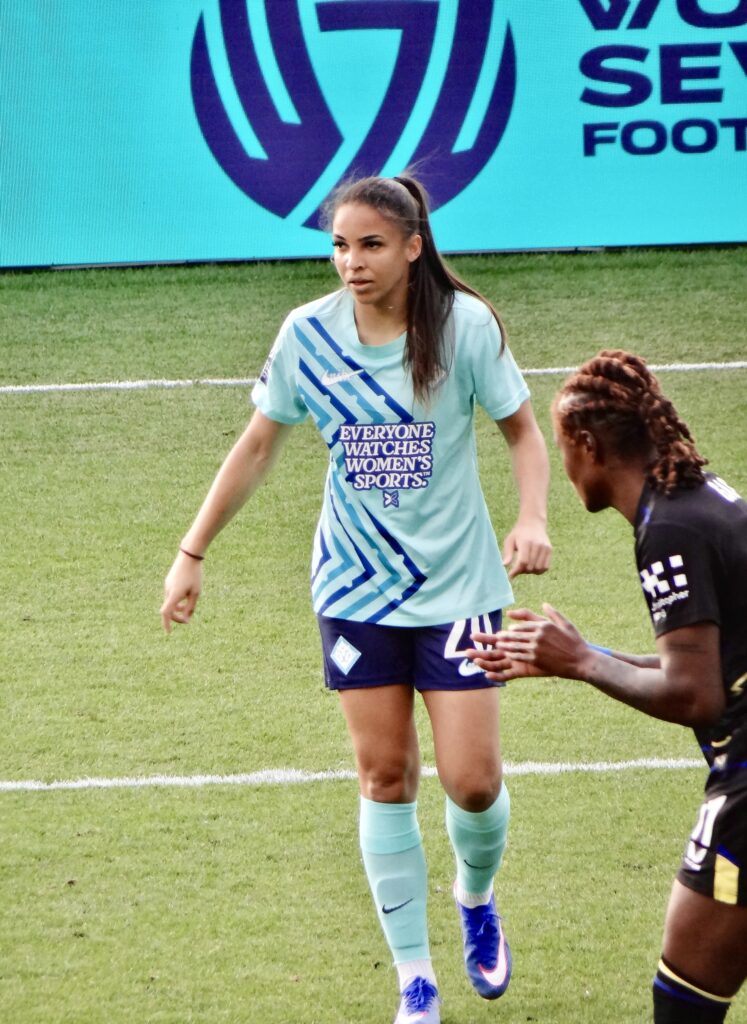
It was quite frankly surreal trying to talk to London City’s stepover queen Delphine Cascarino (above) after their loss to Everton, with the victors meanwhile singing loudly behind her as they left triumphantly. I was eager to know how much she had enjoyed it nevertheless.
“Not much fun, because we lost, twice. But when the team scored, that was fun,” she said. But reflecting on the whole experience, she added: “It’s really good vibes, a lot of fans today for us, so with the nice weather, nice stadium, we can just enjoy the tournament.”
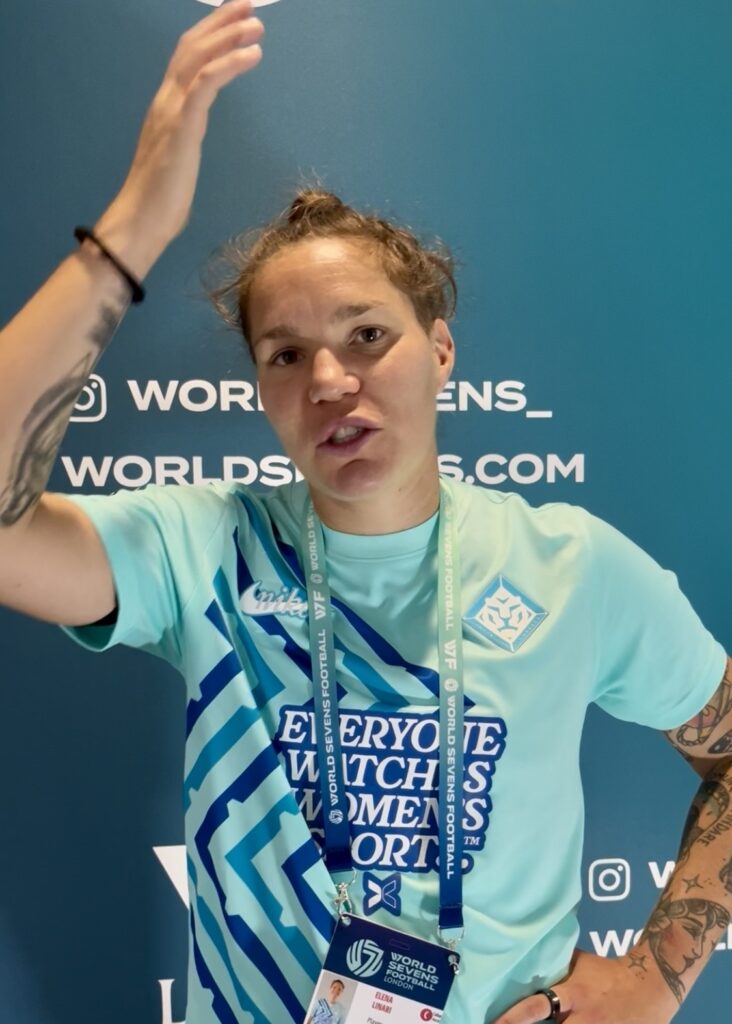
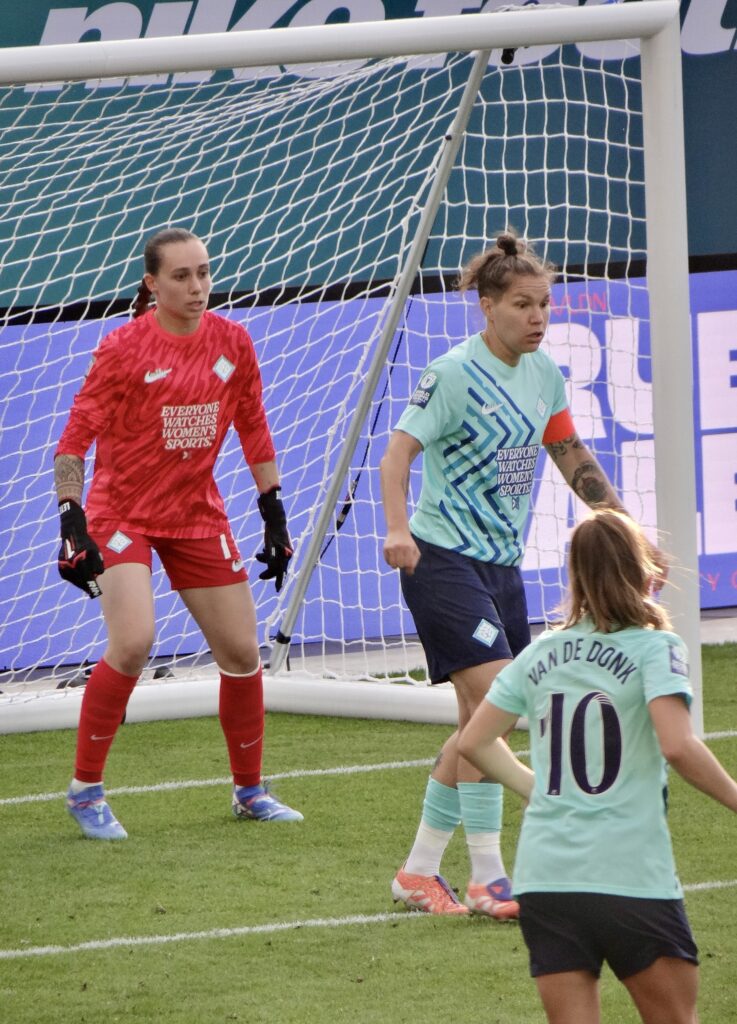
ELENA LINARI
For Italian defender Elena Linari (below), it was fun because it was completely different to all the experiences she’s ever had. Obviously she wasn’t happy that they lost all their games, but said that because it’s the end of the season “you can take it easy, you can lose, win, whatever, but the main part is to enjoy.”
Linari also reckons that the Sevens idea might be better if it was slightly rescheduled. “Why not do it in pre-season and make it more competitive, where players are enjoying it and having fun – but at the same time also training a bit more, taking it more seriously… or maybe in a good moment in the season?”
Having played across various countries, Linari noticed straightaway that World Sevens is “very American, with the music and everything.” But she could definitely see the benefit of more engagement with supporters, as well as the walkouts. “The entrance part has been very nice. Sometimes when you are entering the pitch before the game you are serious. You’re already thinking in the game and in this way you can enjoy it a little bit more.”

HEAD COACH EDER MAESTRE
For their head coach, Eder Maestre, there was only one rule for this tournament: having fun.
“We wanted to create more freedom for the players, trying to connect more with the child that one day we were.”
This also meant he could watch his centre backs play as strikers and vice versa. “Transitions could appear every time. And I really like transitional matches.”
What surprised him most was that all the teams came with a “very demanding mindset”. He could feel it when watching the opening match, Everton v Chelsea, and said that some of his players observed: “they look that they are not having so much fun, they are really committed. They are playing tough.”
So Maestre reiterated that it didn’t matter what the other teams were doing, he wanted his players to remember their first rule: “We can win or lose, but if we don’t have fun today, we lose.”
MAN UNITED
REPORT CARD: bridesmaids yet again!
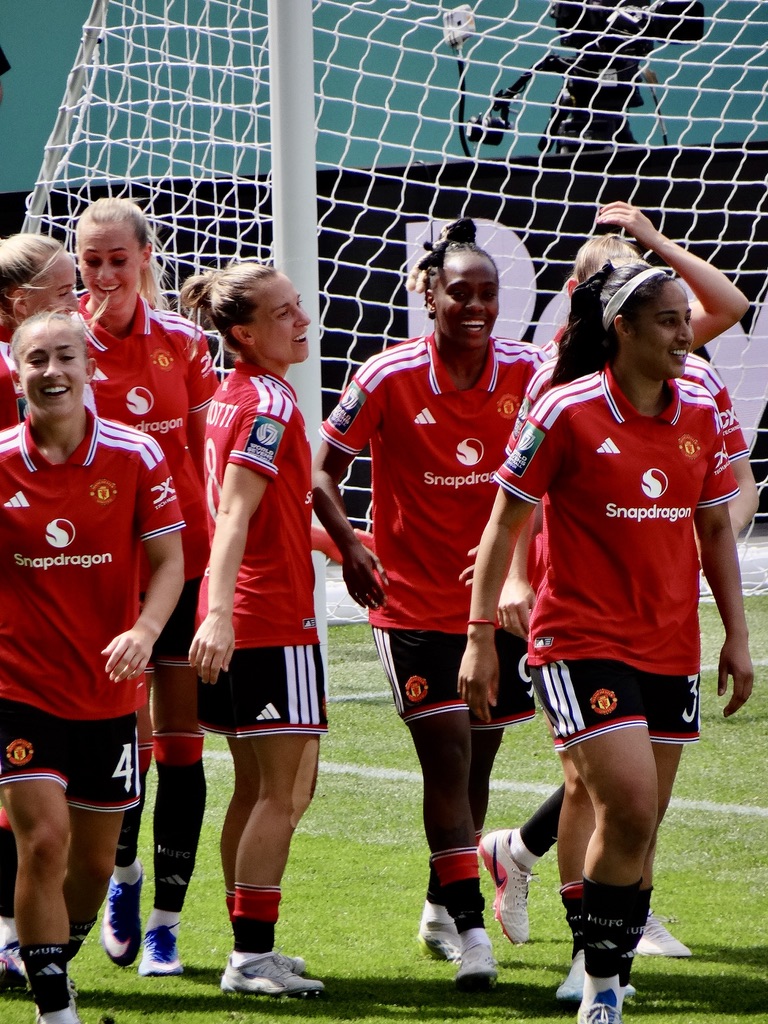
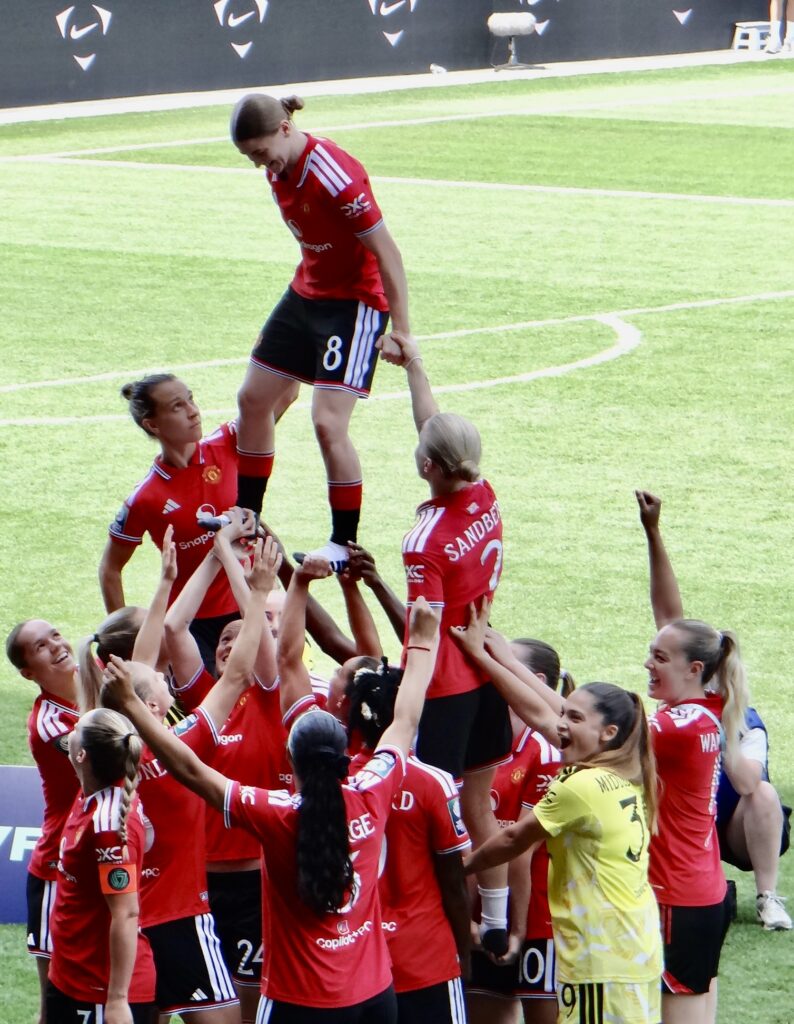
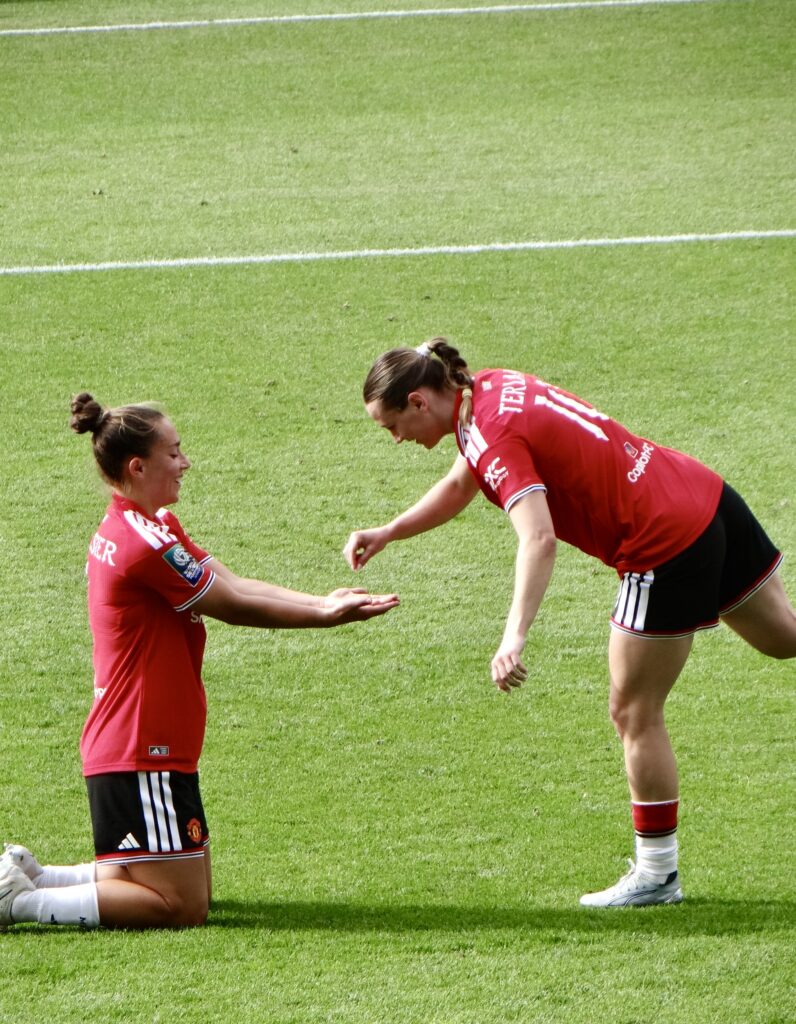
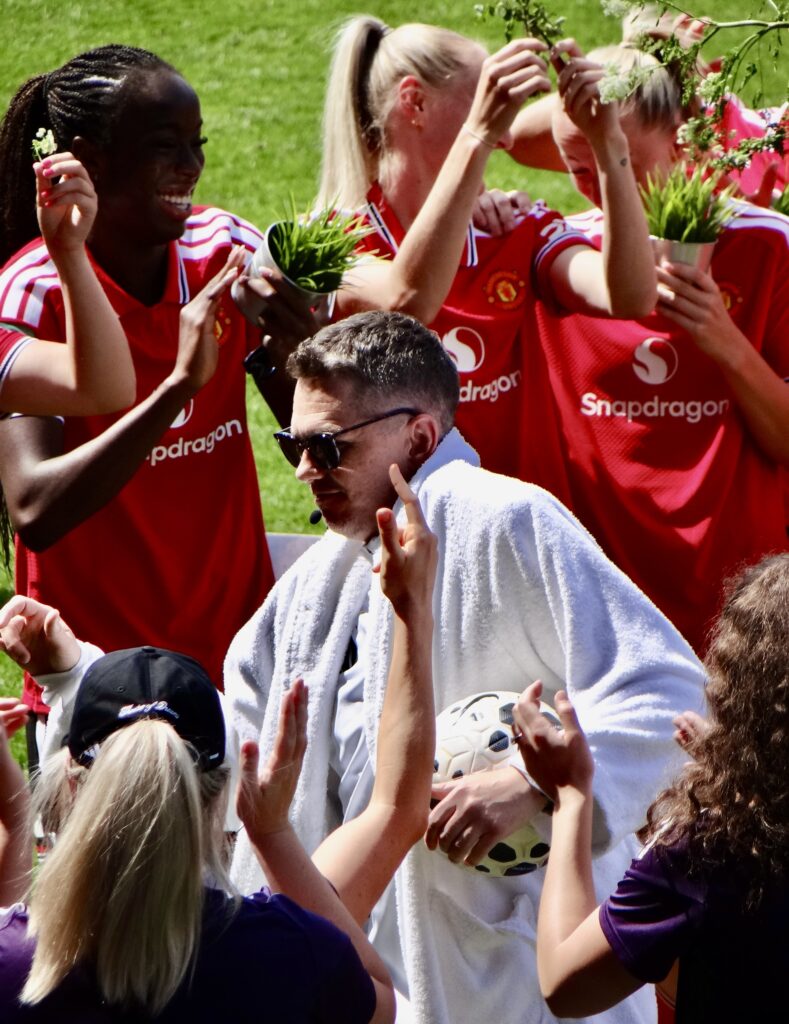
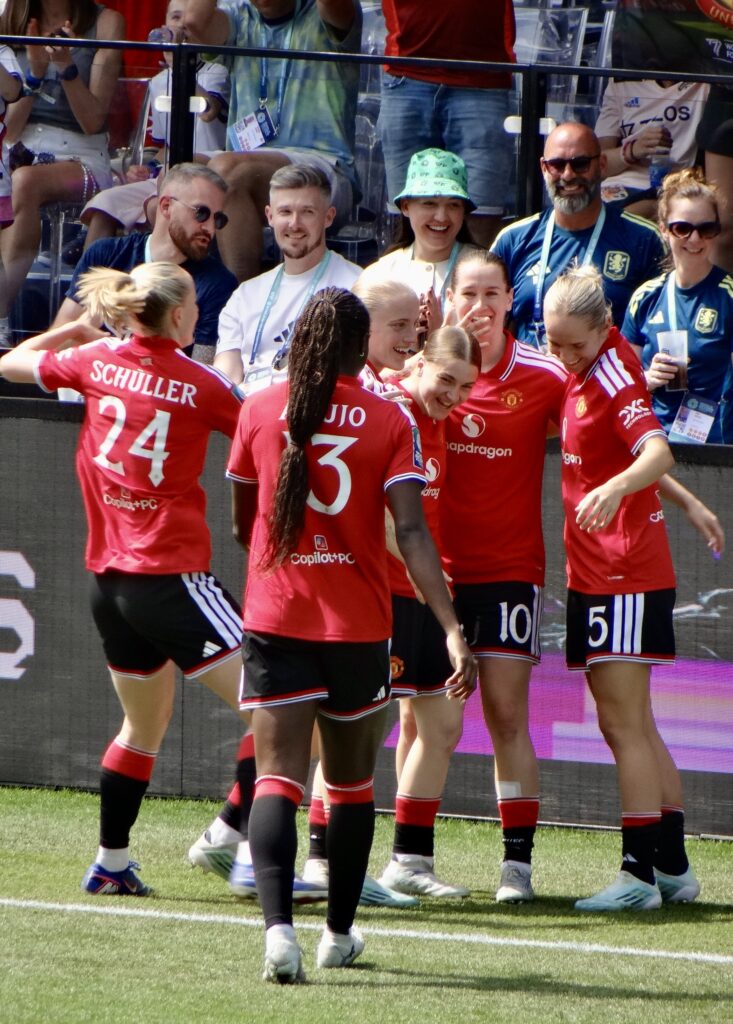
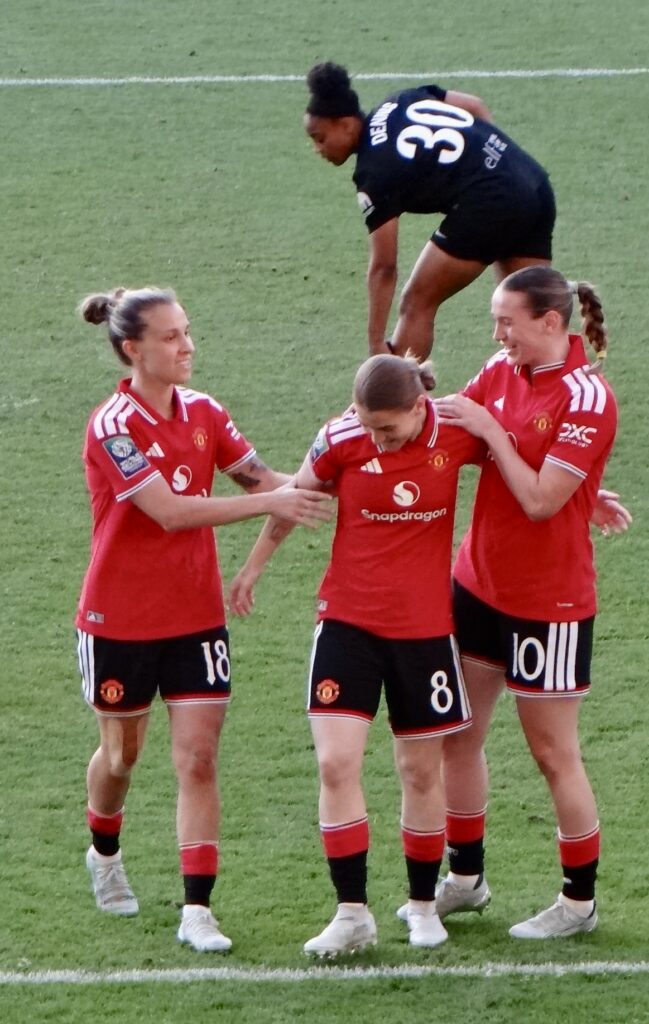
WALKOUTS: chucking Melvine Malard in the air, Jess Park hoisted to the top of a human pyramid, Marc Skinner doing his ‘Bad Bunny at the Superbowl’ walkout. And they had some of the best goal celebrations too (lots of practice with 27 goals)!
MATCHES: beat West Ham 5-4 (with Elisabeth Terland scoring a hat-trick); beat Villa 4-0; beat Spurs 8-2 (with Jess Park getting a hat-trick. Semi-final: beat Everton 5-2 (with Simi Awujo scoring twice). Final: lost excruciatingly to Chelsea 6-5 in the last seconds (Park getting another brace).
IN THEIR OWN WORDS:
MELVINE MALARD
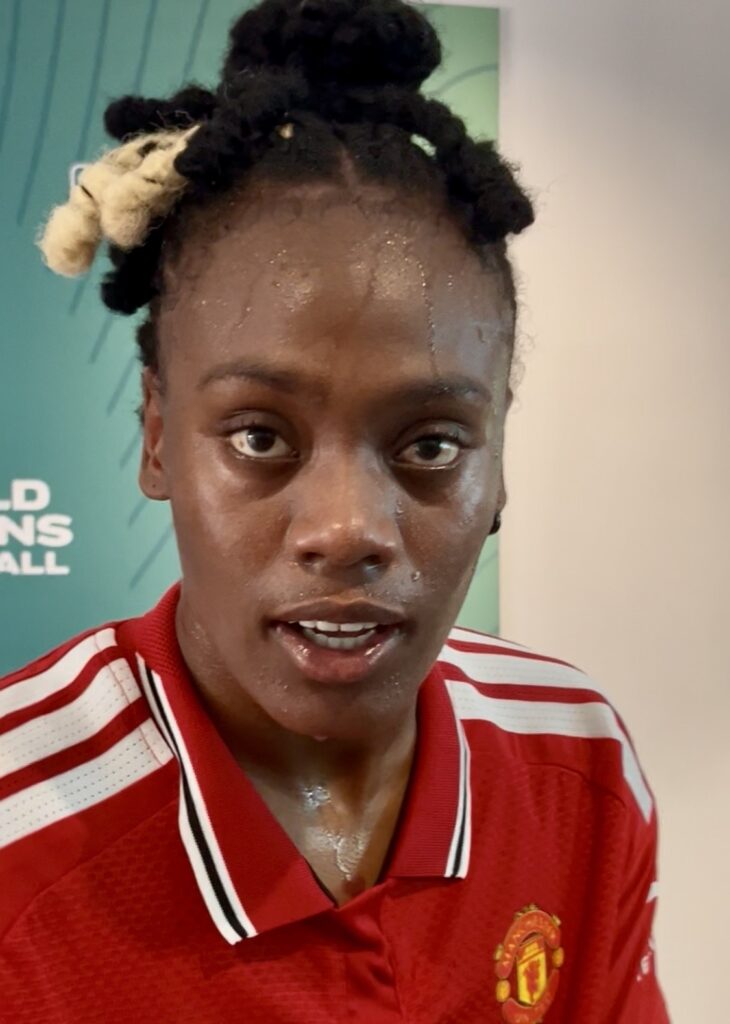
Perhaps the player most looking forward to the Sevens was Melvine Malard (below, left). She’d thrown herself into last year’s inaugural tournament in Portugal and she was ready to go again.
For Malard, it was all about freedom to express themselves, and she was clearly in her element. “When I score, also when we have the ball we can do what we want.
“No instruction, no tactic, no offside, so we don’t think about the teammates, just us, and that is good.”
JESS PARK
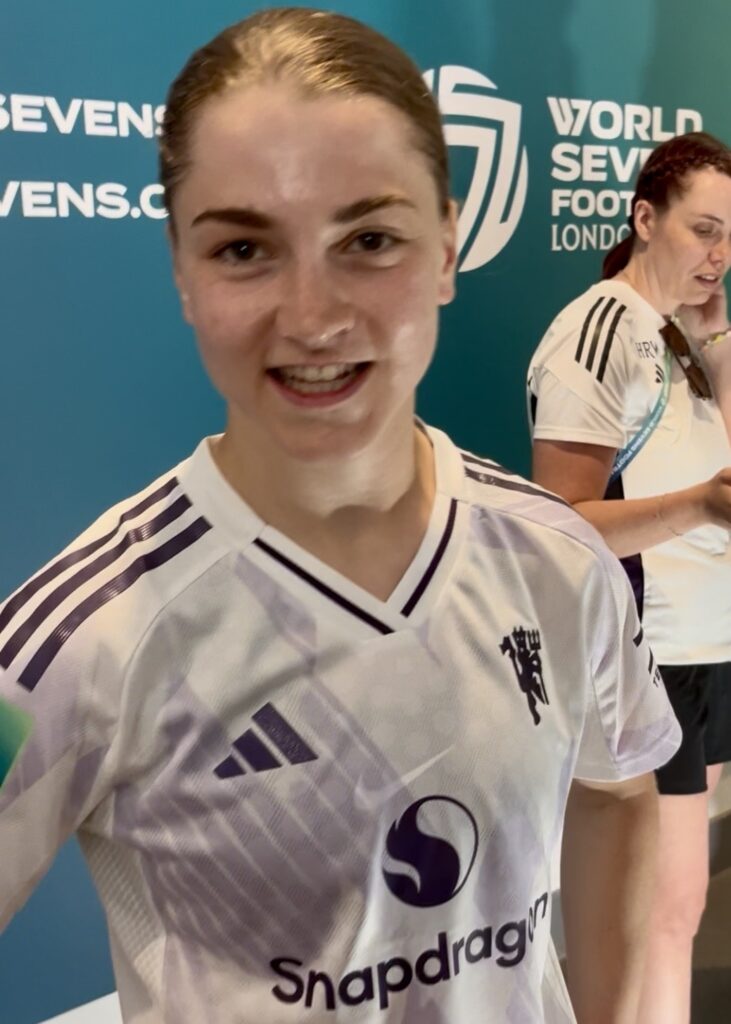
The always impressive box-to-box midfielder Jess Park (above, right) seems equally custom-made for World Sevens and said that herself and Malard suit the format because “We love playing 1v1 games, you know, when you’re facing up a player with those sort of skills, you like to take them on, dribble and drive and shoot. And I think that’s our game.”
For Park the bonus was “playing as a team with a smile on our face. Just enjoying it”.
ELISABETH TERLAND
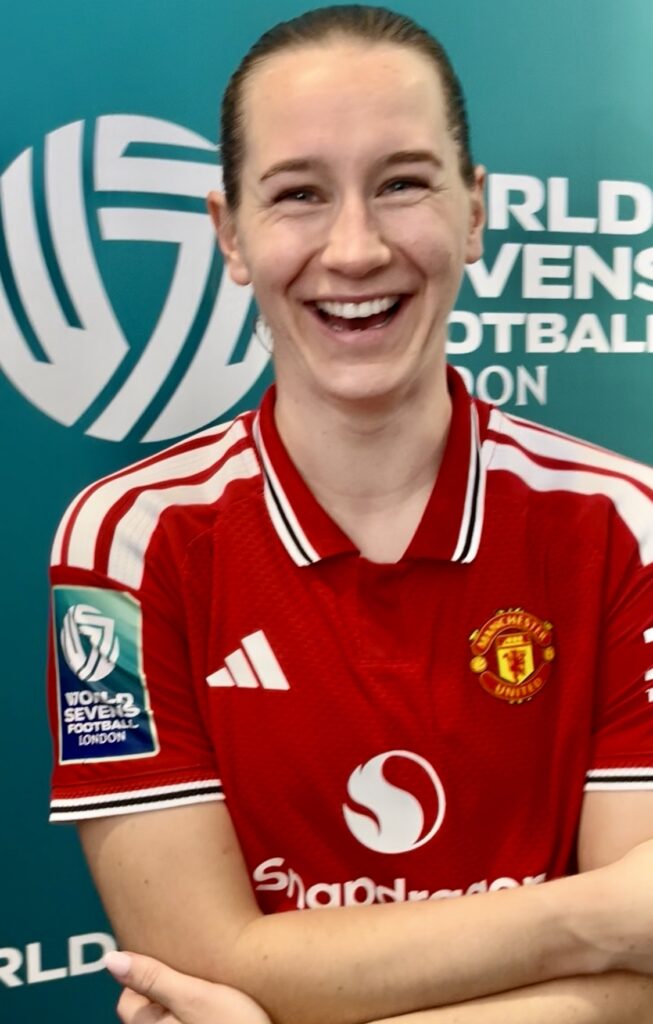
Similarly, striker Elisabeth Terland (below, left) reckoned a tournament like this shows how much they love each other as a team and how much togetherness they have.
“We love to play together and that’s something we obviously bring every week in the league as well. And we can still think about and feel the importance of that.”

HEAD COACH MARC SKINNER
The United head coach, Marc Skinner (above, right, in Stone Roses kit) agreed that this tournament was mad. “Exactly, it’s chaos!”
He compared it to a basketball match, and noted: “It feels as if the intent of this is to score, not just to sit and defend. You’ve seen second half, you know, 5-4 game (v West Ham). I just love that.
“I love the fact you can let loose a little bit,” he added. “And credit to the players, I just give them reins to do that.
“You know what else it helps?” he ruminated, “People don’t understand the communication and the fast pace. You can’t use it in the WSL. There’s too much on it for them to really grasp that. But here, I think those are real key differences.”
Melvine Malard has moved to Chelsea.
Millie Turner and Lisa Naalsund have moved to Birmingham.
Gabby George is now at Brighton.
And Marc Skinner has parted ways with Man United.
SPURS
REPORT CARD: tough start, bold tactics!
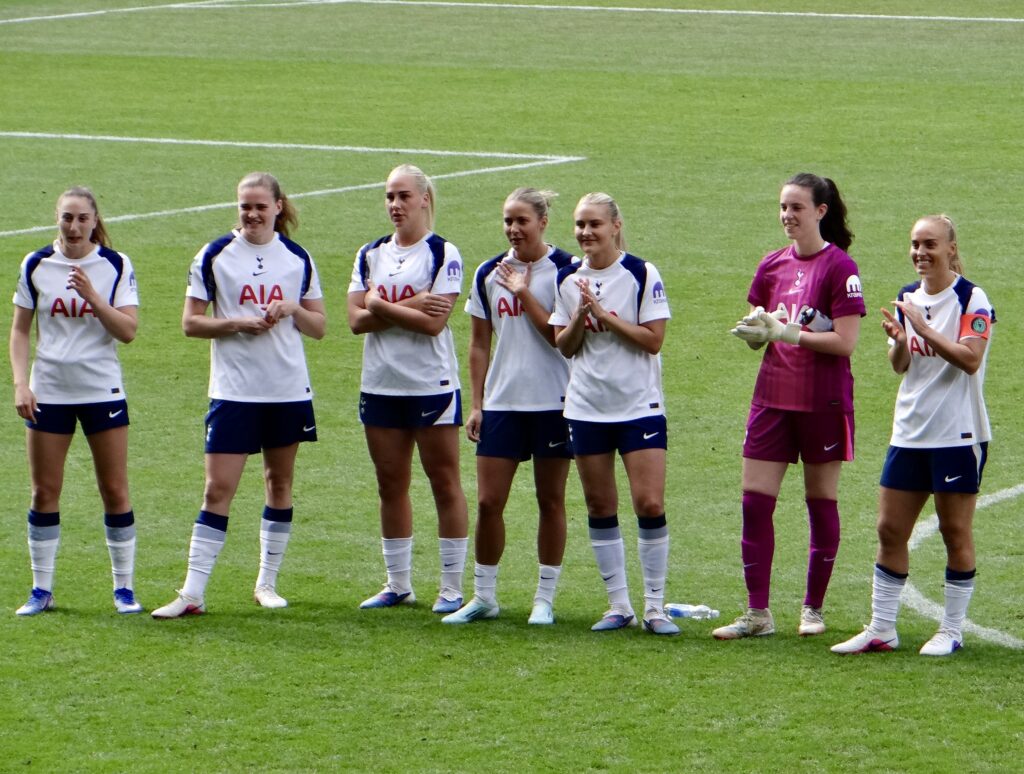
WALKOUTS: best one was the boxing bout between Olivia Holdt and Cathinka Tandberg, with real boxing gloves and Molly Bartrip as the ref. But it was the blend of senior and academy players that really caught the eye when they entered the pitch.
MATCHES: Lost 6-3 to Villa (with Amanda Nildén getting two goals); beat West Ham 4-1; lost 8-2 to Man Utd.
IN THEIR OWN WORDS:
CATHINKA TANDBERG
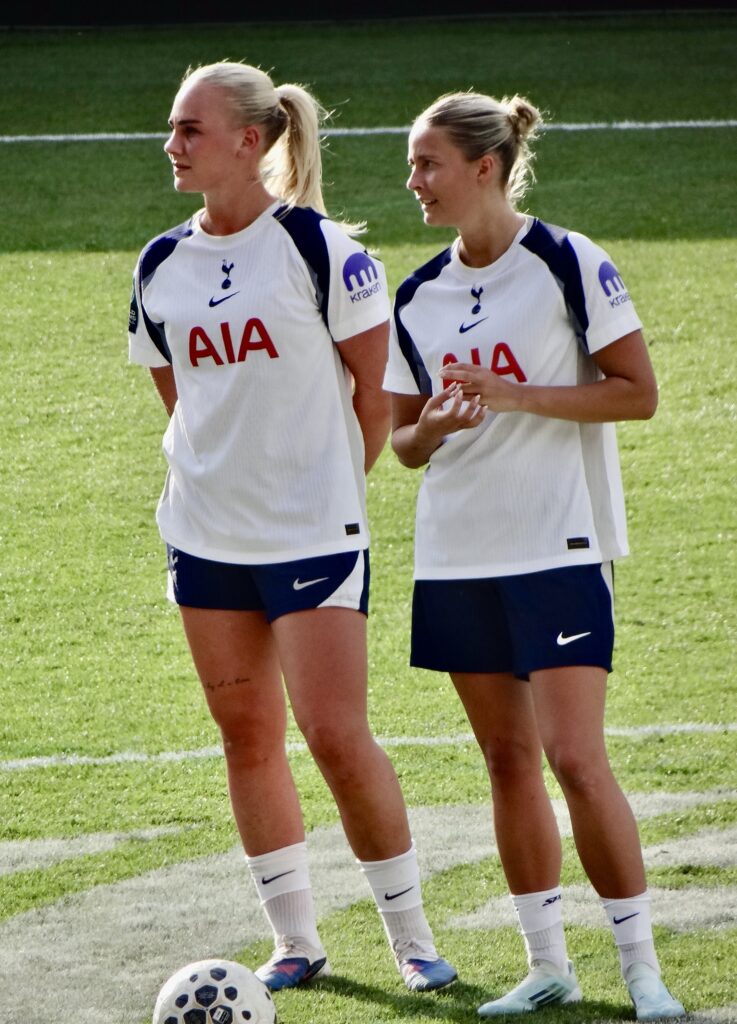
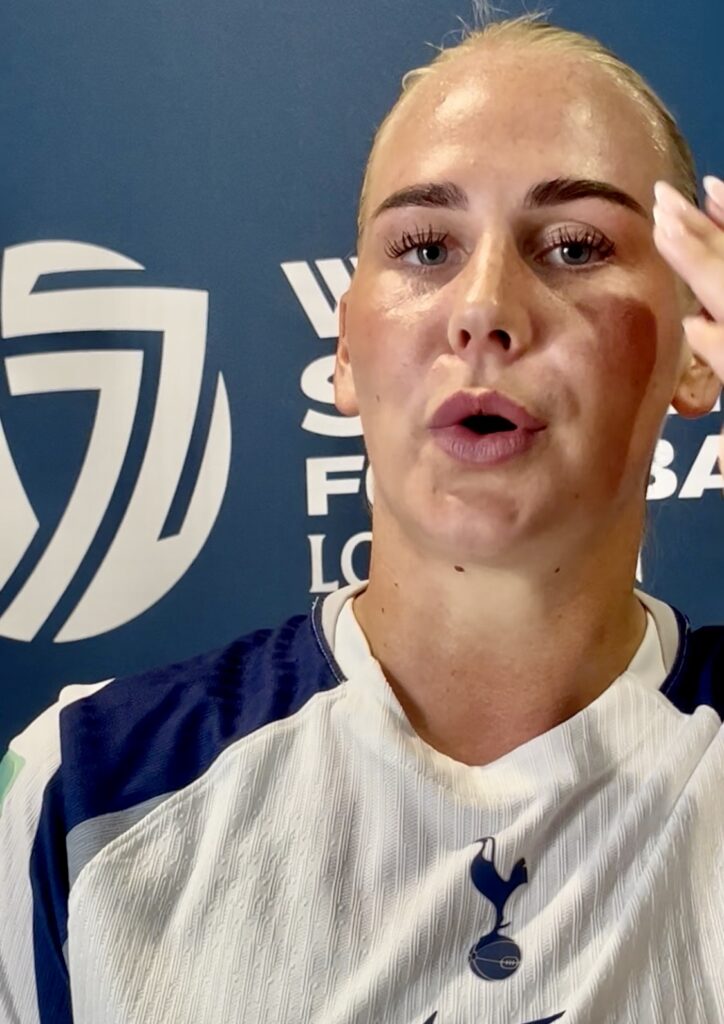
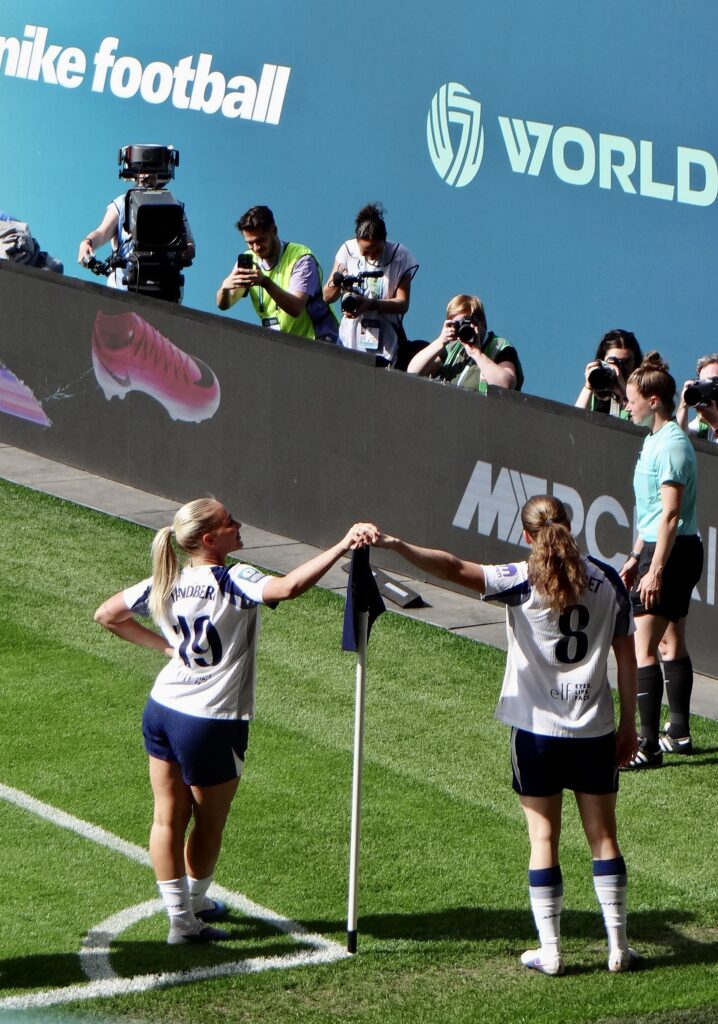
Main topic of conversation with Spurs players and their coach was the unique approach to their Sevens squad. They were literally the only team fielding their academy players. So I asked striker Cathinka Tandberg (above) how it worked.
She explained that they had eight senior players and eight academy players, and tried to “have a player you swap with all the time, so it’s easy to remember, instead of changing round all the time.”
They had spent the previous week training 7v7 with everyone, just getting used to it. And Tandberg emphasised that “everyone needs to play, and we need every player.”
As for their playing style, I noticed that this shifted on the second day and became more direct and one-touch. Tandberg agreed. “Yeah, that’s how we play in general. Yesterday we maybe tried to do something else and tried to change a lot.
“But as you can see, we can play our style and if we just play with freedom, then we know we are good players – and we can win and we can score good goals. I think it’s a lot about freedom and being ourselves.”
RANIA OUKRISS
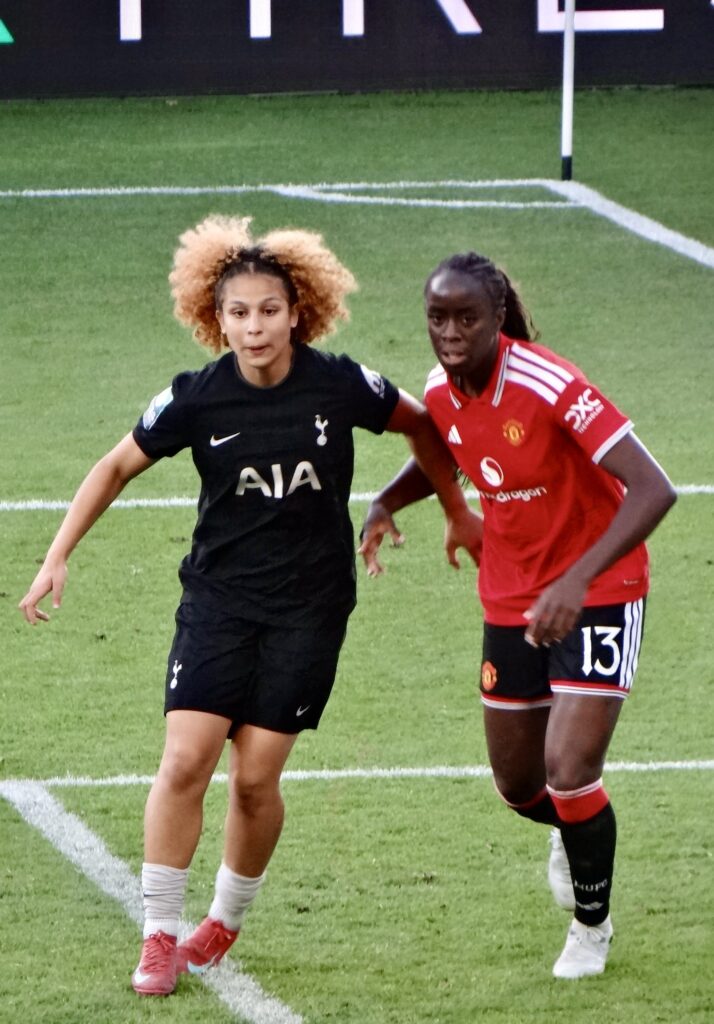
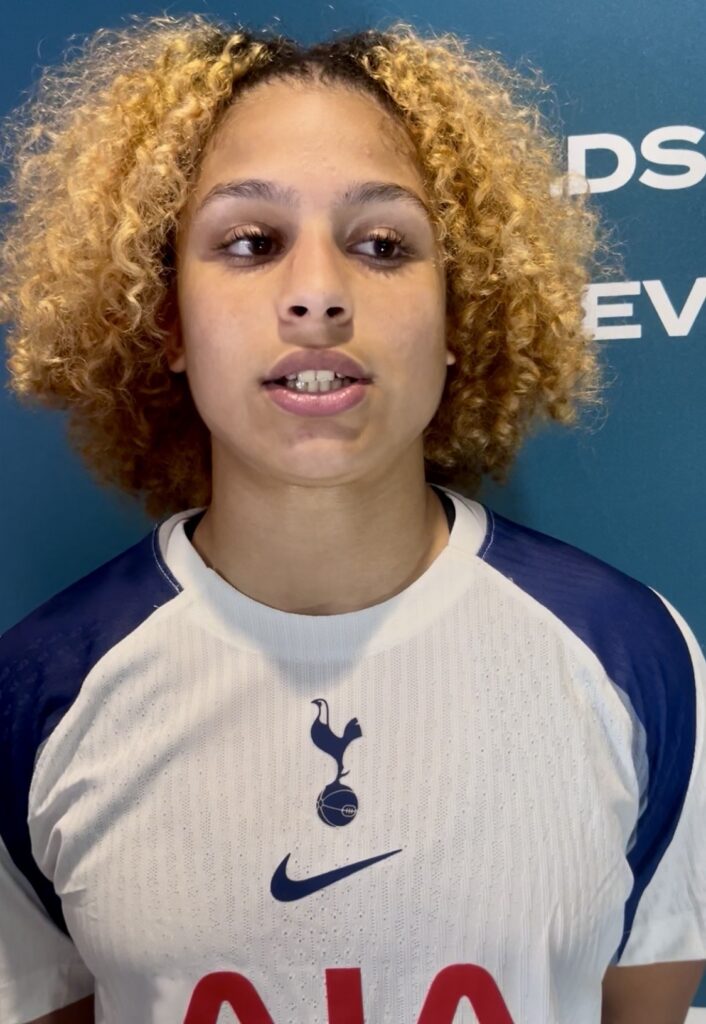
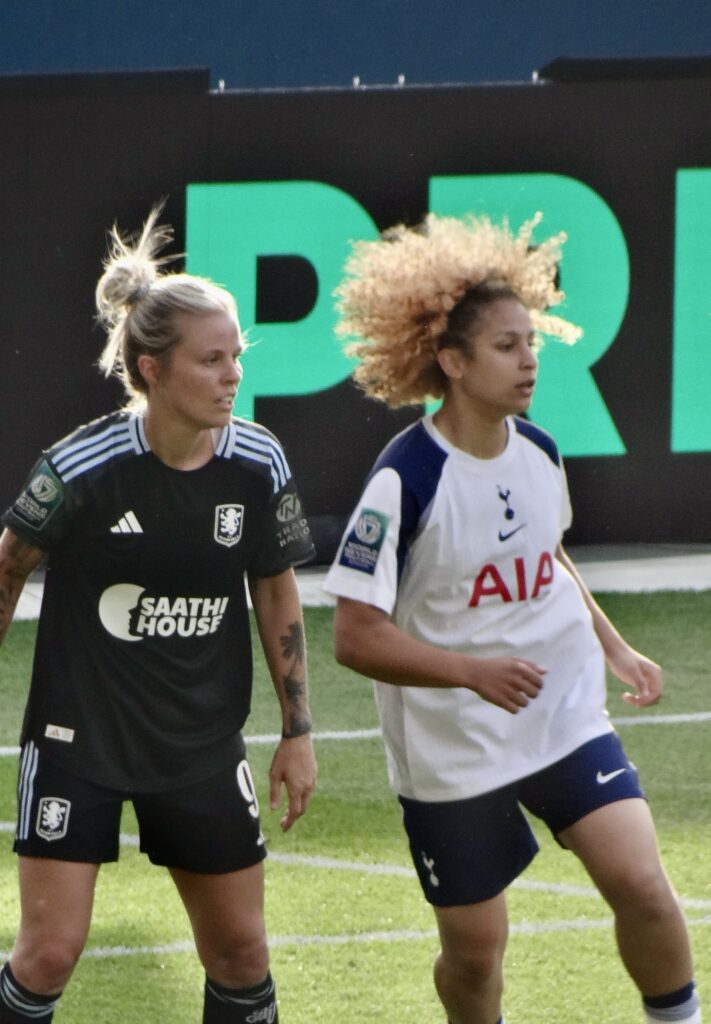
The academy player paired up with Tandberg was the exuberant and eye-catching Rania Oukriss (above), who was equally enthusiastic post-match. She loved having the opportunity to play in games like these and an environment like that at Brentford.
“It’s been really good exposure and the Sevens is a perfect environment to come in and be able to have fun and enjoy it.
“And also be relaxed with really intense pressure on you,” she said. “It’s been hard physically, of course, but the roll-on roll-offs have made it much easier. And to be honest, it’s made it more fun.”
Her pairing with Tandberg was perfect, she said: “Cathinka’s a great player, and she’s good to be paired with because of her experience, her style of play, and because I can pick things up from her and add them to what I’m doing.”
As for playing in front of a big, noisy, partisan crowd, it must have been a great learning experience too. And maybe long term, Spurs academy graduates will take this into their senior careers. Oukriss said that “the noise definitely adds to the atmosphere, the experience. It makes it more warm, more enjoyable, it’s lovely to hear and see everyone and know that they’re behind us.”
ASSISTANT COACH, LAWRENCE SHAMIEH
Being given the reins of Spurs Sevens squad allowed their assistant coach, Lawrence Shamieh to experiment a bit more, notably by putting their youngsters in the spotlight.
“I think that’s part of the enjoyment,” he said. “It was a great opportunity to see some of our 16, 17, 18-year-old academy players playing against some of the best players in the league, some of the best players in the world. It’s a great experience for them.”
This also gave him the chance to observe the togetherness of the group and watch Spurs first team players taking on a mentoring role.
“We’ve been a really together group across the course of the season. And now it’s a good opportunity to welcome in some new faces.”
For Shamieh, the fun side of the Sevens is definitely its end-to-end nature and the outrageous number of goals. “You know, 5-4 scorelines that you normally wouldn’t see in the WSL. And we enjoyed it, which is the most important thing.”
Some players, he said, found it more physically taxing than they expected. “I think a lot go into it thinking they might be able to play a little bit longer or stay on for the whole game, which I think in reality when you’re playing out there and in this heat as well, they don’t last as long!”
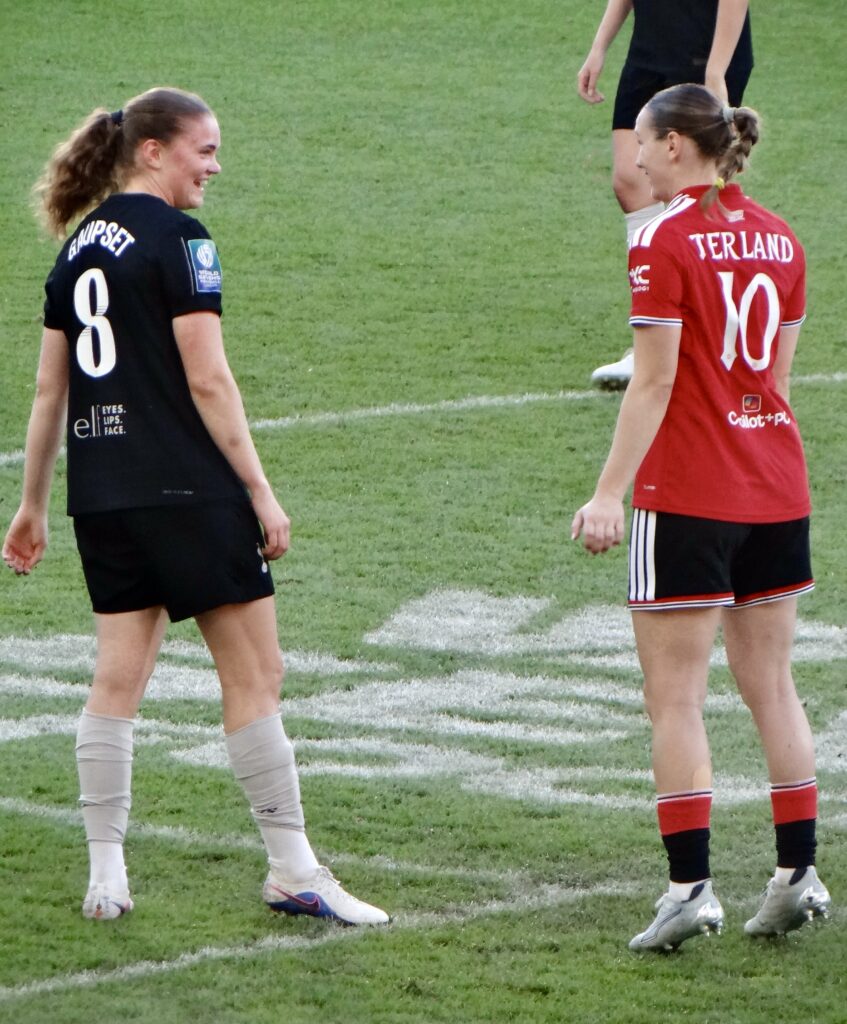
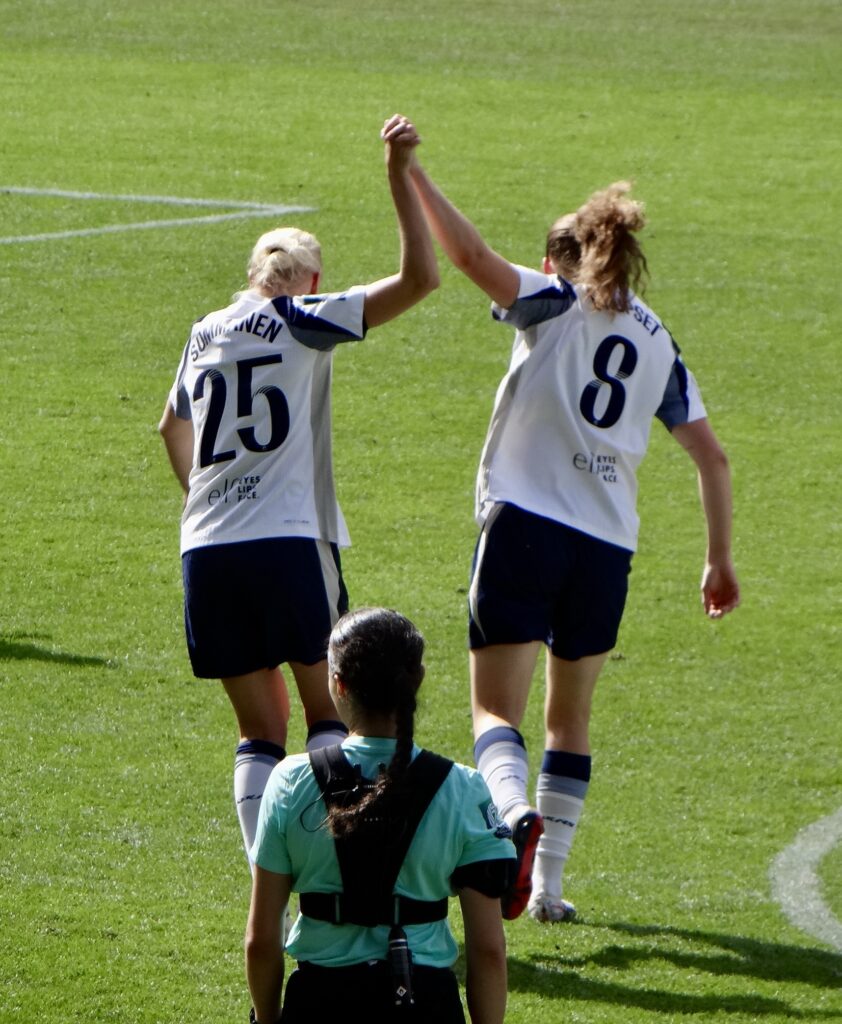
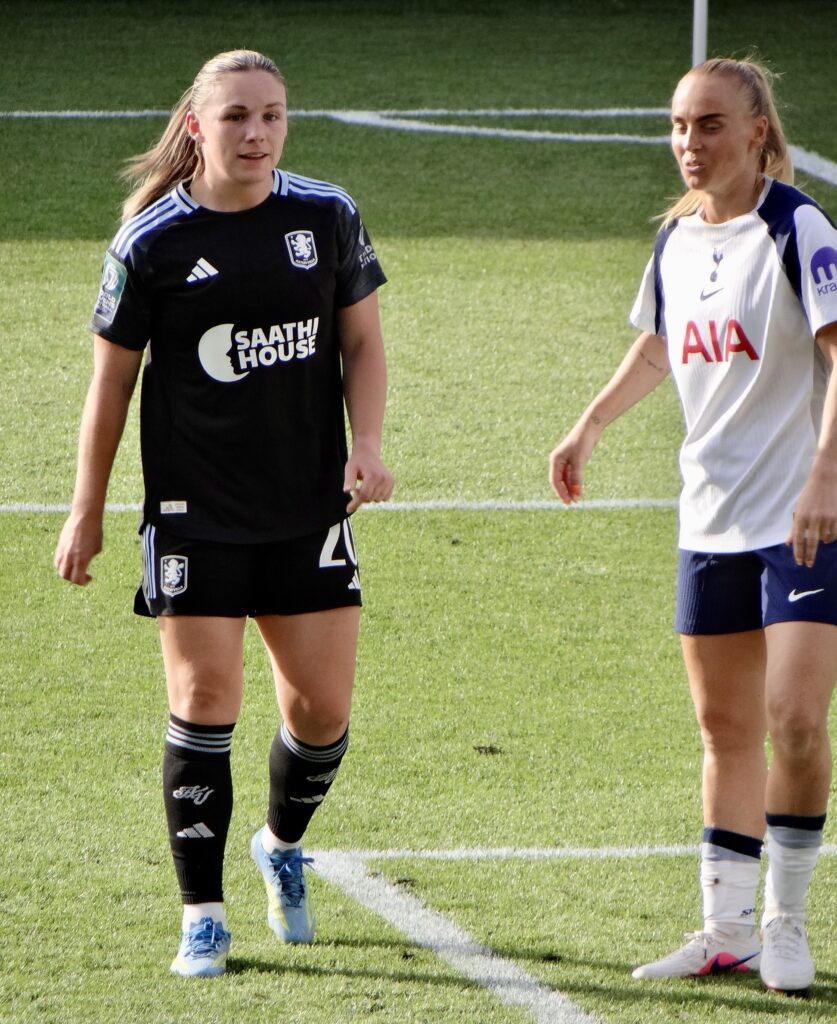
My initial theory – that the skilful, showboating players would thrive in this format – was quickly quashed. And I put it to Shamieh that it was those with physicality who excelled.
“100%,” he said, adding that he’d been involved in this tournament last year with United, “and some of the standout players were probably more the box-to-box, physical profiles rather than the players that you think would be… really skilful dribbling profiles.
“Because of the nature of the game and how physical it is, if you can cover the distance repeatedly, it gives you a big advantage. So, yeah, it’s probably one for the fitter players rather than the most technical ones.”
Molly Bartrip has left for Crystal Palace.
Eleanor Heeps is now at Brighton.
WEST HAM

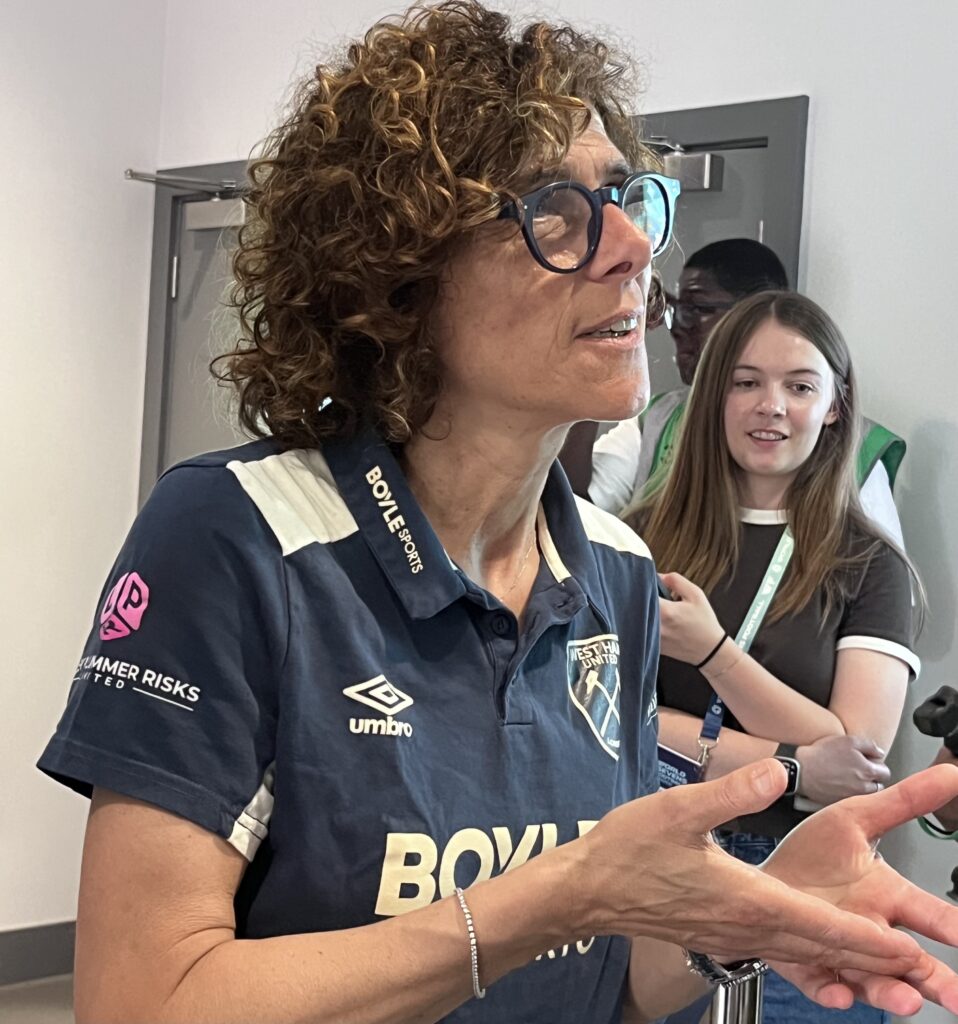
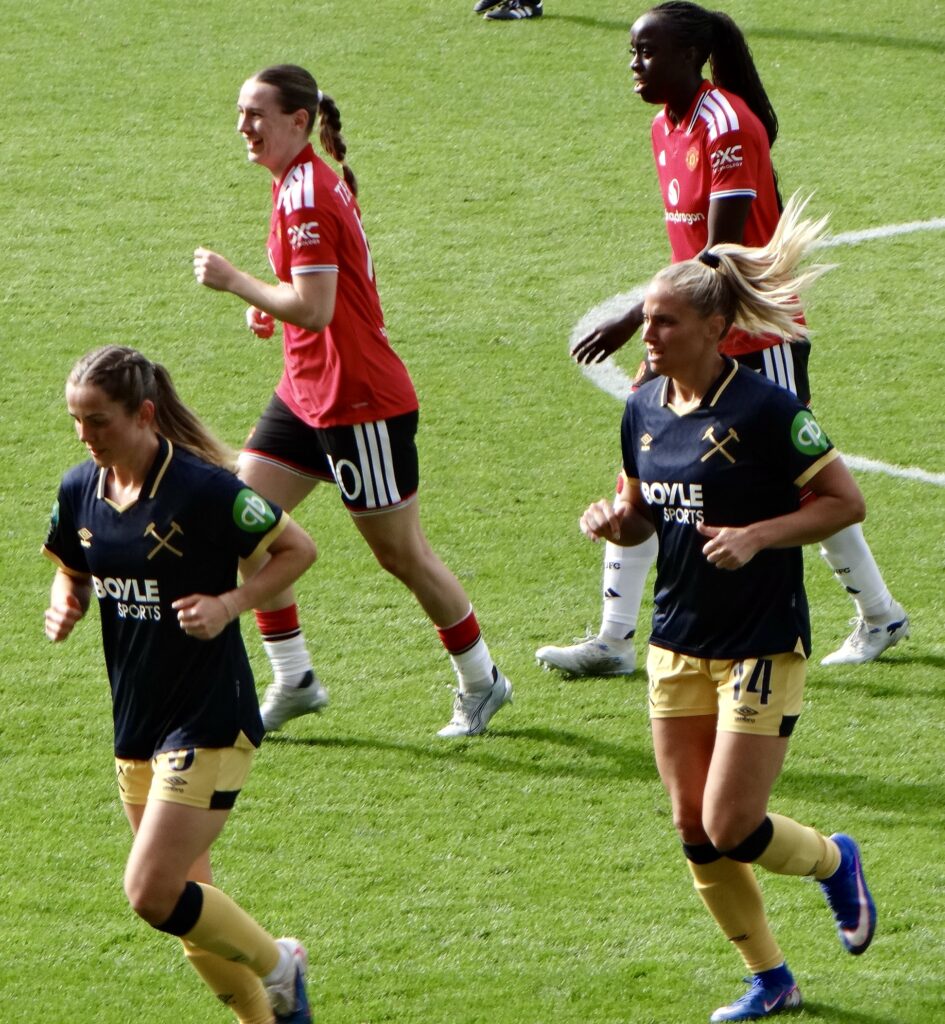
REPORT CARD: couple of tight games, but not their day(s).
WALKOUTS: lots of individualism… leading up to striking a collective, squad pose!
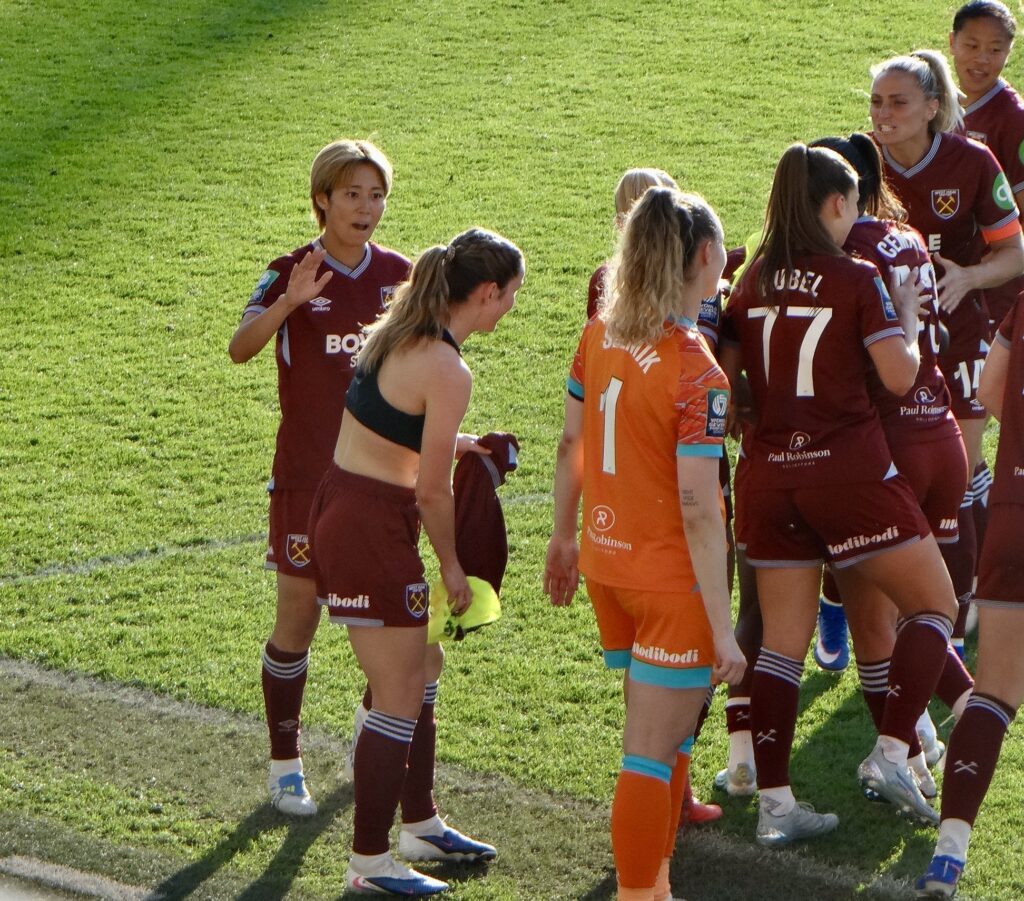
MATCHES: Lost 5-4 to Man Utd (with Ffion Morgan grabbing two goals); lost 4-1 to Spurs; lost 3-2 to Villa (Tuva Hansen scoring in her second Sevens tournament after winning the first one with Bayern Munich, celebrating her goal in similar fashion by ripping off her shirt, and minutes later being stretchered off with an ACL injury, seen below).
IN THEIR OWN WORDS:
HEAD COACH RITA GUARINO
Italian head coach Rita Guarino (above, centre) found the Sevens beautiful to watch “because it’s fast and you can see all the high quality of these players.
She reckoned that the crucial difference in the Sevens is that a player has the ball much more, so they can “show their individual qualities because they touch more times the ball in short spaces. So who has more quality in the short spaces takes advantage.”
Her conclusion? “It’s beautiful to see the players in different environments and how they show their personality, at a competitive level.”

Photos: Helen M Jerome