
IN THE FAST LANE – talking to Sydney Barta
Quitting was never an option for Sydney Barta, as the trailblazing para-athlete tells Olivia Franks.
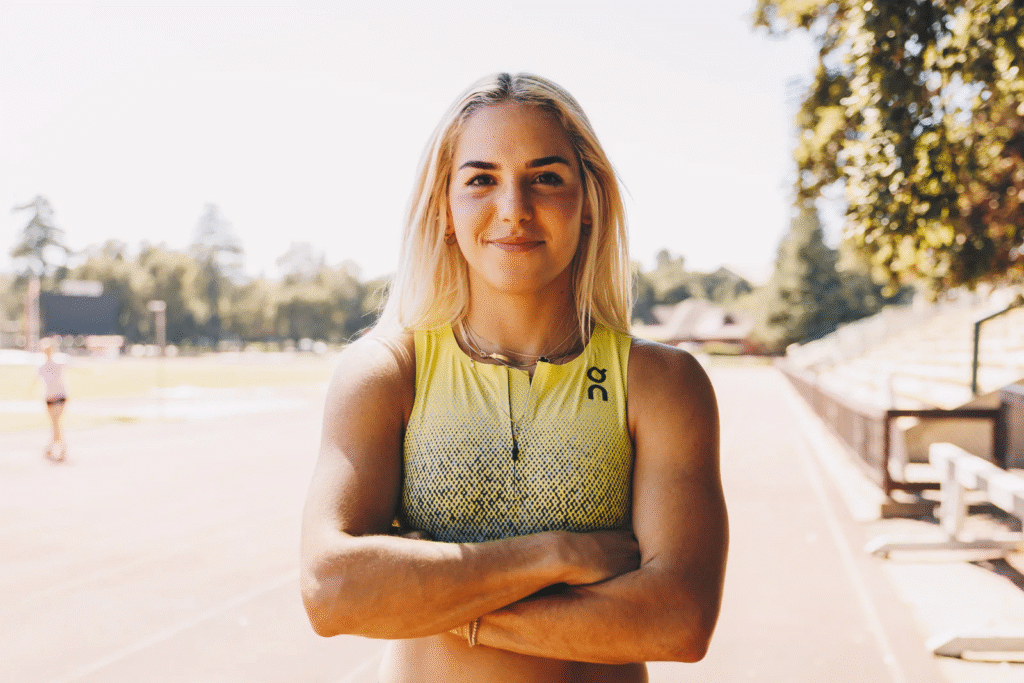
Shattering her left ankle at 6-years-old, and requiring below the knee amputation, Sydney Barta faced a long road to recovery. Now the trailblazer is the first para-athlete on the Stanford track team, has world silvers and bronze in the 200m, and just earned a Rhodes Scholarship to study at Oxford University.
But Barta’s used to being a trailblazer by now. She wears the title with a discernment that belies her youth. It’s seriously impressive.
This year will mark Barta’s second season with the Division I track team at Stanford. I managed to grab her on Zoom before a busy Friday of labs and indoor training in preparation for the NCAA’s indoor season.
The Senior at Stanford said, “I’m intimately aware of the need for advocacy for a lot of people who don’t have the ability to advocate for themselves.
“When people lose their legs, they oftentimes don’t get the opportunity to do something like this.”
Oh, and Barta is on two advisory boards, plans to be a doctor, and helps develop blade plates with On Running, by the way. All in a day’s work.
It nearly didn’t happen for the sprinter, though. Not track stardom, at least.
“When people lose their legs, they oftentimes don’t get the opportunity to do something like this.”
Barta’s mom got her involved in basketball, volleyball, and water polo, so it wasn’t until the Covid-19 pandemic that Barta really decided to give athletics her full attention.
“It was a lot more meditative for me, and during COVID there were a lot of times when I was training alone. So I think being 16, 17 and having the choice to decide: do I want to do this workout?”
Addictive
“The addictive process of refinement and the addictive quest towards betterment – I felt like there was a lot of synergy with that and who I was as a student and who I felt I was trying to be as a person.”
“I just got hooked after that and then ended up going to Tokyo.”
In Tokyo, Barta came fourth at the 2021 Paralympic Games but made it to the podium on her next visit to the country – she won a silver in the 200m in Kobe at the World Championships.
The 21-year-old frequently cites her mother, a college basketball player herself at Princeton, as a pillar of strength throughout her childhood.
“My mom was a big role model for me. She was very real with me and talked to me like an adult that people were not gonna be as willing to include me or give me opportunities because of the accident.”
Her coach, Joaquim Cruz, is a fellow bronze medallist – but in the 800m at the 1984 Los Angeles Olympics. He is a tangible example of where she could end up the next time that LA hosts the games.
“We would whisper in each other’s ears, all of these plans for greatness before I had really done anything in the sport.”
“My mom was a big role model for me. She was very real with me and talked to me like an adult that people were not gonna be as willing to include me or give me opportunities because of the accident.”
It culminated in an addition to the Stanford track team during Barta’s third year at the university where she studies bioengineering.
“Having been at Stanford for two years, I think I had really just accepted the fact that that wasn’t something that was like possible right now.”
But the T64 classified athlete has been embraced as a celebrated member of the squad.
“The coaches believe in para sport, and they’ve also been really willing to learn which is really important because you can’t expect people to understand para right off the bat.
“You can’t expect people to know how to train someone with one leg when they have never done it before, but they all approach it with such curiosity and determination and excitement.”
Elite
In October 2025, Barta signed an NIL deal with On Running – becoming their second para-athlete on the books, and one of only 28 college athletes signed by the brand.
“That was something that I talked about with one of my competitors, very early on, maybe in 2019 Worlds about how important it was that in a final at a Diamond League that everyone was wearing a professional kit because at the end of the day these are elite para-athletes.”
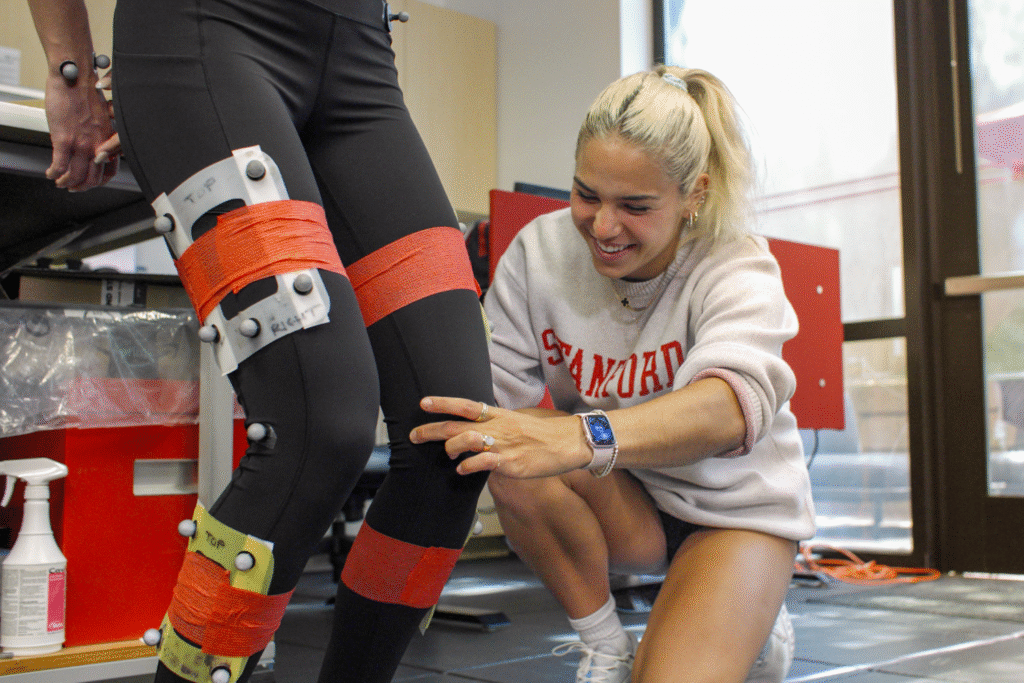
Not only is she resplendent in their kit, but the American is also involved in the development of On’s blade plate. A handy fit, given her specialism of gait analysis.
“You can’t expect people to know how to train someone with one leg when they have never done it before, but they all approach it with such curiosity and determination and excitement.”
“It was a really cool experience to meet the development team.
“Being an engineer at Stanford, we do a lot of concept development and in a lot of the classes that I’m taking now as a senior, we develop tools and products for a user with a specific need and meeting with the people that designed it – I was like, ‘I’m the user with a specific need!’”
As testing is underway for On’s new blade plate, Barta can’t wait to get her hands on the product and test it out. Not just on track, but with the assistance of her lab-mates and their ‘MoCap’ system.
“I had my old blade for like seven years. I just get attached to things! And I liked the way it rode.”
LA 2028
With the obvious shadow of Los Angeles 2028 looming over us, I asked what her aims were for this season.
“I’m pain free, it feels like everything is clicking.
“I’m gonna win nationals in the 200, but I’ve also never won in the 100. And I’m very much gunning for that position.
“I was so close last year that I feel like this is the year. I’m way more explosive. I think it’s gonna happen.”

Having battled with injuries across the last season, and still winning the 200m at nationals, she is approaching this season with extra vigour.
“To be able to have like a full year injury-free running with the Stanford team on a new blade, new spikes, new spike plate – to I feel like I finally have the ability to train without kind of any restrictions and without any restraints.”
But with graduation on the horizon this summer, Sydney Barta is also looking forward to her next challenge: should she play polo or cricket at Oxford?
The sprinter was awarded a Rhodes Scholarship for Autumn 2026.
Whilst her college is unconfirmed, the Stanfordian is hoping for Magdalen. A fan of singing, she plans to join the college choir.
“I’m super excited to see what the limits are this year. I think the visibility is going to grow exponentially.”
“My mom had always said that a Rhodes Scholarship is something that really signifies a quest for knowledge and continued learning.”
Barta visited the spiral city during winter break and was fascinated by the beauty of the buildings – particularly Christ Church, founded in 1546.
“I think one of the main things that I’m excited to do is get back in the cathedrals. It is very beautiful.”
“There is so much history that I feel like I need to like learn about!”
Her planned detour to England brings her many miles closer to the European legs of the Diamond League, by the way, which has begun including para-athletics in their schedules.
“I’m super excited to see what the limits are this year. I think the visibility is going to grow exponentially.”
I, for one, won’t be betting against Sydney Barta.
Photos: Stanford Track and Field team, Kurt Hickman, On Running