
SKY’S THE LIMIT? How are broadcasters shaping women’s football?
As the new and highly-anticipated Women’s Super League season kicks off this weekend, it was about time we looked at how the broadcast coverage is changing, at pace.
So we sent our football writer Phoebe Music along to Sky Sports, to learn more about their plans for increased WSL coverage, but mainly to talk to two of their major talents, ex-players and now respected pundits, Izzy Christiansen and Rachel Corsie.
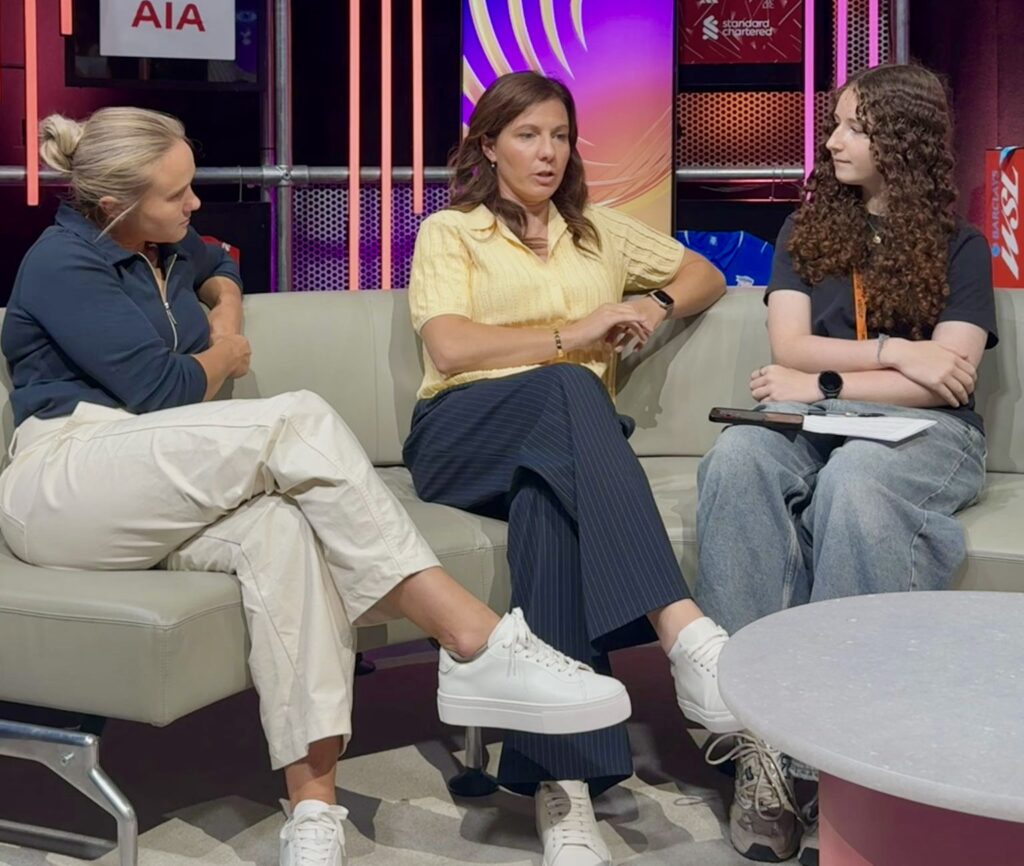
Women’s football is entering a new phase, and broadcasters are evolving alongside it. As the sport continues to grow, the focus is increasingly on not just showing more games, but improving how the game is covered, and bringing more depth to the stories around it.
Sky Sports is at the centre of that change and this season, they will broadcast 163 WSL matches live – 45 more than last season, including 108 exclusively live matches. In addition, following feedback from clubs, Sky is looking at greater flexibility around kick off times, with multiview, touchscreen analysis and dedicated broadcast slots aiming to make their coverage more engaging and accessible. They reckon they’re the closest they’ve ever been to the clubs, and one of the biggest investors in women’s sport.
Punditry
We wanted to learn more, so we asked to speak with two of Sky Sports’ biggest names.
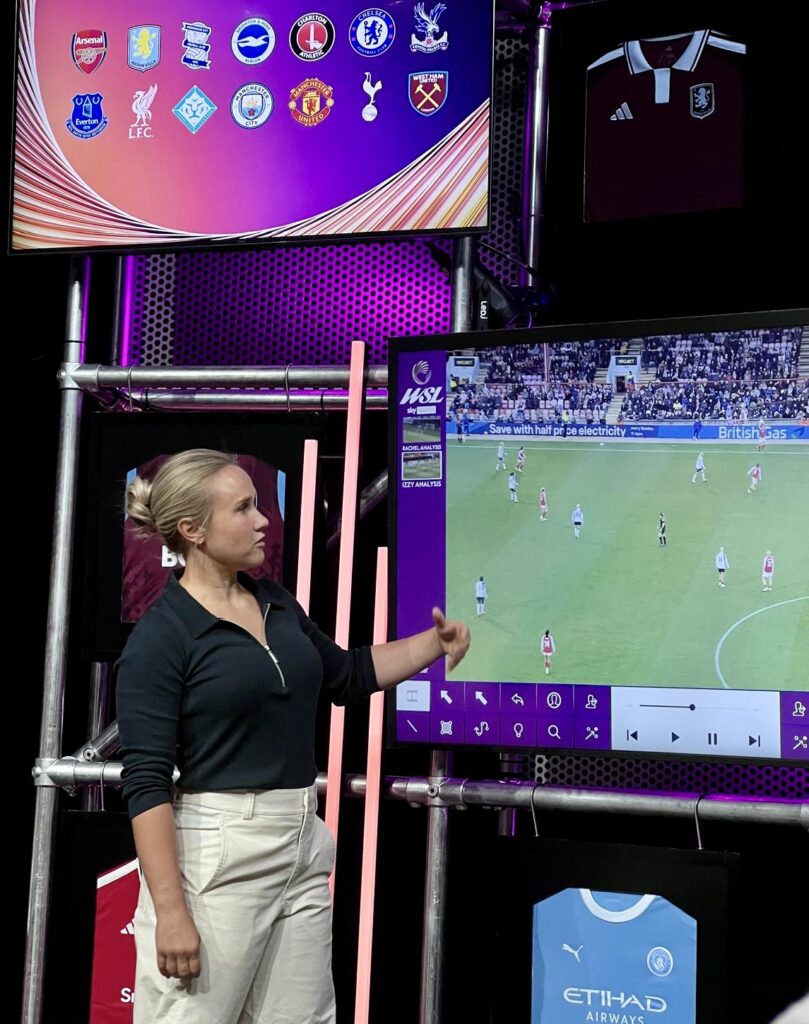
Izzy Christiansen (below, left), the former England international, spent much of her career in the WSL, with spells at Everton, Birmingham City and Manchester City, where she won every major domestic honour. She also became a Champion’s League winner during her time at French giants Lyon. With 31 caps for the Lionesses, Christiansen was named PFA players’ player of the year for the 2015/16 season before retiring at the end of the 2022/23 campaign. She quickly moved into broadcasting, becoming a core part of Sky Sport’s WSL coverage, while also working across the men’s Premier League and Carabao Cup. Alongside her media career, she took on the role of head coach of Manchester City’s Next Gen U21 team in 2025, and joined the Lionesses’ U23 set-up as assistant coach.
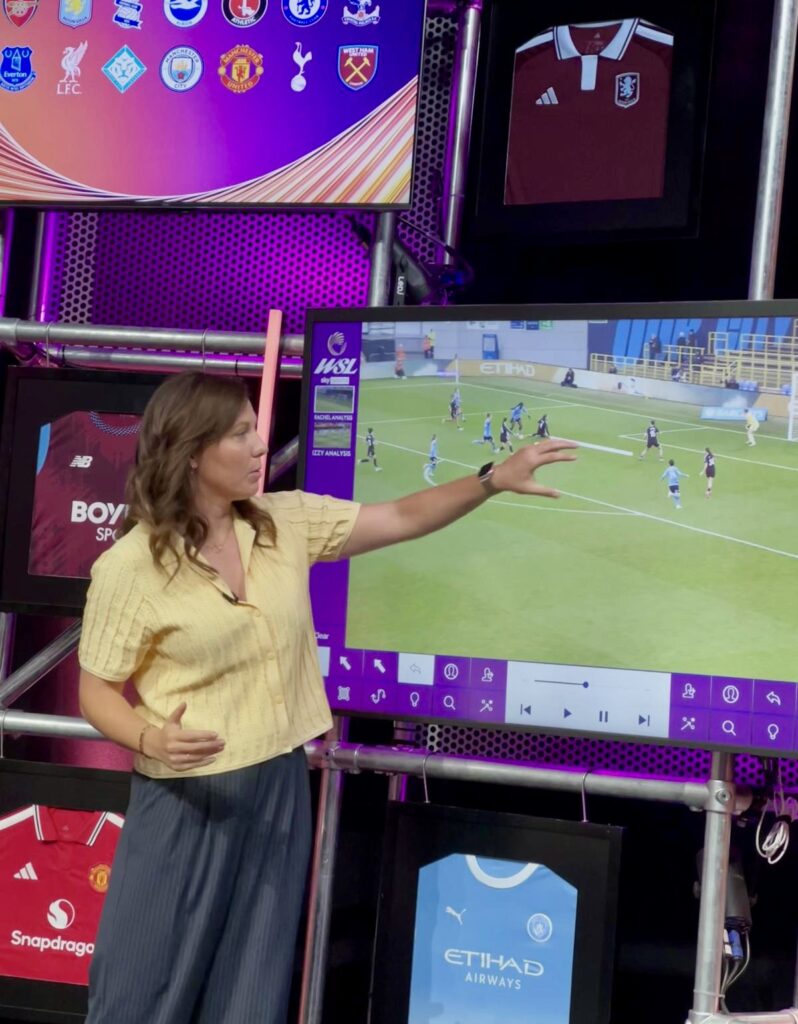
Rachel Corsie (below, right) played across Scotland, England, the USA and Australia during her career, including spells at Seattle Reign and Aston Villa. The former Scotland captain earned over 150 caps for her country, captaining them at their first ever FIFA women’s world cup in France in 2019, and won 16 major trophies at club level. After retiring in 2025, Rachel made the move into a broadcasting and punditry career, playing a core role in Sky’s coverage of the WSL, while most recently being a co-commentator for the men’s World Cup this summer. In July Corsie was also appointed to the board of directors for Aberdeen football club, to support the continued development of the club’s women’s and girls’ programme.
Both Izzy Christiansen and Rachel Corsie played at the highest level for clubs and country – so they know their stuff – and they answered all our questions in detail.
You’ve both played through a huge period of growth in women’s football, how do you think the media coverage of the game has changed and what are the visible changes you’ve seen?
Izzy Christiansen: I think it’s grown relative to the game’s growth. The media coverage has changed a lot and there are people who were covering it before other people were covering it 15, 20 years ago – like the Tony Leightons of the world, who did terrific things in the whole ‘when no-one was watching’ time. So, I think the growth has been incredible really, and the success at both Euros hugely helped the interest and the growth across the media platform, so it’s grown at a really exciting rate that is very relevant to the game.
Rachel Corsie: The only thing I’d add – and the biggest change from even a few years when I was playing – is the volume of games now that are on TV specifically, and how that has helped and is part of that landscape shifting. I still feel there’s a little bit of work to go in terms of us creating those stories that become the really exciting and interesting stories that people want to read more about. I think sometimes we’re still in an area where we like to keep it quite safe, but I think it will help us continue to help change, and accelerate maybe a little quicker, if we’re willing to maybe be a little braver with it, certainly talking about the football side of things.
Do you think media now strikes the right balance between the analysis of women’s football, but also celebrating the stories and the personalities behind it?
IC: I think the women’s football audience does have segments that differ to men’s football audiences, and I think there’s a space and different media platforms for everything. I’ll always gravitate towards more in-depth tactical analysis. There’s some tremendous newspaper outlets that cover that with The Guardian, The Times, The Telegraph. I think all three cover the game excellently and strike a really nice blend between the person stories and the analysis, and there’s a space for both. And I also work across men’s football as well and people are often a little bit frightened to use comparisons to men’s football. But for me I think we always need to look at it, not necessarily copy it, but there are elements of stuff that’s worked across both men’s and women’s football that’s had a really positive effect in women’s football.
RC: Probably me and Izzy are kind of the example I go back to, just because I think there’s room for us to always be willing to do more analysis and continue the analysis. There are differences in the fan groups, but there are also definitely fans that like the analysis, us as two examples. We love going into the details – I always love those types of programmes on whatever football they’re covering. So you remember that it’s important we also cater for that, because I do also think that’s an avenue for new fans to also get the chance to be brought into the game too.
How important do you think broadcasters like Sky have been in changing the perception of women’s football and what does this new level of visibility mean to you?
IC: I think Sky’s investment has been unmatched in the women’s game. The long-term plan and vision of progressing and showcasing the WSL is very much aligned with Sky’s beliefs. Sky do men’s football at the top, top level, with the most live games. Sky now do women’s football in the same capacity. So I think it presents a lot of parity across the board relevant to the two leagues. And we have two of the best leagues in the world on the men’s and women’s side being showcased on Sky. The plan and the progression has been incredible, and we want to do what we do best, which is football, we want, like we said, to bring out the football stories and I think there’s no other way of putting it other than they’ve invested heavily and they’re showing the trend, to help to keep pushing the game forward.
Does more coverage automatically mean it’s better for the game? What else do you think needs to be done to help grow the game to the next level?
RC: I think more coverage is a good thing. And I think Sky is the best place for it to be. It’s got the capability and the resources to do it to such a high level. Also they’re adaptable and flexible, trying to make things better and better, and you see that year on year. That’s why I think more games is going to be better. And Gary [Hughes, director of football at Sky Sports] touches on that; they listen to clubs, and if some clubs feel they’re not the main game, then can they have that flexibility for kick-off times? Great, we can accommodate it and make it happen, and hopefully if we see it’s successful, then we can continue like that and it’s a change for next season.
You’ve both made the shift to the media, how was that transition and what have your experiences as players brought to that role?
RC: For me personally, the transition has been smooth. I’ve enjoyed it. I got the chance to progressively do little bits over probably the last three or four years of my playing career as well, which certainly helped to then take the big jump into a role where you’re potentially covering two, three games every week across different competitions. And being a recent player, of course, allows you to have a connection with players that are still playing. You’ve got recent experiences, you’re very close to those memories of knowing exactly what it’s like in different moments, so I think that is always good for the coverage.
And covering the game as opposed to being on the pitch, is there anything that you now notice that you wouldn’t have seen when you were a player?
IC: Context to everything is key as a player. There’s always 10, 15 decisions that happen before a major decision. So people tend to focus on the error or the goal or the highlight rather than the context around it, and I think it’s the same in punditry. There’s a lot that goes on, it’s very difficult to sit on this sofa and speak succinctly about the game in the time frame you’re restricted to, so that’s probably one thing for fans watching the game… audiences to probably understand the context around the situation before they judge. And I think the same could be said on the pitch as well.
When you were playing or even now, is there a particular player you looked up to or learned something from – and what did you learn?
IC: Mine was Frank Lampard, goal-scoring midfielder, now coach. So, yeah, he was always a role model for me, just based on the way he played. Loved the way he played.
RC: I definitely don’t have one clear person. But I obviously had the chance to spend five years playing WSL, seven years playing the NWSL, and I just learned that you can learn from everybody. I got the chance to play with a lot of different players and play with and against a lot of the best players in the world over those years, so you almost have to absorb and learn all the time. I can’t really pinpoint one player, but I just know that I probably learnt that lesson too late, but I got there eventually and realised, you know, just absorb everything you can!
Photos: Phoebe Music