
THREE HERE NOW? An oasis of visibility in Manchester.
Wythenshawe have big ambitions. They’re aiming to be the third biggest football club in Manchester: United, City, Wythenshawe.
This may sound deluded, but underestimate them at your peril. Clare McEwen hears from key members of the club aiming to create 50 women’s and girls’ teams, and leave a lasting legacy.
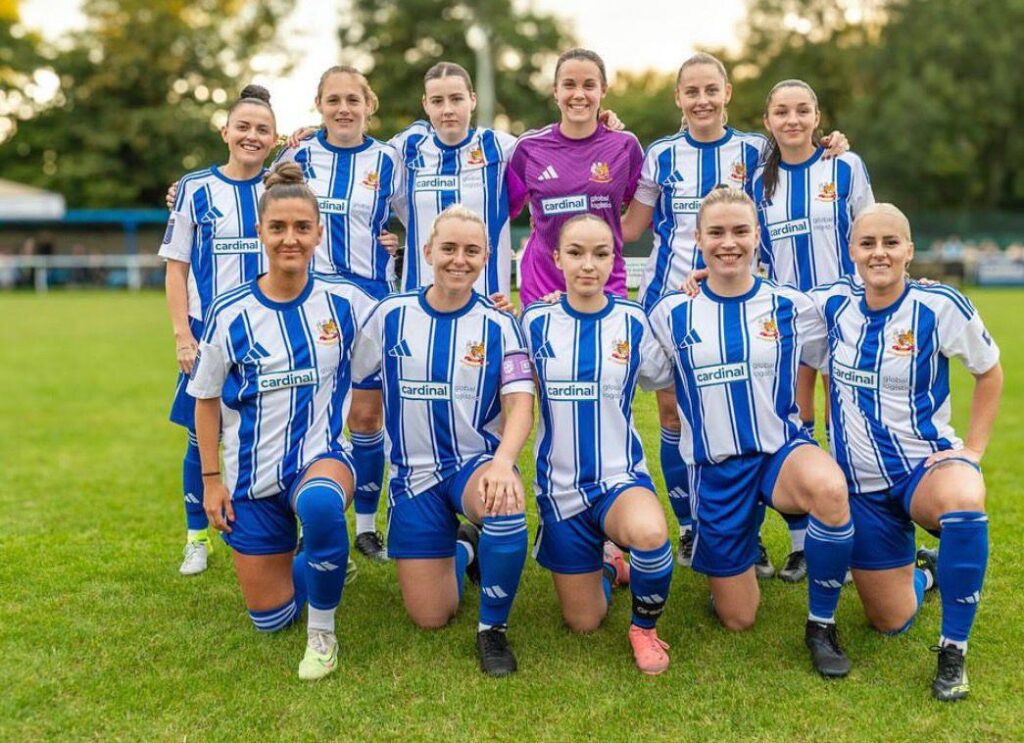
You’d be forgiven for not knowing much about Wythenshawe. And I get the impression they kind of like being underestimated. But the rise of their women’s team is getting hard to ignore.
They have won back-to-back promotions over the last two seasons, rising from Tier 6 of the pyramid to Tier 4. The goal for this season is promotion from the FAWNL North Division to Tier 3. When I spoke to them, they were fighting at the top of their division with eyes on nothing less than another promotion.
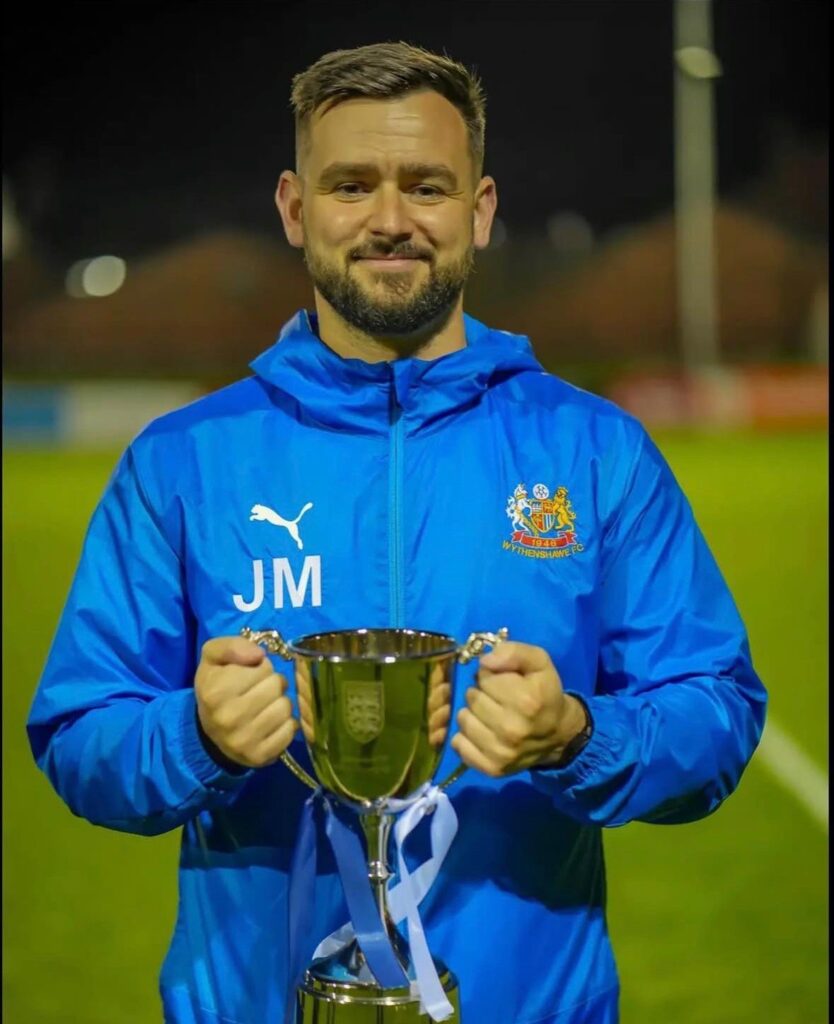
Manager, James Mulvihill, has masterminded the team’s remarkable progress over the past two years. The local lad came to the team with the intention of getting them on the football map,
“It was always important to me that when people talk about football and Wythenshawe, it isn’t like, oh, have they got a team? Oh, how are they doing? They know how we’re doing and we’re kind of synonymous with being successful.”
So what kind of football has got Mulvihill’s team to this position?
“We hunt teams down, we create relentless pressure. We don’t look at badges of clubs and think, oh, they’re a big famous team. We stick it on them.
“We’re not showing teams respect, we’re putting people on the back foot as soon as possible. Creating relentless pressure – you’ll be able to vouch for it from minute one.
Fast Start
“When we get to training, it’s a million miles an hour, and we want to roll that into match days. The feedback we’ve had from other teams is, ‘we just really didn’t know what to do with you guys in the first half’.
“I think that’s testament to the effort and energy that the girls and all the staff put in when they’re on the training pitch.”
This kind of energy and success makes people take notice. It brings in more fans and inspires more girls.
“I’ve always taken great pride in being an inspiration to the younger generations.”
Kirsty chambers
That’s an important driver for Wythenshawe’s captain, Kirsty Chambers. Chambers came over to Wythenshawe because she believed in what they were building, including the girls’ side of the club:
“That was one of the main reasons why I came over to Wythenshawe – the setup they’ve got for the juniors. It wasn’t something we had at my old club. We tried to set it up and the whole 11 years I was there it never took off.
“I’ve always taken great pride in being an inspiration to the younger generations. I’ve got nieces and nephews, cousins, so many kids in my family and they all look up to me as that female footballer.
“We’ve got a few junior girls that come to our games every week and they’d rather come to our games than go to the Women’s Super League games. For us, that’s a massive feeling of pride and joy that these girls look up to us.
“When you ask them who they want to play for, their answer is always ‘Wythenshawe first team’. For me, it’s always been a thing of inspiring the next generation.”
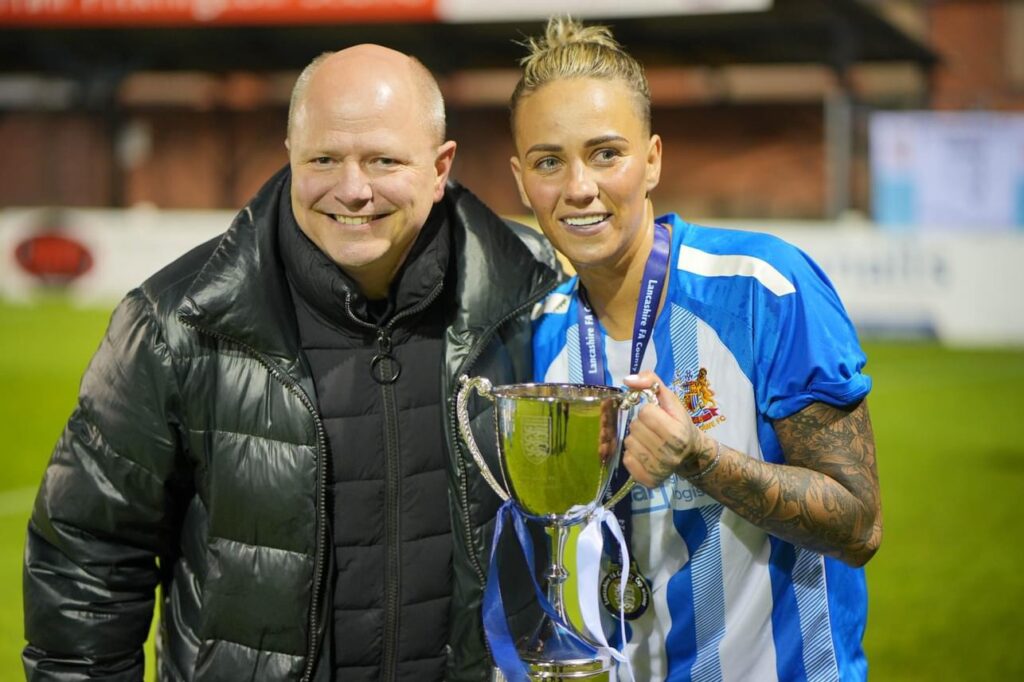
There’s an important message there about role models. Girls don’t necessarily need to see the big name stars: there’s so much power throughout the pyramid. The engagement between first team and junior teams at clubs like Wythenshawe provides role models and mentors up close.
All of this gives the perfect platform for Club Chair, Carl Barratt, to achieve his ambition of growing the club from 63 teams to 100 – with 50 female teams to match the male side of the club.
Support
Currently the club has teams at some age groups – plus a Wildcats programme – but not the full pathway to the first team. With the support of Premier League funding, Barratt wants to,
“Replicate some of the success we’ve had on the boys side and that is to make sure we have every single age group covered and to make sure we’ve got a minimum of three teams playing at every age group.
“And there’s a reason I want that [three teams]. Sometimes people will come and play football because they just want to have fun. They’re not really interested in anything else. So I always want there to be a place for any player in the team. Then I’d like to have two other teams where people are progressing between the two teams. I want to have that all the way up to under-18s and then an under-21s team competing in open age women’s football as well.
“We hunt teams down, we create relentless pressure. We don’t look at badges of clubs and think, oh, they’re a big famous team. We stick it on them.”
James mulvihill
“Fifty teams within five years is my target.
“We will get there but we’ve got to have a structure in place because there’s no point having all these teams without an end goal. I think having a successful women’s first team will make people come to the club and if we can start from age three, all the way up, then we’ve got a pathway for everybody.”
But Barratt’s ambitions couldn’t be realised without funding support from organisations like the Premier League and The Football Foundation:
“Realistically, funding partnerships are the most important thing in football. We talk about coaches, volunteers, kids playing football, but without the facilities, we’ve got no chance.”
Raise the Profile
Nick Perchard, Director of Community at the Premier League, explained how the Premier League’s partnership is helping support football for women and girls.
“We’re trying to support the women’s game from that very foundational level, getting girls into the game for the first time, right the way through to the Women’s Super League. We’re very proud to support the Women’s Super League but below that we have the National League which is just this incredible competition.
“Over the next three years, we’re investing £2.7 million into the FA Women’s National League to help them deliver their strategy – delivering a really high quality league that provides great opportunities for women playing the game that really drives forward club standards.
“Ultimately, it’s about raising the profile of this incredible part of the women’s game. The more we can do that from the Premier League’s perspective, the more support we can provide great clubs, like Wythenshawe women; great leagues, like the FA Women’s National League, and hopefully that’s just going to help the game to grow in general.”
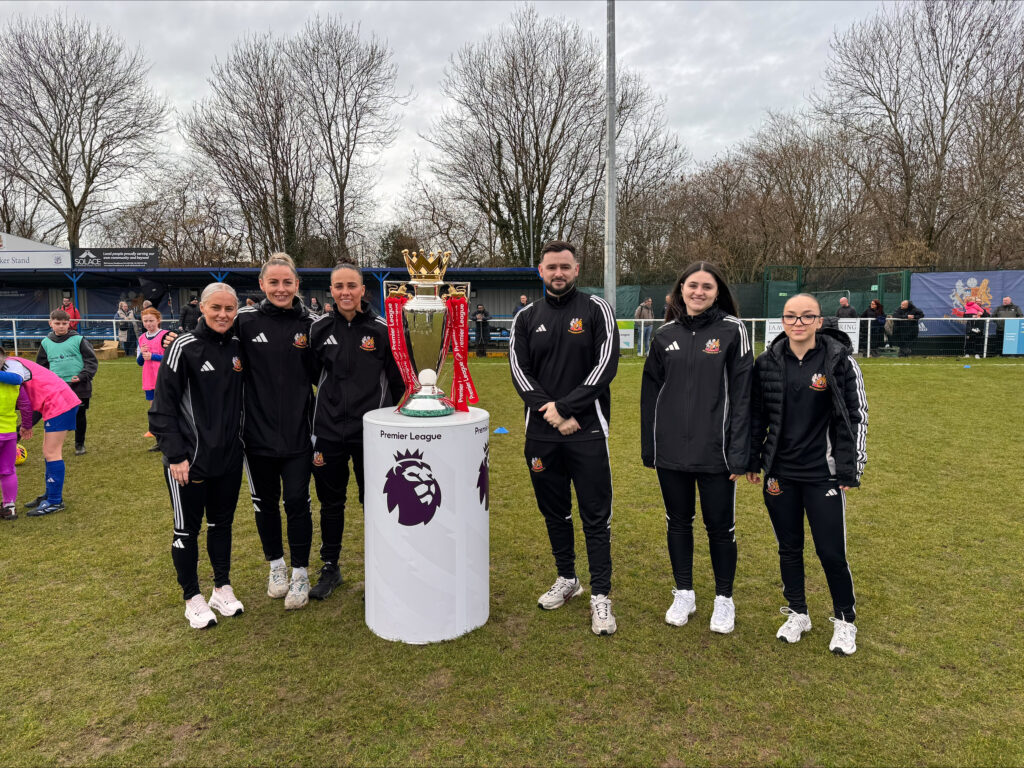
Specifically, Wythenshawe have received money for floodlights, to improve drainage on pitches, and to improve stadium facilities for players and the community (on both the women’s and men’s sides).
As Club Chair Carl Barratt says,
“Without their money, facilities don’t get bought and paid for. And this is the most important thing.
“It’s funny, I’m looking at the money that we’ve received, it’s a huge amount of money and I can’t thank the guys enough, but we’re probably only halfway where we need to be. Our plan is to have 100 teams with the main priority going on girls and the women’s side.
“I think the partnership between Wythenshawe, The Football Foundation, and the Premier League has just been phenomenal. I can’t thank them enough for what we’ve received.”
And there we have a blueprint for success: investment, the vision and dedication of a Club Chair who wants to grow women and girls’ football, a successful first team, and a culture that everyone wants to be a part of.
I certainly wouldn’t rule out Wythenshawe becoming the third biggest team in Manchester. Would you?
Photo credits: Blue Ribbon / Lucy Palmer