
YOU CAN HEAR ME SMILING – Emily Herbert on the Art of Football Commentary
You’ve no doubt heard Emily Herbert commentating on WSL matches on radio and TV – as well as Premier League and EFL games – with the necessary precision, plus flair, wit and palpable enjoyment.
Happy broadcasting with or without a co-commentator, Herbert tells Helen M Jerome that she works for everyone from the BBC, Sky and Arsenal to production companies like Aurora and IMG for worldwide feeds.
Our conversations spanned two high-profile WSL games at the Emirates and Stamford Bridge. In the process we dug into Herbert’s motivation, vocal techniques and preferences – including whether to say “Aggie” or “Beever-Jones” when she scores – and kicking off with how she got started…
How did you get into commentary? Is there a route with steps and stages?
Yes, I think there are. I wasn’t following football about three years ago, which is when I started.
I went into my local BBC station, and they knew I played rugby, and they were like: right, you’re going on a sports team because you’re a girl and you play sport!
So I did and then I fell in love with football.
I started being behind the scenes, doing production and then stepping into reports, which is just an update into a main commentary when a goal is scored, etc.
And then from that, this season I’ve started doing full commentary.
So have you commented on rugby as well?
No, no, I just played rugby.
Would you? Is that something you’d like?
I don’t even follow rugby, so no.
I prefer playing rugby than football.
But I prefer watching football than rugby.
I went into my local BBC station, and they knew I played rugby, and they were like: right, you’re going on a sports team because you’re a girl and you play sport!
So I did and then I fell in love with football.
Who has influenced you, maybe who you admire as commentators, female and male, and why?
As I wasn’t following football about three years ago, they’re new inspirations really.
I’d say Vicki Sparks is up there, Jacqui Oatley are the main ones. I like Nick Godwin at BBC Radio London, I think he’s superb. And I also like Ali Bruce-Ball at 5 Live.
What’s the difference when you’re commentating between doing radio and TV?
Yeah, it’s actually a really big difference.
With TV, you’ve got a lot more pauses, because of course the viewer can see what’s happening.
You don’t have to describe what’s happening. And that’s the main difference – description.
With radio, you’re constantly saying where they are on the pitch, who’s got the ball, what colour hair they’ve got, what colour boots they’ve got. It’s adjectives all the time.
Different words to say how they’re playing balls through and what kind of chip it is, etc.
TV, because they can see it, you can just say the name of the player, and it’s much easier doing TV.
Which you prefer and why?
Good question. I love radio.
I think radio is my thing. So I prefer doing radio commentary.
And with radio, normally you’ve always got a co-commentator so you can bounce off them and I like having a chat. So I prefer doing radio.
TV is bigger, probably people would think, but I think radio is more delicate and intricate and I prefer that. It’s more intimate, I think.
With radio, you’re constantly saying where they are on the pitch, who’s got the ball, what colour hair they’ve got, what colour boots. It’s adjectives all the time.
Different words to say how they’re playing balls through and what kind of chip it is.
TV, because they can see it, you can just say the name of the player, and it’s much easier.
But TV presumably pays a bit better?
Um… BBC 5 Live pay the same as an Arsenal commentary, but a Sky commentary will pay more.
An interesting thing, when people are listening to commentaries, is voice. There’s a lot of pressure on women’s voices. So tell me what kind of voice is best to develop as a commentator?
Yeah, it’s deep. So as you can hear now, my voice is quite deep.
What people normally do when they see a goal is scream and go high pitch.
You’ve got to train your voice to go low and deep and scream like: “Russooooooo!” really low and a growl. That sounds best on the mic.
You mentioned pundits, co-commentators. How do you pair up with them?
Well, you’re just given them really.
Producers do that for you. They do sometimes ask who do you prefer working with.
Or not working with, etc. And there are a few.
What makes a good co-commentator? Is it a contrast in voices, which I imagine is important? Or is it they’ve got a regional voice, or that they’re an ex-player everybody knows?
Not necessarily an ex-player, that doesn’t really matter to me.
I like to have a bit of a chat, and a bit of a banter with them, so a good personality for me would work better. But it’s not in all cases.
So tactically, because my job is not to analyse, my job is just to describe what’s on the pitch.
If I describe and then when the replay happens, they can give me an answer as to why that’s happened, that helps my commentary, for example, you can see more partnerships being developed, etc. So tactically is a better co-com.
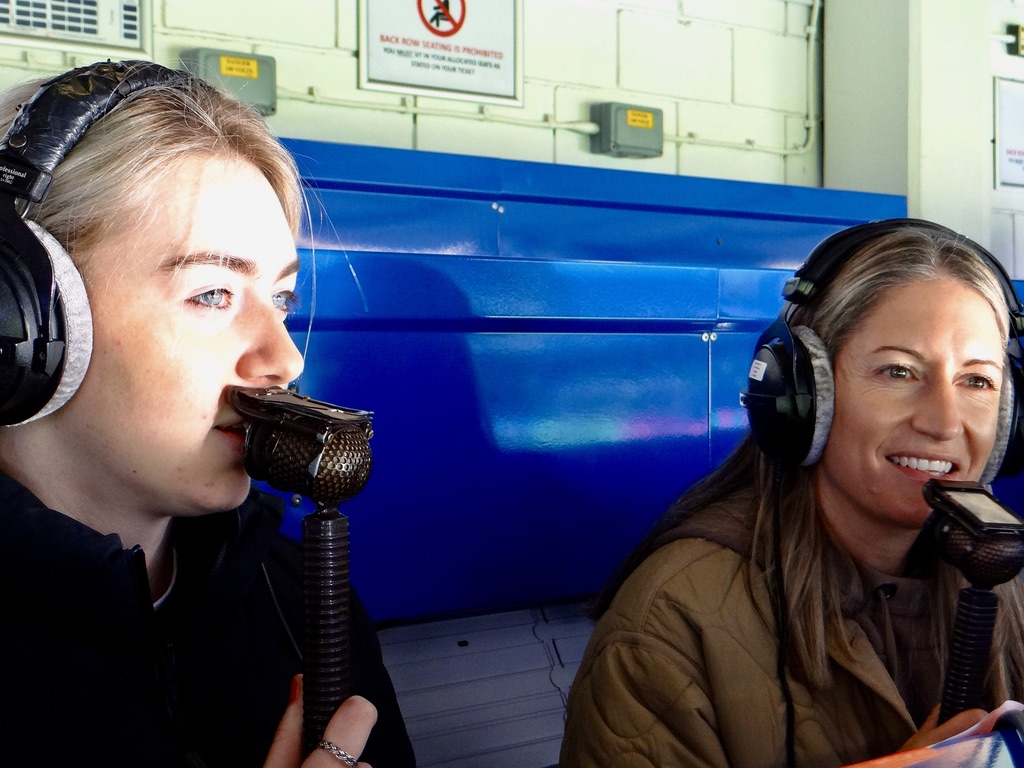
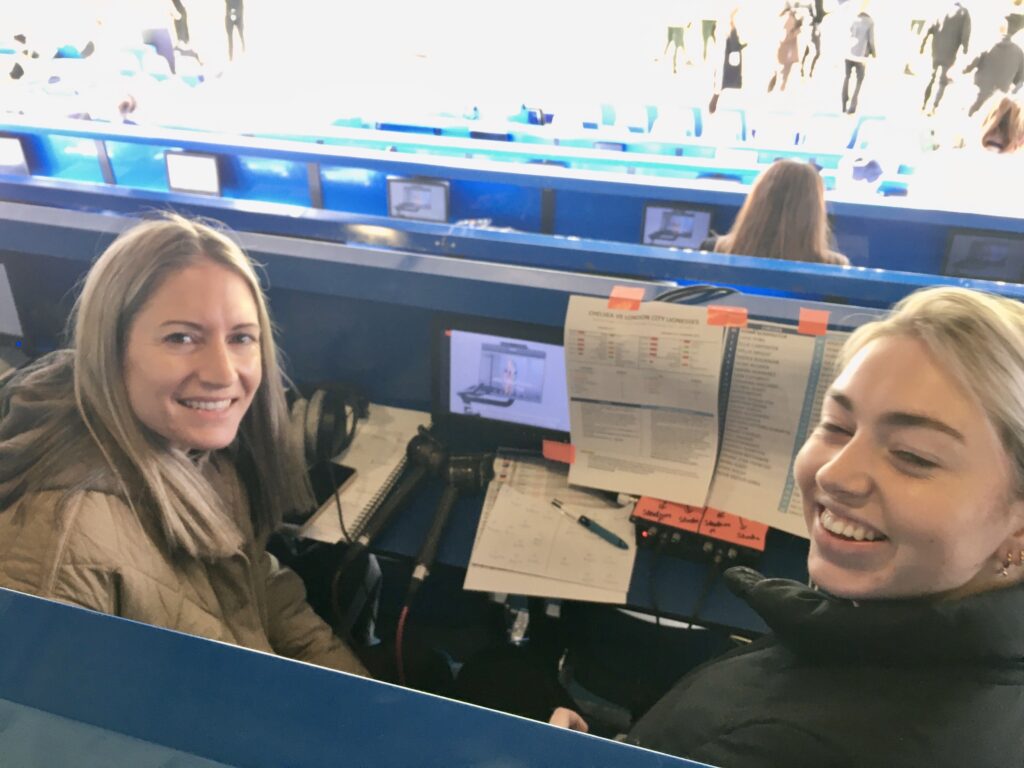
Who, particularly on the radio, have you paired up with most successfully?
I think Courtney Sweetman-Kirk is my favourite one because she can give a bit of banter and she’s very good tactically.
Keeps it quite simple.
You might be different, but for me I’m not into my tactics really, of football. I just describe them.
So if she can describe it to me simply, that helps me. And probably the general viewer too.
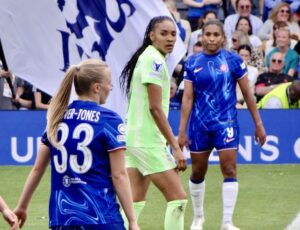
I just had Jenna Schillaci (above), who was good.
I’ve never done it with her before, but she analyses the game better than others, which is what I want.
I don’t need them to describe it; I just need them to tell me why this happened.
Then that creates conversation and discussion.
Was there a particular moment in the game where she really highlighted something?
Yeah, well when Chelsea played a back three, and then went to a back four when Niamh Charles came on at half time, she was explaining why that was happening.
Also Jana Fernandez and the player at the top, Freya Godfrey, that partnership. Discussing that.
What people normally do when they see a goal is scream and go high pitch.
You’ve got to train your voice to go low and deep, and scream like: “Russooooooo!” really low and a growl. That sounds best on the mic.
Why are so many goalkeepers, co-commentators?
I hadn’t actually thought of that, but you’re right.
Probably maybe because they can see the whole pitch.
You know, they’re not called into action all of the game, are they?
So they’re kind of looking and trying to see.
That’s a very good question.
I’ll ask next time!
What’s the difference when you’re commentating on a men’s game compared to a women’s game, when you’re aware of who’s listening?
To be honest, I actually don’t think I think about that.
I want to do a good job regardless.
I was more nervous to commentate today because some people I know were listening.
When I post on social media about men’s games I get more interaction and hate from men, but I actually enjoy that, because I quite like replying to them.
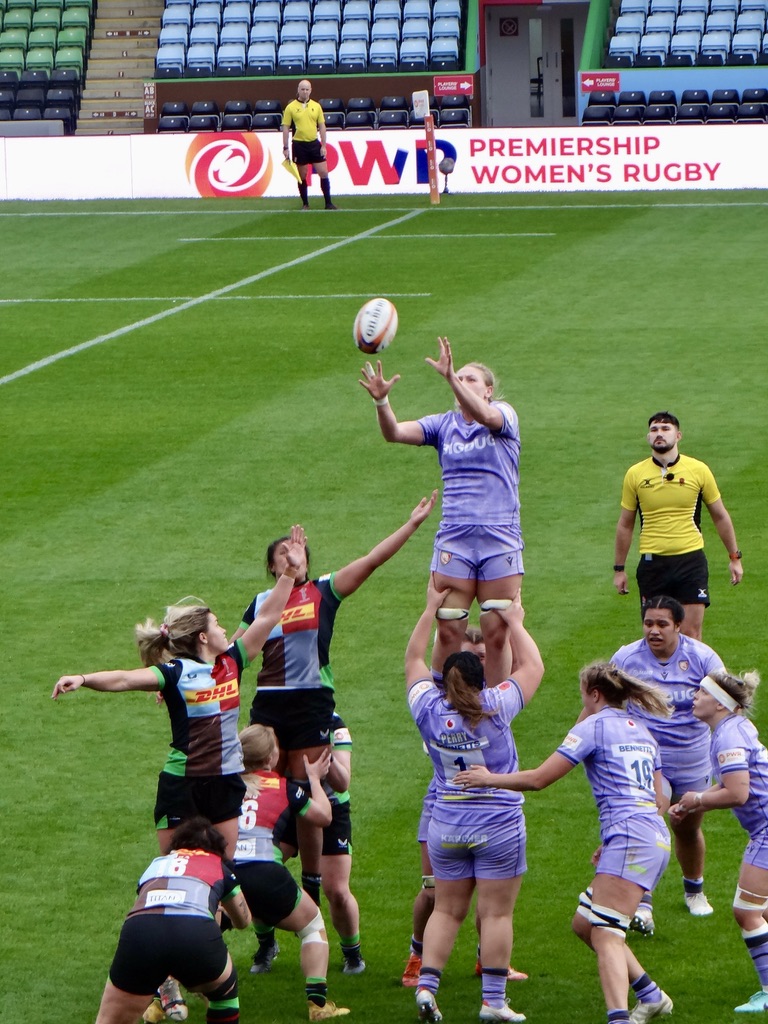
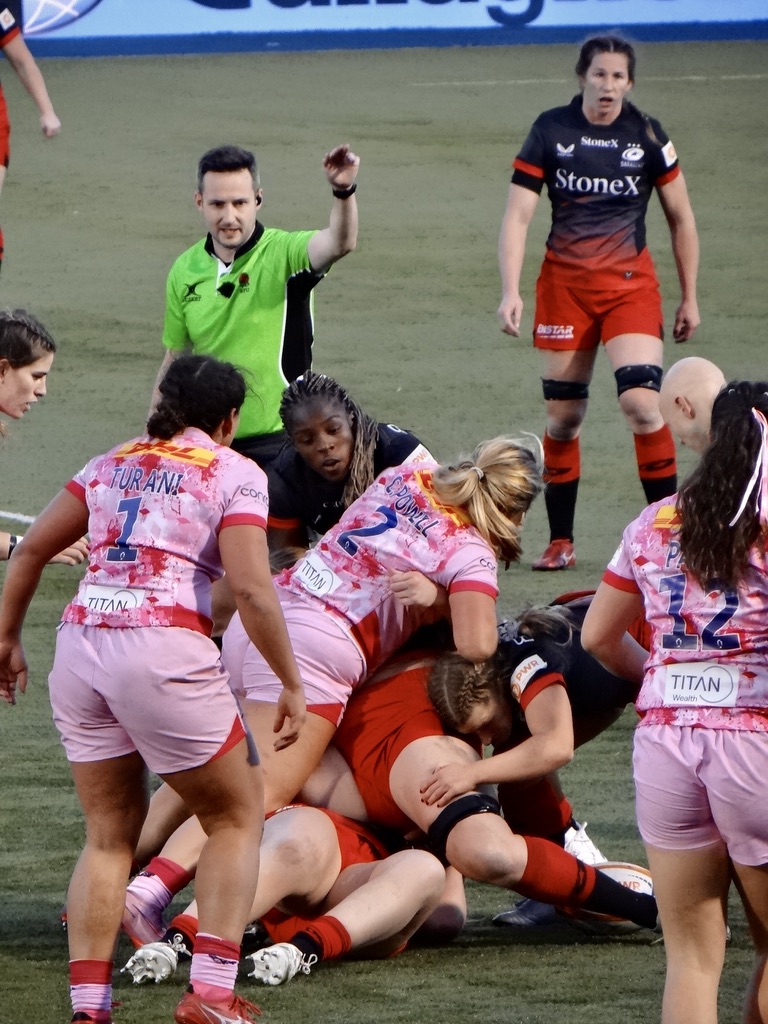
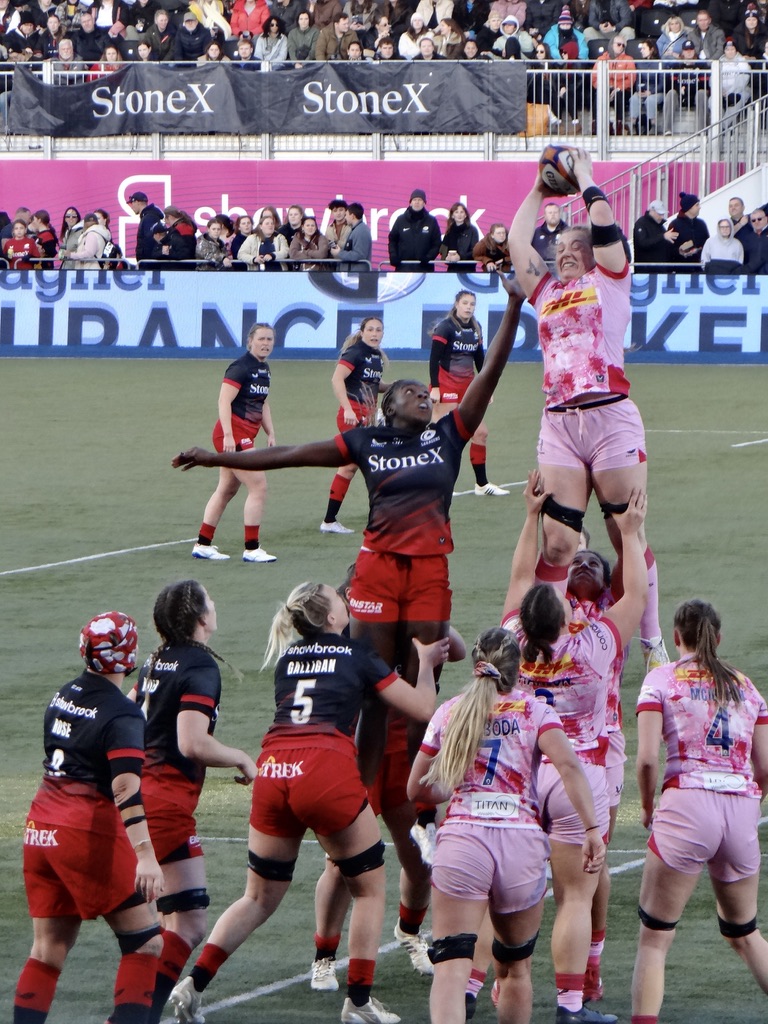
I noticed watching women’s rugby being televised, while the game is going on, they’re actually explaining the rules.
Well with rugby, I guess you have to because it’s more confusing.
And they’re try and get more people into rugby, aren’t they?
So that’s why they’re doing that.
When you started doing comms, were you explaining a bit more; maybe why something was offside, that kind of thing?
If it was a women’s match compared to a men’s? No, it’d be the same. I’d do the same.
There’s no reason why for it to be different, in my opinion, because it’s the same game.
They’re different players, but it’s the same game.
Some things, like men are physically faster and bigger, and sometimes that has an implication in the game, but in terms of the rules they will be the same.
You need to sound like you’re enjoying it and you’re going with the flow and you’re smiling. It helps if you actually smile yourself, even if you’re not happy. You can hear that you’re smiling.
Of all your own bits of commentary, what’s a favourite line?
I probably haven’t got one yet.
I’d say maybe a that Leicester game where it was 2-0 to Leicester at half-time, then Arsenal came back with six, I think.
I had a couple of good shouts then, but I’m still waiting for my iconic line!
What about ones you’ve heard?
Well, on TV, there’s obviously Agueroooooooohhhh!
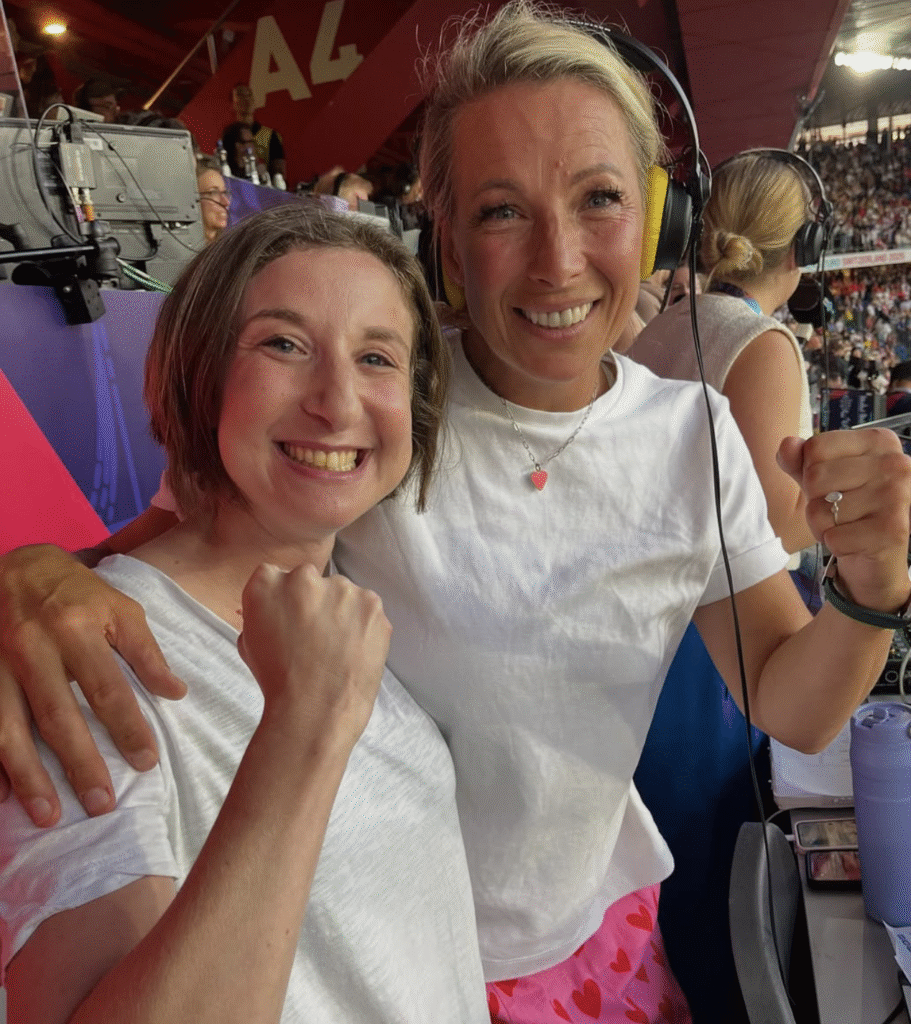
For me the one that sticks in my head is by Robyn Cowen (below, left), who screamed: “England, European champions for the very first time at Wembley!”
That was superb.
I really enjoyed her commentary of that.
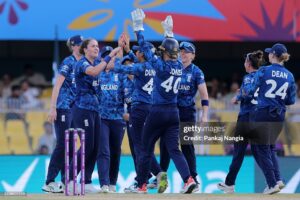
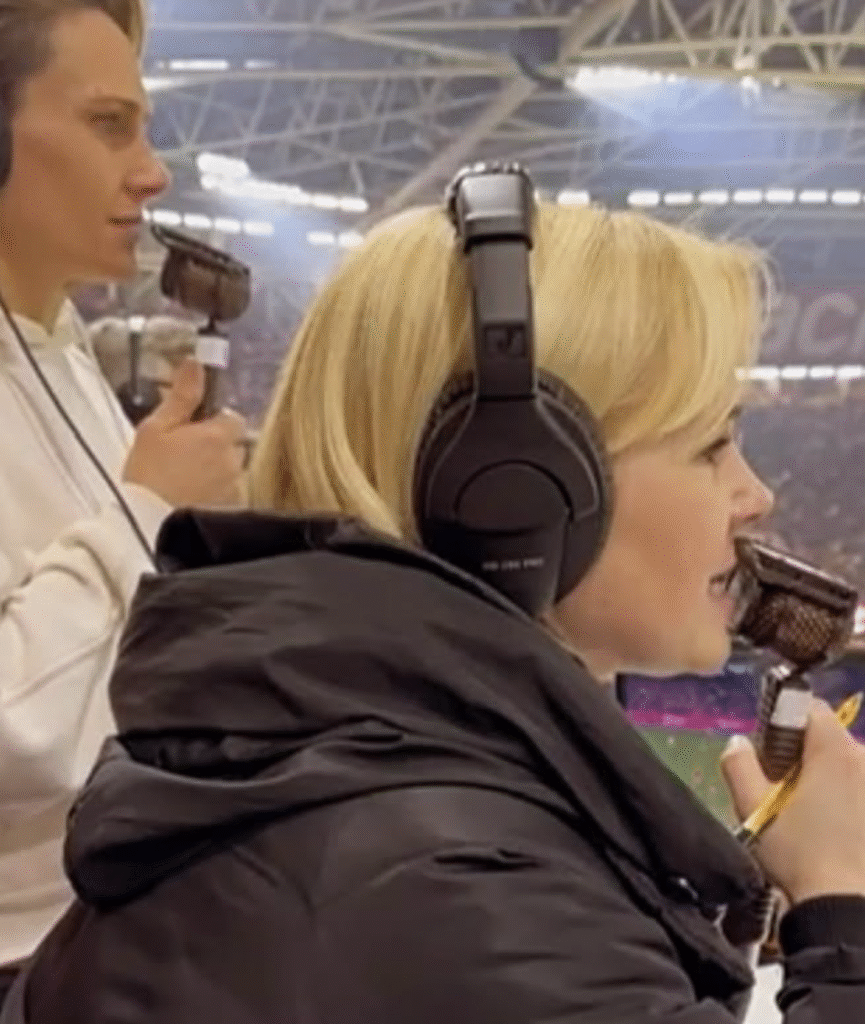
And Sarah Orchard’s commentary of the Rugby World Cup (below, right) this year was very good.
What would be the match you’d really love to commentate on?
Oh, a Euros final, a World Cup game, anything like that.
And if I said there’s an art to commentating – which I believe there is – what is it?
I think it’s flow.
I think it’s enjoyment.
You need to enjoy it.
You need to sound like you’re enjoying it and you’re going with the flow and you’re smiling. It helps if you actually smile yourself, even if you’re not happy. You can hear that you’re smiling, so probably that as well.
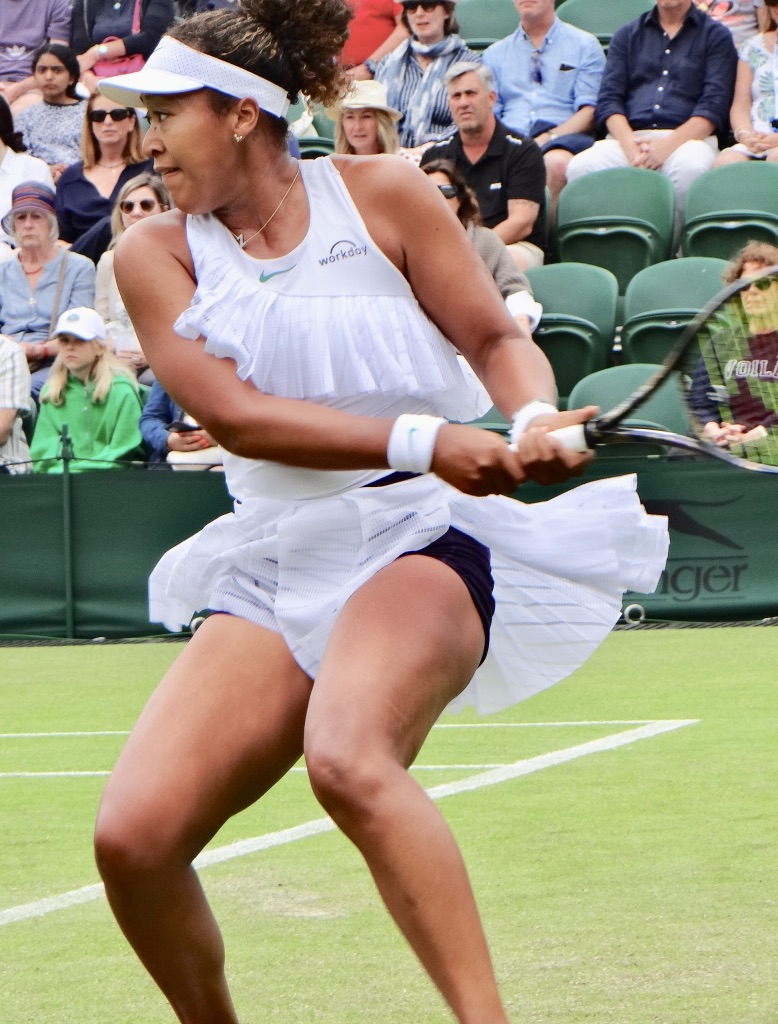
You’ve done a bit of commentating or summarising on other sports like Wimbledon. And I wonder what the different challenge is, because football is obviously your core thing now?
Well, knowledge is the main thing.
I’ve got a lot more knowledge about football than any other sport.
Tennis for radio is so difficult because it’s so quick and it’s the same shots, but you’ve got to describe it differently every time. So that is unbelievably difficult.
Rugby, there’s so many rules, so many different penalties to give away you’ve got to be really hot on it. And you’ve got the referee in your ear as well, so rugby is very hard. I don’t plan to do rugby commentary really.
But they’re the main ones that I’ve reported on.

Is there anything else you’d fancy doing, like cricket?
Not really. I really wasn’t into sport growing up.
I was sporty and I played it a lot of the time, but I never ever watched or followed anything.
It was only when I was shoved into the sport department at BBC Leicester that really I started paying attention to it.
So what were you doing when you first went to BBC Leicester?
Well, I did a journalism degree, and it was my placement, and I was just going there for news.
I knew I wanted to do radio.
I love radio.
I just was going to do news or anything that they put me on radio.
But it was Adam Whitty at Radio Leicester who said: no. Probably because I was a girl as well and I had some inkling of sport.
But it paid off because there is a niche in commentating.
There’s a lack of female commentating.
BBC local radio is excellent, hard to get in, but once you’re in, it’s a training ground. You make your mistakes there and then rise up.
And if women want to do it, there’s such a gap in the market and I’ve risen quite quickly.
Okay, so if any young women or girls fancy doing this kind of thing, what would your advice be?
I think listen, listen, have the radio on all the time.
Listen, listen, listen, listen, find your style, find who you like.
I’d say get involved in your local club.
For me, it was at the time, Maidenhead United, and I started there.
You work from the bottom – which is the National League or below – and work your way up.
And make your mistakes at the bottom.
BBC local radio is excellent, hard to get in, but once you’re in, it’s a training ground. You make your mistakes there and then rise up.
And if women want to do it, there’s such a gap in the market and I’ve risen quite quickly.
Huge gap, massive gap.
So if you want to do it, there’s a real pathway now, an opportunity to get quite big, quite quick.
Ae there things you always carry with you – apart from the chewing gum you let me have today?
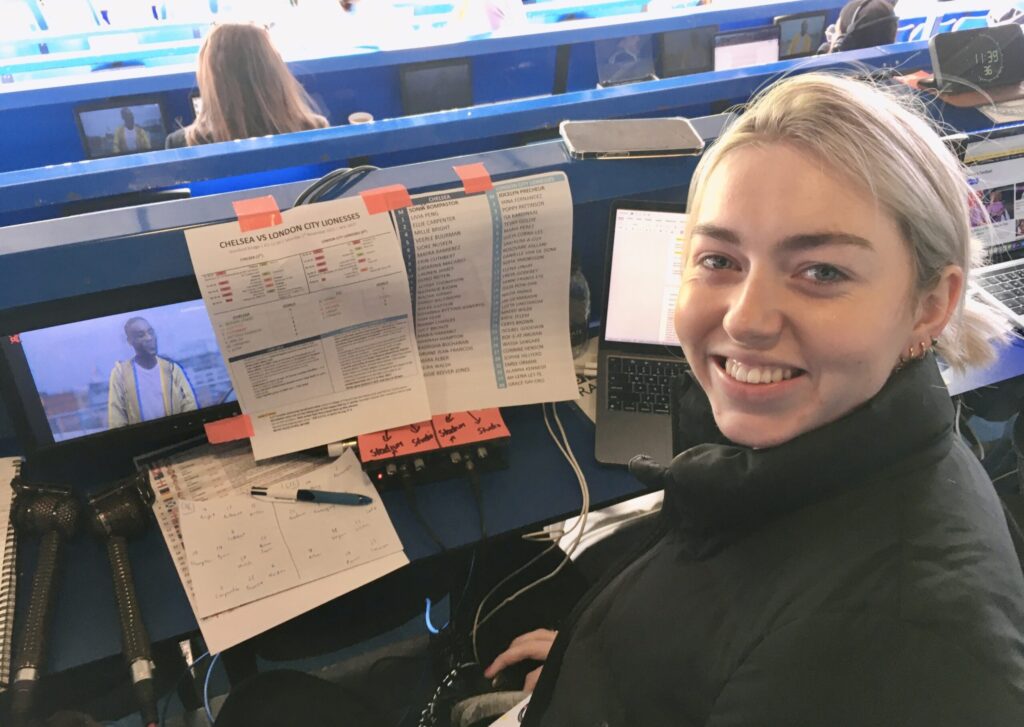
Yes. An extension cable is number one.
Pen, I have a green and a black highlighter for subs.
Notepad, laptop.
Always print my notes off. I do them on my computer, but I print them off.
Bit of paper for number of corners.
And a cup of coffee, probably.
Just rewinding a bit, you said you’re not that tied in with tactics. But presumably you’re getting stuff coming through…
For me xG (expected goals) doesn’t matter, I’ve never used it.
The pundits hate it as well.
But are there things you look at that do mean something?
Yeah, so the obvious ones of possession, shots on target that come up sometimes on the screen, the producers will put in.
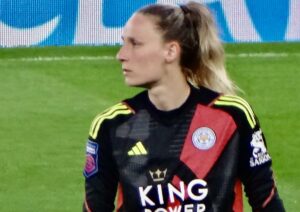
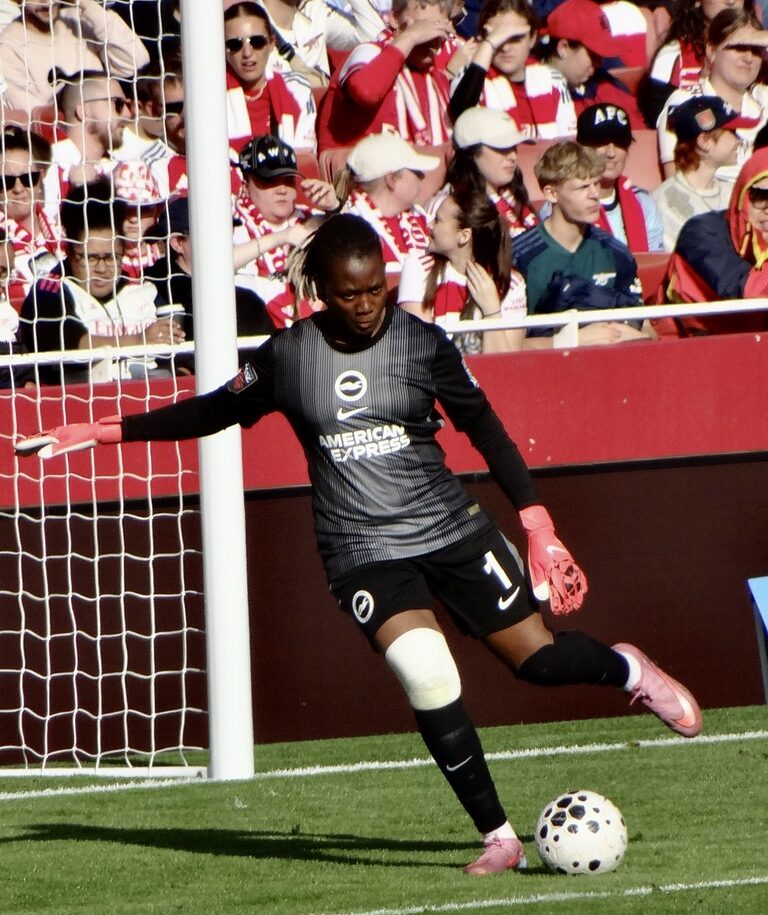
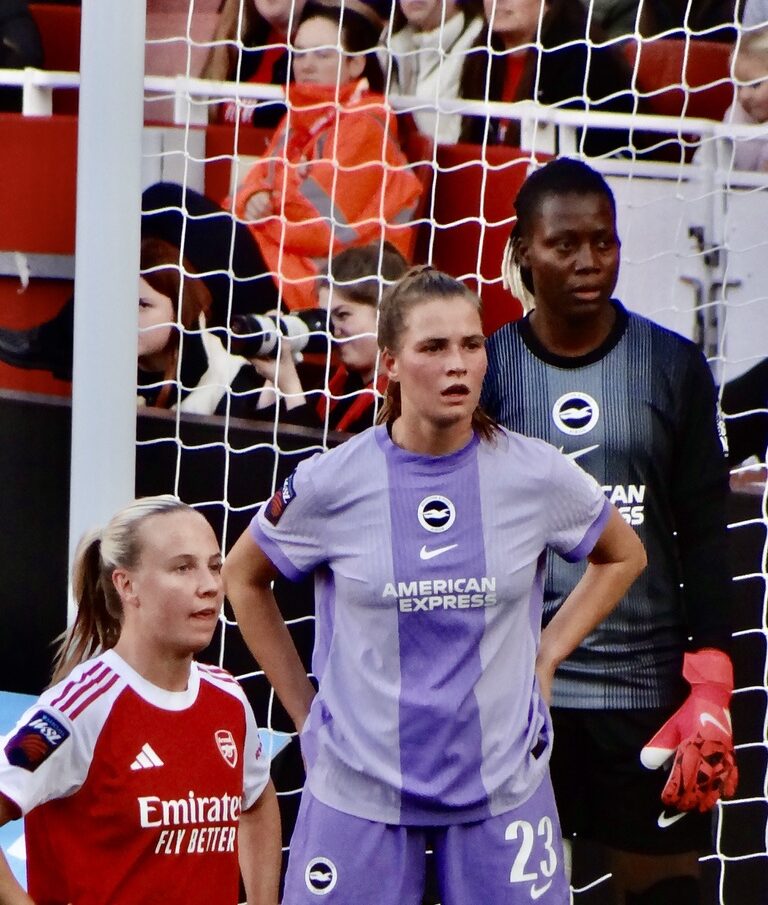
But I think in terms of… not numbers, it’s who I’ve said a lot. The name I’ve said quite a lot, who’s making the most touches, making the most impact in the game. For example I’ve said “Chiamaka Nnadozie” (Brighton’s goalkeeper, above) quite a lot today. So yes, she had a great game.So, probably that and trusting your instincts.
You know because we watch football for a job we know what we’re talking about, and I think that’s a lot of it… as well as imposter syndrome.
I know that wasn’t the question, but it’s trusting your gut.
This is where you can self-own a bit, but what’s the biggest mistake you’ve made when commentating?
Calling a goal scorer wrong! That’s heartbreaking, because you go full out and you scream a name and then on the replay you see that actually someone else headed the ball. And it’s horrible.
Can you remember a particular example?
I’ve definitely done it on the telly.
For example, I did London City Lionesses, and I said “Godwin” instead of “Goodwin”.
Then you kind of rewind and slot it in, that actually it’s Goodwin, not Godwin.
For me xG (expected goals) doesn’t matter, I’ve never used it.
The pundits hate it as well.
Talking of names, have you ever had to commentate on an Icelandic game?
No. I’ve done reports on an Icelandic game, but I’ve never commentated on it. But it’s all dottirs.
By the time you’ve got the end of the name, the ball’s in the net!
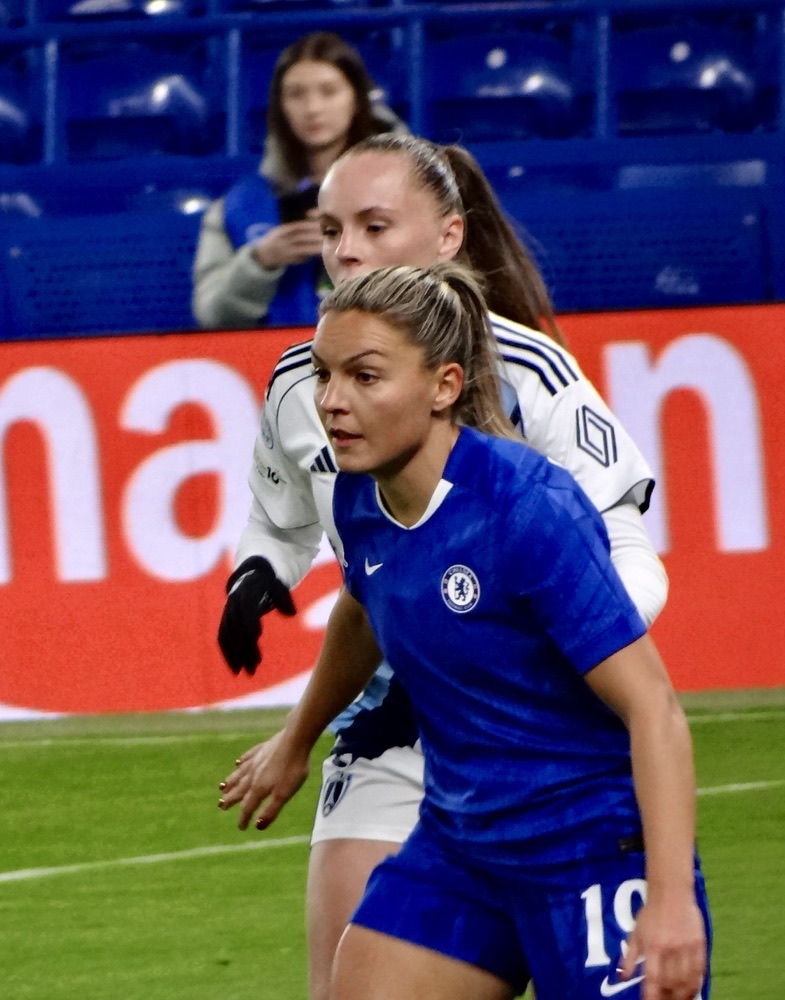
Well, Rytting Kaneryd (below, left) is the same thing, for double-barrelled names you’ve got to speak quicker.
So would you just say Aggie for Beever-Jones?
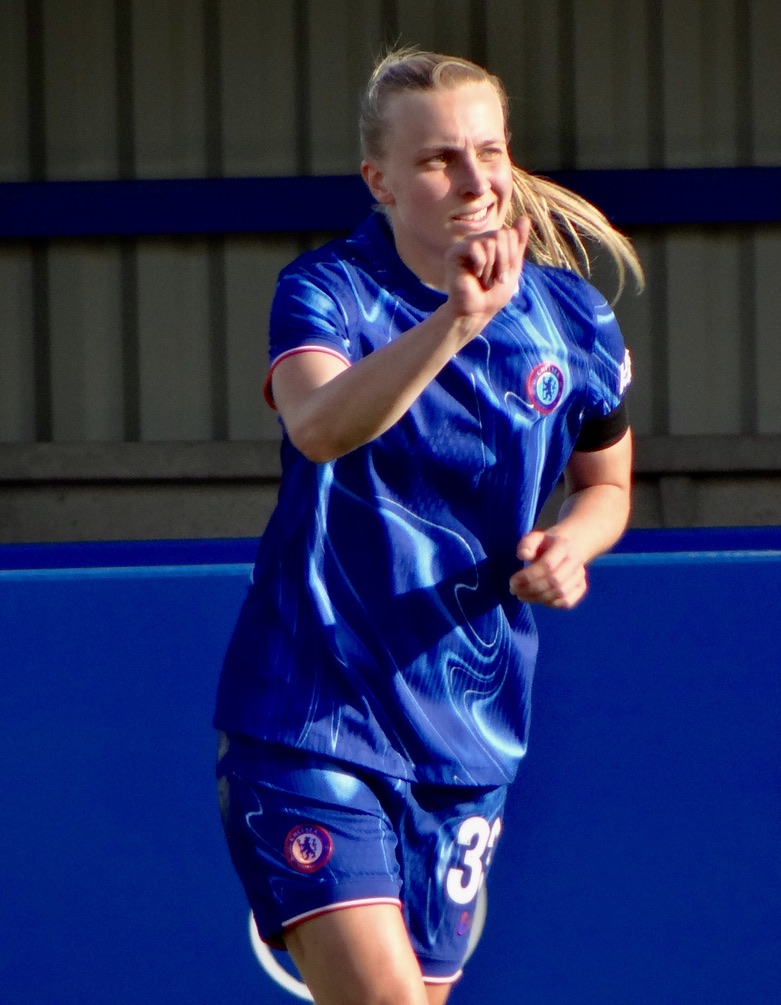
I’d say Beever-Jones (below, centre). I think I get away with that one!
In terms of someone scoring, surely it’s more exciting to shout out Aggie! than Beever-Jones?
I think it sounds better with Beever-Jones, personally.
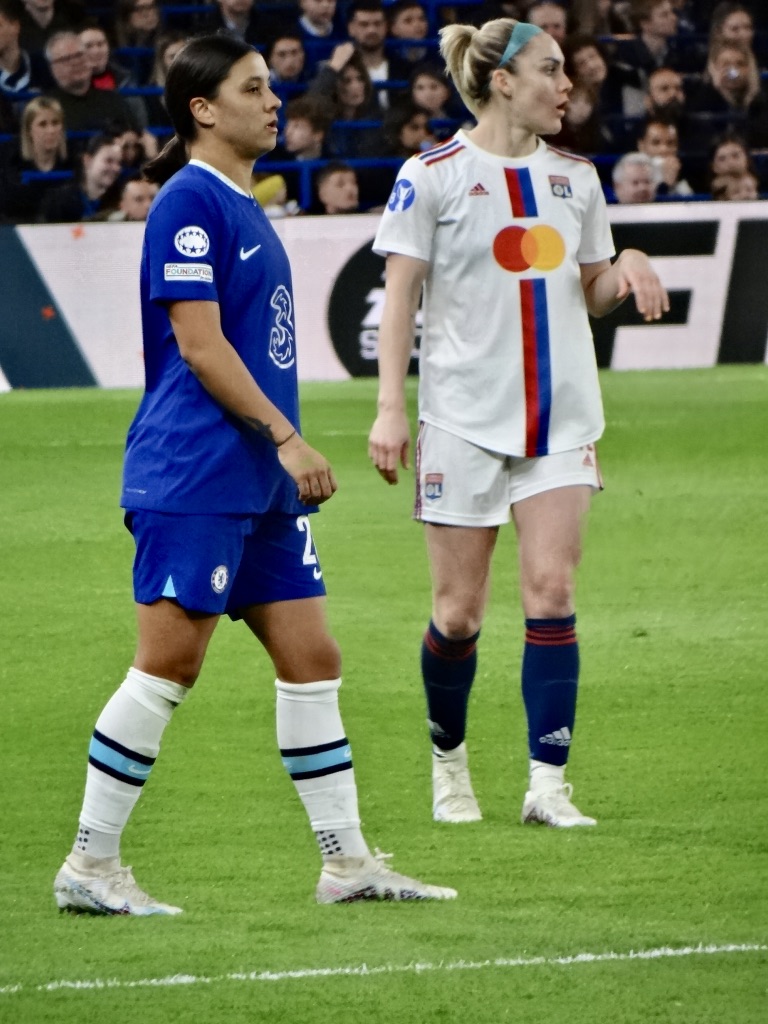
You were talking about getting the level of voice right. And in being declarative, if you’ve got a short name, it’s much easier to give it a little bit of heft?
Yeah, like Kerr today.
Do you just roll your Rs?
No, I can’t roll my Rs, but I shout Kerr!
And Carpenter again is an easy one (Kerr and Carpenter, above, right).
Talking of Ellie Carpenter, when I interviewed her, she said the key for her in terms of women’s sports growing, is that everything needs to be free to air.
Well, if you don’t know about it, if you don’t know how good it is, you’re not going to pay for it, are you? So yeah, I agree with that.
Obviously, it’s not something I can control because I commentate for who I want to commentate for. But yeah, it’s a good point.
Maybe that’s why I never started watching football, because it was on Sky and I wasn’t going to pay for Sky, when I didn’t know what football was about.
Women’s games being played at main stadiums all helps the growth of the game.
And more women commentators getting into the game. Producers are really hot on trying to find that now. They’re almost digging, trying to find women, so you know society is changing.
You mentioned it earlier, and I don’t think any women should have imposter syndrome, but I think 100% of them do. It’s nuts because no man would ever… so is there something that we can do to change that? Maybe positive discrimination?
I think it’s going the right way, like women’s games being played at main stadiums all helps the growth of the game.
And more women commentators getting into the game. Producers are really hot on trying to find that now. They’re almost digging, trying to find women, so you know society is changing.
I think just keep going and, you know, more men are watching women’s sports than ever.
Just keep growing.
I think it’s on the right tracks, but it’s time, isn’t it…